
Sport Motivation Scale (SMS) Test
How the Scales are Structured
Who Usually Takes This Test?
See How You Compare
Below is a preview of how scores are typically distributed across each scale.
Example Questions From the Test
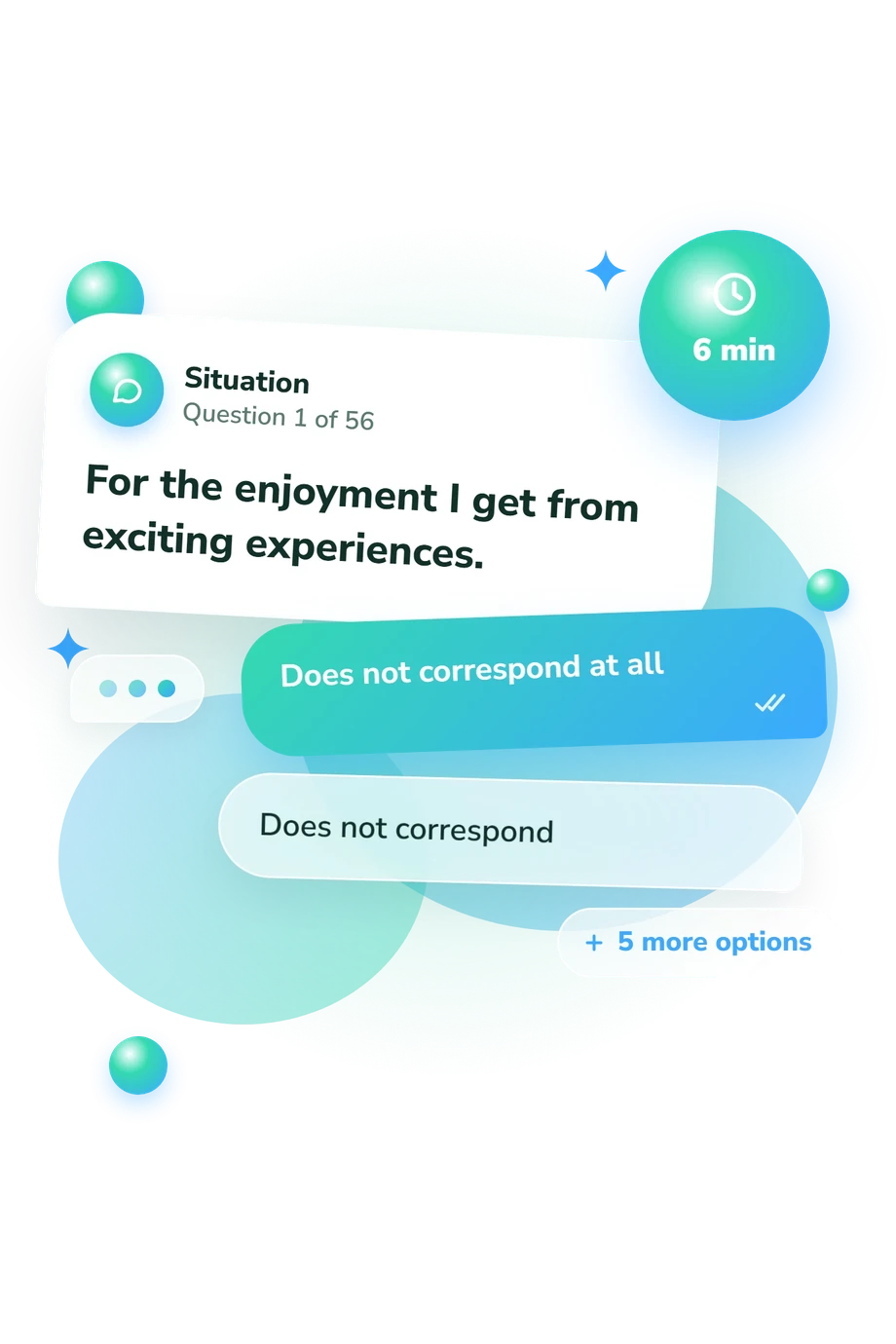
- Does not correspond at all
- Does not correspond
- Rather does not correspond
- Moderately corresponds
- Rather corresponds
- Corresponds
- Completely corresponds
- Does not correspond at all
- Does not correspond
- Rather does not correspond
- Moderately corresponds
- Rather corresponds
- Corresponds
- Fully corresponds
- Does not correspond at all
- Does not correspond
- Rather does not correspond
- Moderately corresponds
- Rather corresponds
- Corresponds
- Completely corresponds
Sport Motivation Scale (SMS) Test - Description and methodology of the test
For athletes examining what keeps them engaged in training, this assessment organizes the reasons behind participation into a readable motivational picture. The Sport Motivation Scale (SMS) Test can show how intrinsic and extrinsic motives and amotivation appear in the current pattern. The results make this sport motivation test useful for self-reflection and more focused conversations about training support.
What This Assessment Explores
Rather than treating motivation as one quality, the assessment covers rewarding, necessary, social, and difficult-to-sustain aspects of sport. Items address learning, improvement, fitness, recognition, relationships, pressure, guilt, and doubts.
These themes show whether engagement is driven by intrinsic motives, shaped by extrinsic expectations, or accompanied by amotivation; doubts, low confidence, and unclear direction appear as item content in this athlete motivation questionnaire. The score reflects the broader pattern.
The displayed scale is Professional Sport Motivation Assessment, ranging from 0-100. Its bands are Low motivation 0-33, Moderate motivation 34-66, and High motivation 67-100. It covers intrinsic and extrinsic motives and amotivation in professional sport.
These themes are grouped as:
- Enjoyment and growth motives show whether learning and improvement reward participation.
- Extrinsic motives show how approval, relationships, fitness, prestige, or pressure matter.
- Amotivation shows whether unclear direction, doubts, or low confidence weaken commitment.
Methodology and Scientific Basis
Each statement uses a seven-point scale, from "Does not correspond at all" to "Completely corresponds." Respondents judge how closely a reason, feeling, or doubt matches participation, so this is a self-report task rather than a test.
The SMS motivation assessment produces one overall score reflecting the broader pattern of intrinsic and extrinsic motives and amotivation. It does not present separate motive scores or specify an item-weighting and norming procedure; the resulting score is not a standardized measure. Read it by its direction and context rather than as a clinical cutoff.
The 28-item structure and wording identify this questionnaire as an online adaptation or translation of the original 28-item Sport Motivation Scale (SMS). That instrument distinguishes intrinsic and extrinsic motives and amotivation. SMS-II is a later revised instrument; its validation does not validate the scoring used here. Self-determination theory explains different forms of regulation.
Current circumstances, relationships, external expectations, confidence, and self-perception can influence answers. Honest self-observation matters when items concern pressure, doubts, or low ability. Read the result as a current reflection of motivational tendencies when considering training or support.
- Pelletier, Luc G., Tuson, Kim M., Fortier, Michelle S., Vallerand, Robert J., Brière, Nathalie M., and Blais, Marc R. (1995). Toward a New Measure of Intrinsic Motivation, Extrinsic Motivation, and Amotivation in Sports: The Sport Motivation Scale (SMS). Journal of Sport and Exercise Psychology, 17(1), 35-53. 10.1123/jsep.17.1.35
- Pelletier, Luc G., Rocchi, Meredith A., Vallerand, Robert J., Deci, Edward L., and Ryan, Richard M. (2013). Validation of the revised sport motivation scale (SMS-II). Psychology of Sport and Exercise, 14(3), 329-341. 10.1016/j.psychsport.2012.12.002
- Deci, Edward L., and Ryan, Richard M. (2000). The “What” and “Why” of Goal Pursuits: Human Needs and the Self-Determination of Behavior. Psychological Inquiry, 11(4), 227-268. 10.1207/S15327965PLI1104_01
Updated: