
Psychological Types of Love Test
How the Scales are Structured
Who Usually Takes This Test?
See How You Compare
Below is a preview of how scores are typically distributed across each scale.
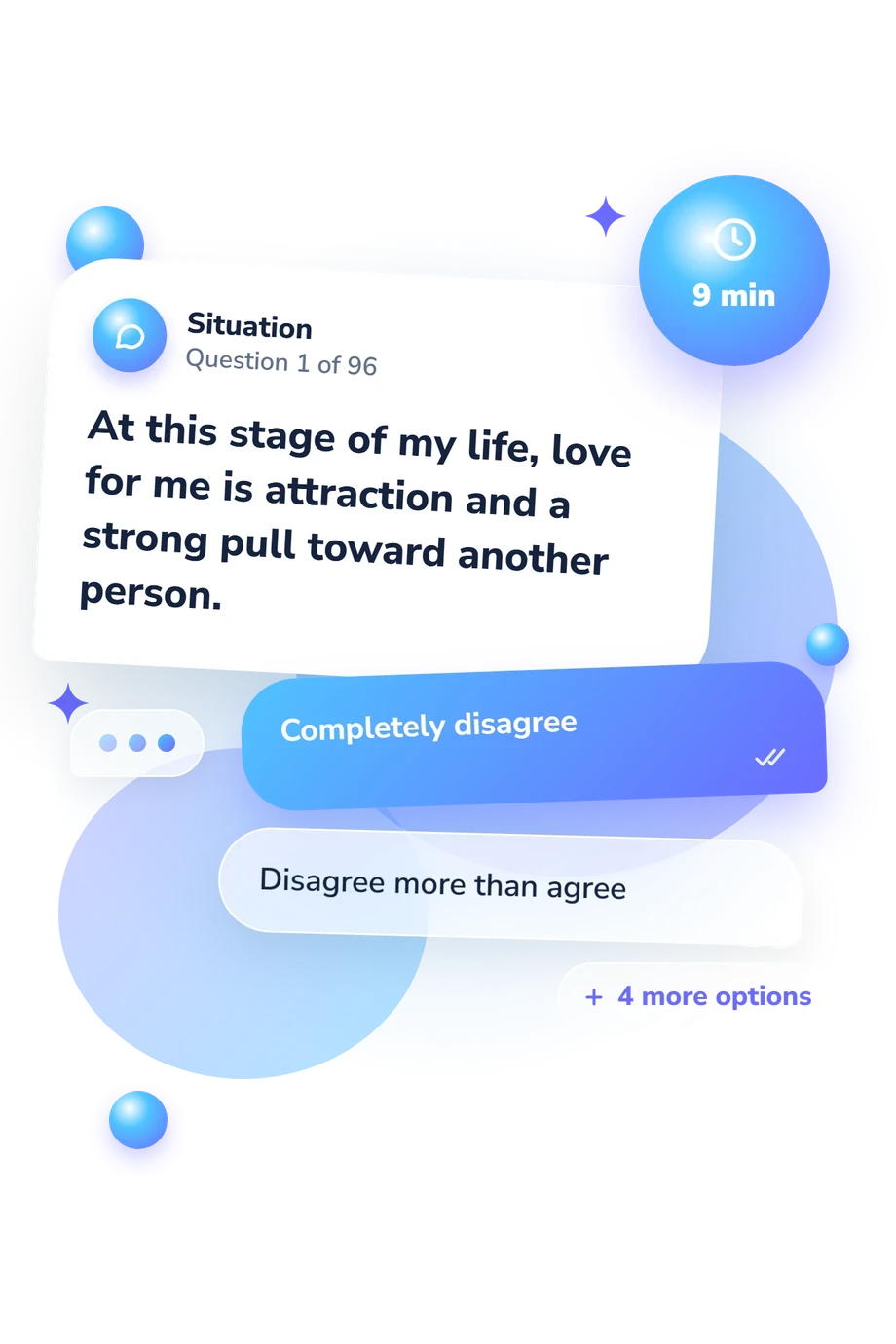
Example Questions From the Test
- Completely disagree
- Disagree more than agree
- Partly agree
- Agree more than disagree
- Almost completely agree
- Completely agree
- Completely disagree
- More disagree than agree
- Partly agree
- More agree than disagree
- Almost completely agree
- Completely agree
- Completely disagree
- Disagree more than agree
- Somewhat agree
- Agree more than disagree
- Almost completely agree
- Completely agree
Psychological Types of Love Test - Description and methodology of the test
People reflecting on how they approach or experience intimacy can use the Psychological Types of Love Test to examine their motives, emotions, and attitudes in close relationships. This love styles test is intended for anyone considering romantic attitudes, emotional priorities, and relationship motives. Its profile presents separate style scores, helping readers compare relationship attitudes rather than assigning one overall type.
What This Assessment Explores
Love appears as a pattern of tendencies, not a single ideal. Items address care, closeness, attraction, dependence, pleasure, benefit, and admiration. This love style questionnaire shows which motives and relationship attitudes are more pronounced within each separate dimension.
The six displayed dimensions are:
- Altruistic Love: Agape (0-40) measures selfless care; Lower agape 0-20, Moderate agape 21-30, Higher agape 31-40.
- Obsessive Love (Mania) (0-40) measures dependency and jealousy; Low 0-20, Moderate to High 21-40.
- Pragmatic Love (Pragma) (0-40) measures calculated benefit; Low pragma 0-11, Moderate pragma 12-30, High pragma 31-40.
- Friendship Love (Storge) (0-40) measures warmth and trust; Low 0-11, Moderate 12-30, High 31-40.
- Hedonistic Love (Ludus) (0-40) measures pleasure-focused relating; Low Ludus 0-11, Moderate Ludus 12-21, High Ludus 22-40.
- Passionate Admiring Love (Eros) (0-40) measures attraction and admiration; Low 0-11, Moderate 12-30, High 31-40.
Methodology and Scientific Basis
Each statement uses a six-point agreement scale, giving this love style assessment a structured way to record agreement. The questions address definitions of love, relationship motives, emotional reactions, and views of a partner. Items are grouped into separate dimensions, and the displayed results provide a score and band for each one. The exact item-weighting or reverse-scoring rule is not stated, so the ranges should be read as reported bands rather than reverse-engineered into an answer key.
Conceptually, the questionnaire is consistent with Frolova’s love-types technique (2020); Lee’s 1977 typology supplies the six-style vocabulary, and Hendrick and Hendrick’s 1986 work offers a related self-report approach to love attitudes. The displayed bands should be read as levels within this questionnaire, not as population norms or clinical thresholds.
The profile assesses current love-style emphases as a snapshot rather than a permanent identity. Self-report may reflect current circumstances, memory, self-awareness, and social desirability. Interpret the profile as a contextual description of the tendencies represented by the answers, with separate scores indicating how strongly each style is endorsed.
- Frolova, S. V. (2020). Essential Characteristics and Diagnostic Technique of Psychological Types of Love. Izvestiya of Saratov University. Philosophy. Psychology. Pedagogy, 20(4), 439-448. 10.18500/1819-7671-2020-20-4-439-448
- Lee, J. A. (1977). A Typology of Styles of Loving. Personality and Social Psychology Bulletin, 3(2), 173-182. 10.1177/014616727700300204
- Hendrick, C., & Hendrick, S. S. (1986). A Theory and Method of Love. Journal of Personality and Social Psychology, 50(2), 392-402. 10.1037/0022-3514.50.2.392
Updated: