
Assessment of Positivity and Uncertainty of Ethnic Identity Test
How the Scales are Structured
Who Usually Takes This Test?
See How You Compare
Below is a preview of how scores are typically distributed across each scale.
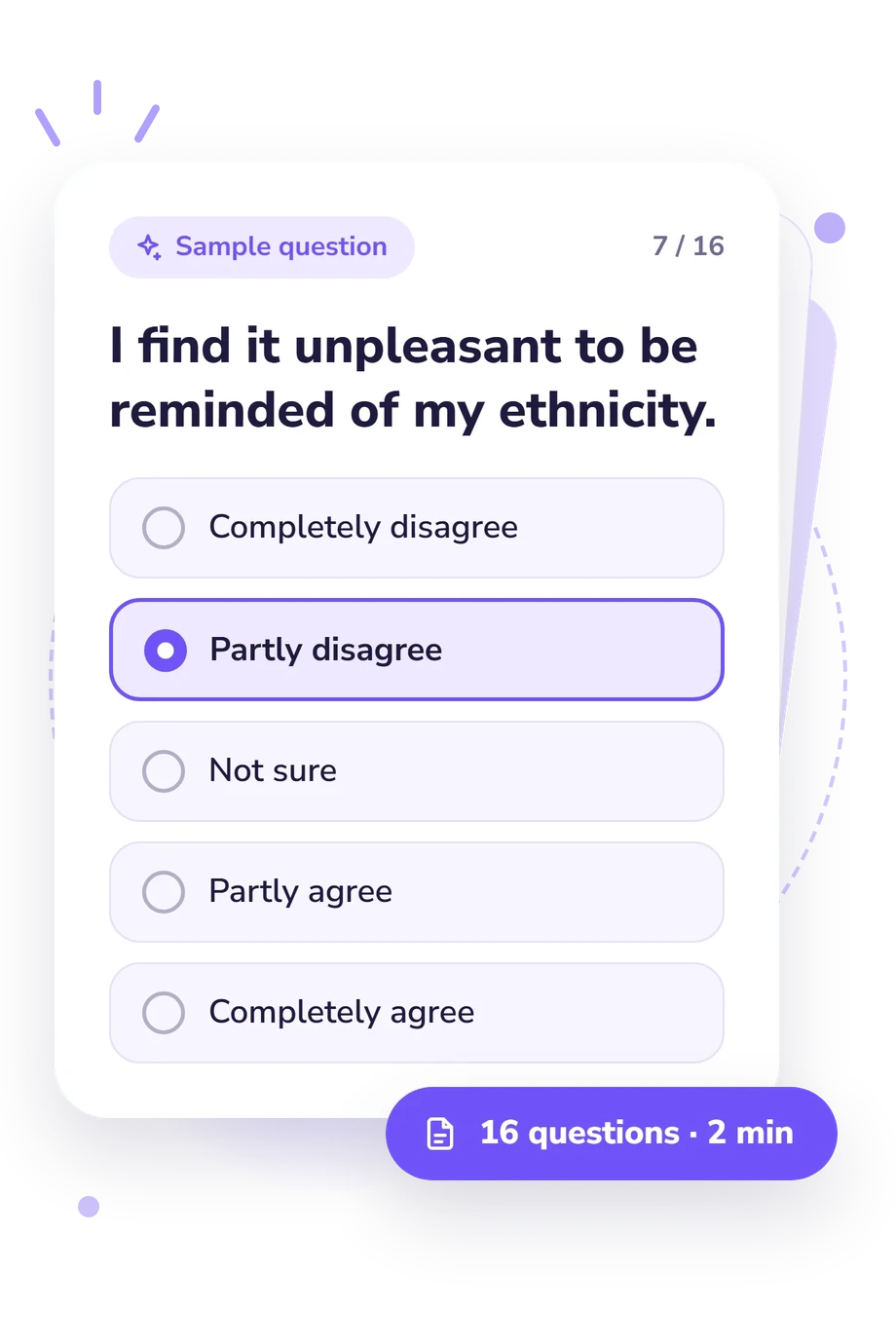
Example Questions From the Test
- Strongly disagree
- Somewhat disagree
- Not sure
- Somewhat agree
- Strongly agree
- Strongly disagree
- Partly disagree
- Not sure
- Partly agree
- Strongly agree
- Completely disagree
- Somewhat disagree
- Do not know
- Somewhat agree
- Completely agree
Assessment of Positivity and Uncertainty of Ethnic Identity Test - Description and methodology of the test
For readers reflecting on belonging, heritage, and everyday experiences of ethnicity, this ethnic identity assessment offers a focused way to consider how group membership feels and how clearly it is understood. The Assessment of Positivity and Uncertainty of Ethnic Identity Test is suited to people who want a concise profile of confidence, emotional evaluation, and ambivalence around ethnic affiliation. It can support self-reflection without reducing identity to one attitude.
What This Assessment Explores
The questions explore two related aspects of ethnic self-understanding. Some statements concern pride, awareness of roots, willingness to retain the same background, and comfort when ethnicity is discussed. Others address discomfort, avoidance, difficulty naming a group, or doubt about whether another person’s classification feels accurate. This ethnic identity questionnaire therefore treats clarity and emotional evaluation as distinct but potentially connected experiences.
The result is organized into these dimensions:
- Uncertainty (1-5) assesses how clearly you recognize belonging to a particular ethnic group; higher scores indicate greater uncertainty. Low uncertainty is 1-2.4, Moderate uncertainty is 2.5-3.4, and High uncertainty is 3.5-5.
- Positivity (1-5) assesses the emotional component of ethnic identity and the degree of positive attitude toward your affiliation. Higher scores indicate a more positively valenced identity. Low positivity is 1-2.4, Moderate positivity is 2.5-3.6, and High positivity is 3.7-5.
Methodology and Scientific Basis
Each statement uses a five-point agreement scale, ranging from strong disagreement to strong agreement, with a middle option for uncertainty. The items describe affirming and uneasy experiences, so the response pattern can show whether clarity and emotional evaluation align or diverge. The two scale scores are reported separately, but the questionnaire does not state how individual responses are weighted.
Methodologically, this self-report questionnaire is a separate formulation conceptually consistent with the Positivity and Uncertainty of Ethnic Identity Questionnaire described by Tatarko and Lebedeva. Phinney and Ong describe ethnic identity as multidimensional, including evaluative and meaning-related elements, while Lebedeva and Tatarko provide related evidence on ethnic identity and intergroup attitudes. These sources support the construct, but do not establish this version as a standardized reproduction of a published instrument.
When interpreting this ethnic identity test, compare the two scores with personal history, cultural surroundings, and recent experiences. This version has no stated population norms or validation evidence, so results are descriptive rather than diagnostic and may be affected by response style, current context, and self-awareness.
- Tatarko, Alexander N., & Lebedeva, Nadezhda M. (2011). Methods of Ethnic and Cross-Cultural Psychology: Textbook and Methodological Guide. Moscow: Higher School of Economics. 10.17323/978-5-7598-0867-1.
- Lebedeva, Nadezhda M., & Tatarko, Alexander N. (2005). Ethnic Identity, Group Status and Type of Settlement as Factors of Intergroup Intolerance. Psychological Journal, 26(3), 51-64.
- Phinney, Jean S., & Ong, Anthony D. (2007). Conceptualization and Measurement of Ethnic Identity: Current Status and Future Directions. Journal of Counseling Psychology, 54(3), 271-281. 10.1037/0022-0167.54.3.271
Updated: