
Uncertainty and Threat Experience Scale Test
How the Scales are Structured
Who Usually Takes This Test?
See How You Compare
Below is a preview of how scores are typically distributed across each scale.
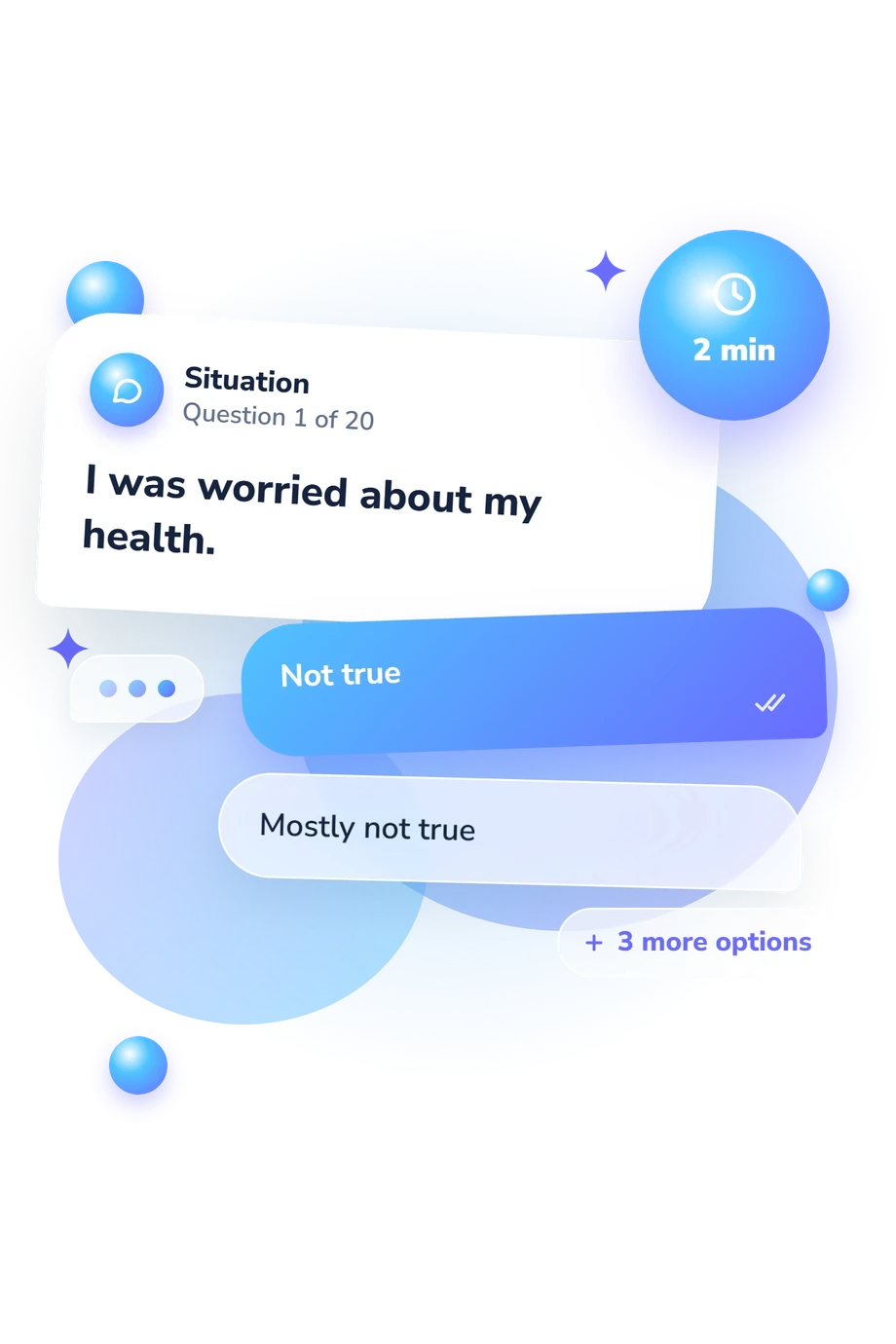
Example Questions From the Test
- Untrue
- Mostly untrue
- Not entirely true
- True
- Completely true
- Not true
- Mostly untrue
- Not entirely true
- True
- Completely true
- Not true
- Mostly not true
- Not entirely true
- True
- Completely true
Uncertainty and Threat Experience Scale Test - Description and methodology of the test
For people who feel unsettled by changing circumstances, the Uncertainty and Threat Experience Scale Test organizes several kinds of perceived risk. It is intended for anyone who wants a clearer picture of current worry, insecurity, and emotional pressure. An uncertainty and threat assessment can show which life domains deserve closer reflection, while keeping the result focused on present experience rather than forecasting events.
What This Assessment Explores
Questions cover security, health, finances, and predictability. The uncertainty and threat questionnaire describes current experience.
The scales are:
- Threat of Shortage of Essential Supplies (0-8) measures resource anxiety; Low concern 0-2; Moderate concern 3-5; High concern 6-8.
- Threat of Situational Instability (0-8) measures instability; Low threat 0-2; Moderate threat 3-5; High threat 6-8.
- Threat of Financial Problems (0-8) measures financial anxiety; Low threat 0-2; Moderate threat 3-5; High threat 6-8.
- Threat to Loved Ones' Health (0-8) measures others' health concern; Low concern 0-2; Moderate concern 3-5; High concern 6-8.
- Threat to Personal Health (0-8) measures health anxiety; Low 0-2; Moderate 3-5; High 6-8.
- Uncertainty and Threat Experience (0-40) measures insecurity; Low 0-12; Moderate 13-31; High 32-40.
Methodology and Scientific Basis
Items are first-person statements about worry, perceived risk, or anticipated disruption. Five ordered responses move from untrue or mostly untrue to true or completely true, making this an uncertainty and threat test using dimensional self-report rather than an interview or performance task.
Scores are grouped by domain and overall. No per-answer conversion or weighting rule is stated, so read numerical values through the displayed bands rather than reverse-engineering response labels. Higher results indicate more perceived threat and insecurity.
The evidence base is conceptually consistent with the Feelings of Uncertainty and Threat Scale described by Vermote and colleagues (2022), which examined threat and uncertainty during pandemic disruption. This questionnaire is not presented as a validated reproduction or adaptation of that published instrument. Chen and colleagues (2015) connect environmental and financial safety with psychological functioning, while López-Íñiguez and colleagues (2022) examine threat and functioning during crisis conditions.
Here, no norms or clinical cutoffs are stated. Current events, self-awareness, and response bias can affect self-report, so the result is a snapshot for reflection rather than a diagnosis.
- Vermote, Branko; Waterschoot, Joachim; Morbée, Sofie; Van der Kaap-Deeder, Jolene; Schrooyen, Charlotte; Soenens, Bart; Ryan, Richard; Vansteenkiste, Maarten. Do Psychological Needs Play a Role in Times of Uncertainty? Associations with Well-Being During the COVID-19 Crisis. Journal of Happiness Studies. 2022;23(1):257-283. 10.1007/s10902-021-00398-x
- Chen, Beiwen; Van Assche, Jasper; Vansteenkiste, Maarten; Soenens, Bart; Beyers, Wim. Does Psychological Need Satisfaction Matter When Environmental or Financial Safety Are at Risk? Journal of Happiness Studies. 2015;16(3):745-766. 10.1007/s10902-014-9532-5
- López-Íñiguez, Guadalupe; McPherson, Gary E.; Zarza Alzugaray, Francisco J. Effects of Threat and Motivation on Classical Musicians’ Professional Performance Practice During the COVID-19 Pandemic. Frontiers in Psychology. 2022;13:834666. 10.3389/fpsyg.2022.834666
Updated: