
Psychological Adaptability Self-Assessment Test
How the Scales are Structured
Who Usually Takes This Test?
See How You Compare
Below is a preview of how scores are typically distributed across each scale.
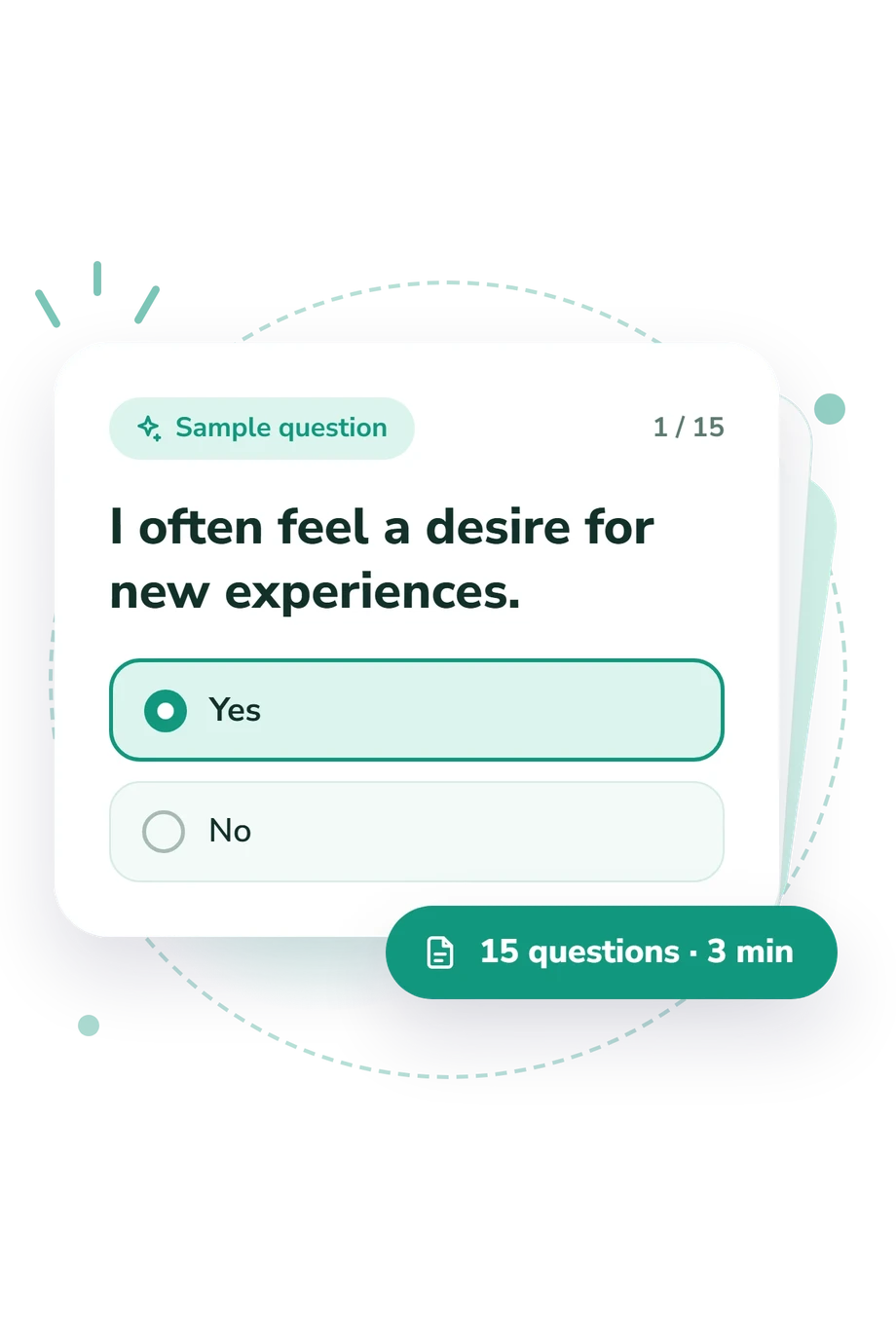
Example Questions From the Test
- Yes
- No
- Yes
- No
- Yes
- No
Psychological Adaptability Self-Assessment Test - Description and methodology of the test
People who want to understand how they respond to unfamiliar social demands may use this questionnaire as a practical starting point. The Psychological Adaptability Self-Assessment Test focuses on everyday flexibility and social adjustment, giving the respondent a way to reflect on personal patterns rather than a fixed label. This psychological adaptability assessment offers a broad indication of how the respondent adapts to social and environmental change, while the situations in the questions serve as reflection prompts rather than separately distinguished domains.
What This Assessment Explores
Items cover novelty, social contact, changing demands, shifts between rest and activity, unfamiliar people, learning, habits, established views, and a slower pace.
Together, these themes describe situations that may support or complicate adjustment. A self-assessment of psychological adaptability helps readers treat them as prompts, not separate traits. The displayed Socio-Psychological Adaptability scale runs from 0-10: Low adaptability (0-3), Moderate adaptability (4-7), and High adaptability (8-10). Higher scores indicate flexibility, ability to initiate and maintain social relationships, and psychological resilience; lower scores may indicate difficulties with social adjustment, reduced sociability, and potential problems integrating into a group. These themes contribute to one adaptability result:
- Social contact shows comfort with unfamiliar people and groups.
- Flexibility shows readiness to change tasks, settings, or routines.
- Energy describes movement into activity and sustained involvement.
- Learning and persistence show how habits form and ideas are maintained.
Methodology and Scientific Basis
Each statement uses a Yes-or-No response. Items address both ease and difficulty in adjustment, so no answer should be interpreted alone. The questionnaire returns one displayed adaptability result; the Yes/No weighting or scoring direction is not documented, and the point value assigned to Yes or No is not stated.
Its conceptual reference is the Self-Assessment of Psychological Adaptability described in Fetiskin's 2002 work. This online questionnaire is conceptually consistent with that instrument; the cited work supplies a reference point rather than proof of equivalence. Biletska's 2023 study reported an association between social-psychological adaptability and conformist behavior among first-year college students.
As a psychological adaptability test, it is best read as a structured self-reflection profile. The displayed bands are this questionnaire's categories, not population norms or clinical thresholds; responses can also shift with honesty, self-awareness, and current circumstances. Interpret the result alongside concrete examples of daily adjustment.
- Fetiskin, Nikolai Petrovich, Vladimir Vasilievich Kozlov, and Gennady Mikhailovich Manuilov. (2002). Socio-Psychological Diagnostics of Personality Development and Small Groups. Moscow: Institute of Psychotherapy. 490 pp.
- Biletska, Anastasiia Olehivna. (2023). The Correlation Between the Propensity for Conformist Behavior and Social-Psychological Adaptability Among First-Year College Students. Scientific Bulletin of Kherson State University. Series Psychological Sciences, no. 2, pp. 5-10. 10.32999/ksu2312-3206/2023-2-1
Updated: