
Life Experience Reflection Questionnaire for Primary School Children Test
How the Scales are Structured
Who Usually Takes This Test?
See How You Compare
Below is a preview of how scores are typically distributed across each scale.
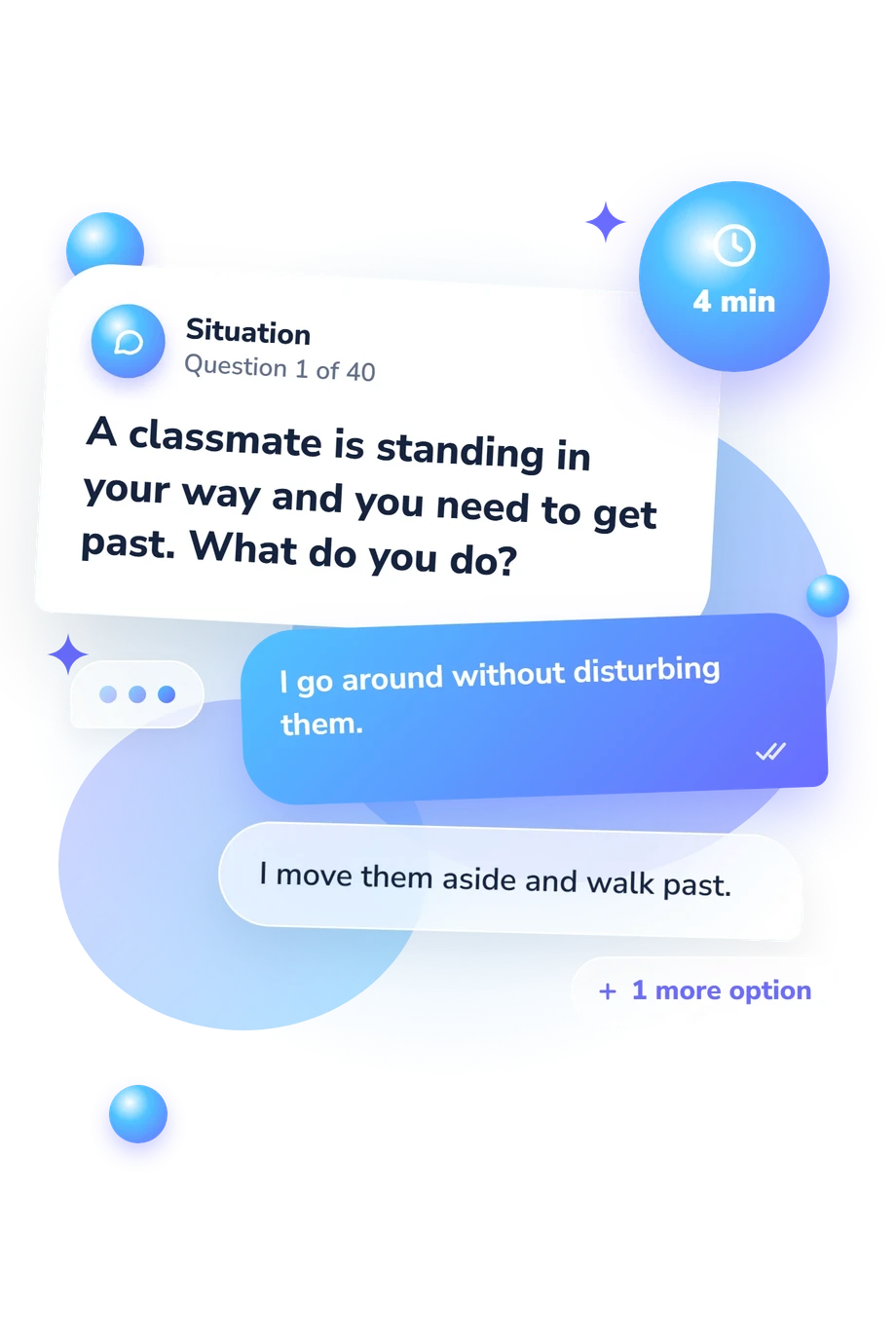
Example Questions From the Test
- Go around without disturbing them.
- Move them aside and walk past.
- It depends on what kind of mood I am in.
- Nothing; it is none of my business.
- I do not know in advance how things will turn out.
- I would go up to him and start talking to him.
- I hurry to school.
- If someone else rushes to help, I will go too.
- I call an ambulance and ask passers-by for help.
Life Experience Reflection Questionnaire for Primary School Children Test - Description and methodology of the test
Children complete this assessment, while parents and educators use the resulting profile to discuss conduct, development, and support needs. The Life Experience Reflection Questionnaire for Primary School Children Test gives adults a structured way to listen to a child's reasoning rather than reduce the child to a score. By making that reasoning discussable, this moral reflection test for primary school children supports calm conversations at home or school.
What the Questionnaire Measures
Situations cover social, school, and personal dilemmas: helping, responding to unfairness, accepting responsibility, resisting dishonest advantage, handling praise or insult, and balancing duty with comfort. The result describes moral reference points in these choices, not a fixed character label.
The displayed dimensions are:
- Lack of Formation (0-20) counts choices with no clear preference, suggesting unformed moral attitudes and unstable, impulsive behavior; Low unformedness 0-9 and High unformedness 10-20 are shown.
- Egoistic Orientation (0-20) reflects choices tied to egoistic attitudes; Low 0-9 and Pronounced 10-20 are shown, with the latter indicating a pronounced egoistic orientation and some amoral orientation.
- Moral Development (0-20) reflects choices tied to moral reference points; Needs support 0-9 and Sufficient 10-20 are shown, with the latter indicating adequate moral development.
For families and teachers, this children's moral development questionnaire can help adults discuss the profile with the child and identify areas for encouragement.
Methodology and Evidence Base
Each item presents a brief situation with three response options. The child chooses the response that fits best. Alternatives contrast helpful or principled conduct with self-protective, indifferent, avoidant, impulsive, or uncertain responses. The displayed scales count relevant selections, while no individual-response point value is specified.
As a primary school moral education assessment, this online questionnaire is conceptually consistent with Reflecting on Life Experience (Shchurkova, 1991), which uses everyday choices to examine moral orientation. Its themes also align with Nikolaev and Guzeeva’s (2020) primary-school study. This relationship does not establish the questionnaire as a direct adaptation or standardized version of those works.
Interpretation should start with each displayed band and then return to the situations behind the choices. A result showing frequent moral reference points reflects the selections made in this questionnaire, while a pattern of self-focused or unclear choices identifies topics for conversation. Because responses are self-reported, results may vary with mood, wording, social desirability, and self-awareness; broader observation is needed before firm conclusions.
- Shchurkova, N. E. (1991). "Reflecting on Life Experience." In N. E. Shchurkova and V. N. Shvyreva (comps.), New in the Educational Work of the School, pp. 59-69. Moscow: Moscow City Institute for Teacher Development.
- Nikolaev, Egor Vasilievich, and Guzeeva, Lyubov Mikhailovna. (2020). Studying the Level of Moral Education in Primary Schools. Modern Problems of Science and Education, 6, 36. 10.17513/spno.30296.
- Stepanov, E. N. (ed.). (2001). The Educational Process: Studying Effectiveness: Methodological Recommendations. Moscow: Sfera. ISBN 5-89144-153-5.
Updated: