
Workplace Situations Questionnaire Test
How the Scales are Structured
Who Usually Takes This Test?
See How You Compare
Below is a preview of how scores are typically distributed across each scale.
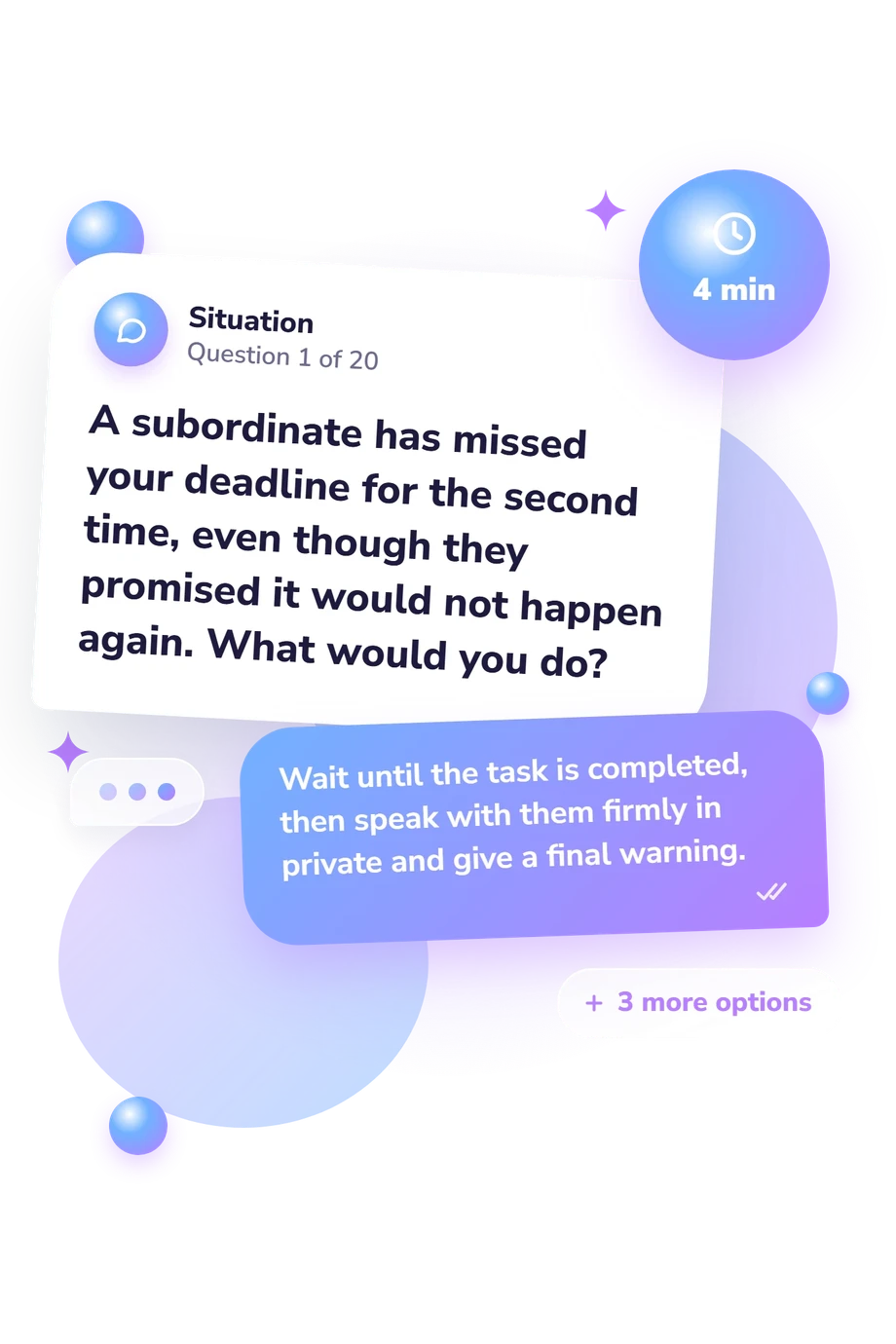
Example Questions From the Test
- Without challenging the supervisor’s assignment, I would strictly observe the chain of command and suggest that the subordinate postpone their current work.
- It depends on how much authority the supervisor has for me.
- I would tell the subordinate that I disagree with the supervisor’s assignment and warn them that in similar situations in the future I will cancel tasks given to them without coordinating with me.
- In the interest of the work, I would suggest that the subordinate complete the work they have already started.
- I would start with the task from the person I respect more.
- I would start with the task that seems most important to me.
- I would complete the task from the higher-level manager first.
- I would complete the task from my direct supervisor.
- I should stop the conflict at work; resolving their interpersonal issues is their own personal matter.
- It is best to ask representatives of employee or community organizations to handle the conflict.
- First, try to understand the underlying reasons for the conflict and find a resolution that is acceptable to both.
- Identify who in the team is an authority figure for those involved, and try to influence them through that person.
Workplace Situations Questionnaire Test - Description and methodology of the test
Managers, team leads, and professionals preparing for supervisory responsibility can use the Workplace Situations Questionnaire Test to examine how they might handle authority, conflict, delegation, and pressure. It is useful when a reader wants a structured snapshot of managerial preferences rather than a prediction of job performance. By turning practical dilemmas into a profile, the questionnaire offers a workplace leadership assessment for guided self-reflection.
What This Assessment Explores
Scenarios cover authority, conflict, deadlines, staffing, fairness, misconduct, and change.
Together, these choices provide a management style assessment of preferences under pressure across four dimensions:
- Formal Hierarchy (0-20) measures managerial distance, authority, and status; higher results suggest formal style. Bands: Flexible with hierarchy 0-6, Balanced formality 7-12, Strongly status-focused 13-20.
- Self-Oriented (0-20) reflects personal goals and independence; higher results may indicate a stronger emphasis on personal autonomy, self-realization, and leadership. Bands: Low self-orientation 0-4, Balanced self-orientation 5-6, High self-orientation 7-20.
- People-Oriented (0-20) reflects humane leadership, delegation, and participation; higher results indicate stronger communication and collaboration. Bands: Low 0-4, Moderate 5-6, High 7-20.
- Task Orientation (0-20) reflects competence, independent decisions, and productivity; higher results suggest a task-focused style, while lower results may suggest reduced initiative or greater passivity in work-related situations. Bands: Low 0-6, Moderate to high 7-20.
Methodology and Evidence Base
Each item presents a workplace dilemma with four possible actions. The respondent chooses the response that feels most acceptable or most likely, capturing preferences in context rather than abstract agreement.
Selected answers produce four displayed scores from 0 to 20. The questionnaire does not specify how individual responses contribute to each scale, so its calculation cannot be independently reconstructed; interpretation should use the displayed bands.
Ershov's 1977 Production Situations method provides a conceptual parallel to the questionnaire's conflict-based leadership situations, where choices reveal value orientations in collective leaders. The online questionnaire is not that instrument or a direct adaptation.
By presenting choices about authority and relationships, the scenarios make this a managerial orientation test of preferences across workplace situations. The result is a self-report profile whose displayed bands should be read descriptively within this questionnaire. Current pressures, self-presentation, and self-awareness can influence choices, so interpret the bands alongside observed behavior when decisions carry weight.
- Litvintseva, N. A. (comp.). (1994). Psychological Tests for Business People. Moscow: Intel-Sintez.
- Ershov, A. A. (1977). Projective Method for Determining the Value Orientations of Collective Leaders Through Conflict-Situation Resolution. In Psychology of Personality and Small Groups (Experimental and Applied Psychology), Issue 8, pp. 127-130. Leningrad State University.
- Ershov, A. A. (1976). Personality and Collective: Interpersonal Conflicts in the Collective and Their Resolution. Leningrad: Znanie.
- Melnik, Yuri I. (2025). Professional Well-being of a Manager and Its Relationship with Self-efficacy, Machiavellianism and Managerial Orientations. New Psychological Research, No. 4, 103-121. 10.51217/npsyresearch_2025_05_04_05
Updated: