
Perm Ethnic Self Questionnaire Test
How the Scales are Structured
Who Usually Takes This Test?
See How You Compare
Below is a preview of how scores are typically distributed across each scale.
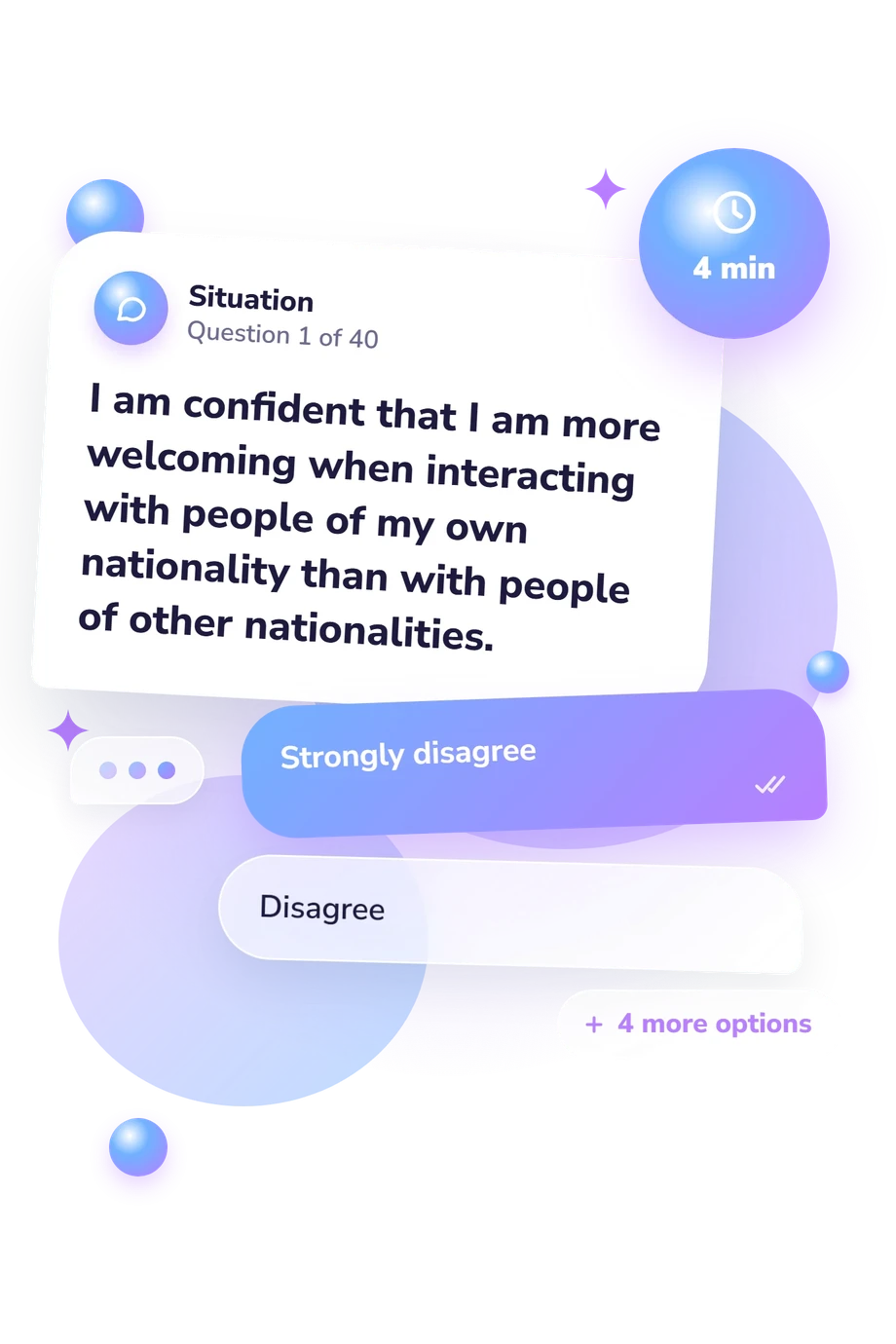
Example Questions From the Test
- Strongly disagree
- Disagree
- Somewhat disagree
- Somewhat agree
- Agree
- Strongly agree
- Strongly disagree
- Disagree
- Somewhat disagree
- Somewhat agree
- Agree
- Completely agree
- Completely disagree
- Disagree
- Somewhat disagree
- Somewhat agree
- Agree
- Strongly agree
Perm Ethnic Self Questionnaire Test - Description and methodology of the test
People who want to examine how ethnic affiliation shapes ordinary attitudes and choices may find the Perm Ethnic Self Questionnaire Test useful for structured self-reflection. It focuses on the personal meaning of belonging, not on assigning a clinical label. As an ethnic identity questionnaire, it helps organize patterns involving cultural attachment, social expectations, change, and the degree of autonomy in one's ethnic self-concept.
What This Assessment Explores
Items address trust within one's ethnic group, interest in history, language, music, cuisine, rituals, holidays, and judgments about understanding people from other groups. Together, the items sample how respondents report their relationships, cultural preferences, social expectations, and sense of personal agency.
The four displayed dimensions are:
- Embodied Self (5-30) shows everyday integration; Low integration (5-13), Moderate integration (14-22), High integration (23-30).
- Conforming Self (5-30) shows orientation toward ethnic norms; Low orientation (5-14), Moderate orientation (15-22), High orientation (23-30).
- Transformed Self (5-30) shows change under outside influence; higher results may suggest flexibility; Low transformation (5-13), Moderate transformation (14-22), High transformation (23-30).
- I-Authorial (5-30) shows autonomy and reflection in affiliation; Low authorial stance (5-13), Moderate authorial stance (14-21), High authorial stance (22-30).
Taken as an ethnic self-assessment, the result is best read as a pattern across the four dimensions.
Methodology and Scientific Basis
Each statement uses six ordered choices from strong disagreement to strong agreement. The self-report format captures degree rather than a yes/no position and asks about attitudes, preferences, and reactions connected with ethnic belonging.
The questionnaire reports four displayed scale results; it does not specify how each answer contributes. The bands are descriptive: a higher result on one dimension is not automatically better than a lower result on another because dimensions differ.
The closest source is Perm Ethnic Self Questionnaire (Ryabikova, 2002), but equivalence with this online form has not been established. Reliability and validity findings apply to that original instrument, not automatically to this form. The questionnaire is conceptually consistent with Kornienko and Baleva (2013) on intraethnic factors, Baleva's multimodal self, and Phinney's Multigroup Ethnic Identity Measure (1992), rather than adapting Phinney's measure.
No population norms or diagnostic thresholds are established for this online presentation, so bands are descriptive rather than clinical cutoffs. Current relationships, cultural exposure, social pressure, self-awareness, and honesty can influence responses. An ethnic identity profile is best used to examine patterns, not summarize identity completely.
- Ryabikova, M. V. (2002). Perm Ethnic Self Questionnaire: Reliability and Validity. In E. M. Berezina (Ed.), 85 Years of Higher Professional Education in the Urals (pp. 112-117). Perm State Institute of Art and Culture, Perm.
- Kornienko, D. S., & Baleva, M. V. (2013). Structure of Intraethnic Factors in Model of Interethnic Relations. Bulletin of Perm State Humanitarian-Pedagogical University, Series 1: Psychological and Pedagogical Sciences, 2013(1), 76-84.
- Baleva, M. V. (2004). The Multimodal Self: Ethnic and Cross-Cultural Aspects (Based on Udmurt and Russian Students) [Candidate of Psychological Sciences dissertation]. Perm State Institute of Art and Culture, Perm.
- Phinney, J. S. (1992). The Multigroup Ethnic Identity Measure: A New Scale for Use with Diverse Groups. Journal of Adolescent Research, 7(2), 156-176. 10.1177/074355489272003
Updated: