
Freudly+971 508685814hello@freudly.ai
Freudly
emotionality

Personality Emotional Orientation Assessment Test
Take the online Personality Emotional Orientation Assessment Test - AI psychologist FreudlyYou can take Personality Emotional Orientation Assessment Testhere. Online version of a simple and accurate psychological test with interpretation.en
Understand which emotions guide a person’s choices and motivation in about 11 minutes. Get a clear profile from 60 items to support counseling, coaching, and workplace motivation.
Start Online Test
Questions: 6011 minutes
08:30
October 2, 2025
October 2, 2025
Material has been updated
October 2, 2025
Material has been published
26,654 views
2,989 completions
2,479 likes
Verified by Daniel Hall
Psychologist with 25 years of experience
Share
Scale Explorer

How the Scales are Structured

example score
3/12
Altruistic Orientation (AO)
Measures the tendency to value and seek emotions connected with helping, supporting, and caring for others.
Lower focus on helping
Balanced helping orientation
Strong helping orientation
04: Lower focus on helping | 58: Balanced helping orientation | 912: Strong helping orientation
A score of 3 suggests helping and caring emotions are present but tend to be a lower priority compared with other emotional goals.
example score
6/12
Acquisitive Orientation (AO)
Measures the degree to which acquiring and owning material items is a preferred source of positive emotion and motivation.
Low
Moderate
High
04: Low | 58: Moderate | 912: High
A score of 6 indicates a moderate acquisitive orientation, suggesting that gaining and possessing things can be rewarding but is not a dominant emotional priority.
example score
10/12
Hedonistic Orientation (HO)
Measures the degree to which a person prioritizes comfort, pleasure, and emotional well-being as preferred experiences.
Low
Moderate
High
04: Low | 58: Moderate | 912: High
A score of 10 falls in the High range, suggesting a strong tendency to value comfort, pleasant sensations, and a generally enjoyable emotional tone in daily life.
example score
6/12
Aesthetic Orientation (AO)
Measures the degree to which a person values beauty, art, and harmony as a preferred source of positive emotional experiences.
Low
Moderate
High
04: Low | 58: Moderate | 912: High
A score of 6 indicates a moderate aesthetic orientation, suggesting that experiences of beauty and harmony are meaningful but typically balanced with other emotional priorities.
example score
6/12
Gnostic Orientation (GO)
The Gnostic scale measures a person’s preference for understanding, intellectual exploration, and learning new information.
Lower gnostic focus
Moderate gnostic focus
Higher gnostic focus
04: Lower gnostic focus | 58: Moderate gnostic focus | 912: Higher gnostic focus
A score of 6 indicates a moderate tendency to seek knowledge and enjoy solving complex problems, without this being the dominant emotional priority.
example score
7/12
Romantic (R)
Measures the degree to which a person is drawn to romance, adventure, and emotionally engaging experiences that feel unusual or mysterious.
Low
Moderate
High
04: Low | 58: Moderate | 912: High
A score of 7 indicates a moderate romantic orientation, suggesting a balanced interest in novelty and mystery alongside other emotional priorities.
example score
9/12
Pugnistic Orientation (PO)
Measures an avoidant emotional orientation marked by distress around obstacles and a focus on feelings tied to overcoming challenges.
Low
Moderate
High
04: Low | 58: Moderate | 912: High
A score of 9 suggests a high avoidant orientation, with stronger distress in difficult situations and a pronounced emotional focus on challenge-related experiences.
example score
6/12
Praxis Orientation (PO)
Measures the extent to which a person finds emotional satisfaction in the process of doing tasks, independent of outcomes or rewards.
Low
Moderate
High
04: Low | 58: Moderate | 912: High
A score of 6 indicates a moderate praxeological orientation, suggesting you often enjoy the work process itself, though this is not always your primary emotional driver.
example score
5/12
Gloric Orientation (GO)
Glorica measures the degree to which a person is oriented toward self-assertion, fame, and recognition from others.
Low
Moderate
High
04: Low | 58: Moderate | 912: High
A score of 5 suggests a moderate preference for recognition and respect, with self-assertion being a motivating factor but not a dominant one.
example score
6/12
Communicative (C)
Measures the extent to which a person is emotionally oriented toward friendship, communication, and receiving interpersonal support.
Low
Moderate
High
04: Low | 58: Moderate | 912: High
A score of 6 indicates a moderate communicative orientation, suggesting you generally value friendly interaction and emotional support while also drawing motivation from other emotional goals.
Start Online Test
just completed the test
DATA-BASED USER COHORTS

Who Usually Takes This Test?

Therapists and counselors
41%OF USERS
They use it to quickly identify what emotional experiences a client values most and to tailor support and motivation strategies.
HR and team leads
34%OF USERS
They take it to understand what drives employees and how to motivate, assign roles, and communicate more effectively.
Self-development seekers
25%OF USERS
They take it out of curiosity and reflection to clarify their emotional priorities and what they naturally strive for in life.
BASED ON AGGREGATED, ANONYMIZED DATA FROM TENS OF THOUSANDS OF FREUDLY USERS.
Benchmarking

See How You Compare

Once you complete the test, your results are compared with real-world data from people in your country.
Below is a preview of how scores are typically distributed across each scale.
Altruistic (A)
Altruistic (A)
Average
7.7
Normal range
6.39.2
min.
0
max.
12
This curve shows how scores are typically distributed.
Once you complete the test, your result will appear on the scale so you can see how you compare.
Acquisitive (A)
Acquisitive (A)
Average
6.9
Normal range
4.79
min.
0
max.
12
This curve shows how scores are typically distributed.
Once you complete the test, your result will appear on the scale so you can see how you compare.
Hedonistic (H)
Hedonistic (H)
Average
3.5
Normal range
1.35.7
min.
0
max.
12
This curve shows how scores are typically distributed.
Once you complete the test, your result will appear on the scale so you can see how you compare.
Aesthetic (A)
Aesthetic (A)
Average
3.2
Normal range
15.5
min.
0
max.
12
This curve shows how scores are typically distributed.
Once you complete the test, your result will appear on the scale so you can see how you compare.
Gnostic (G)
Gnostic (G)
Average
8.1
Normal range
5.910.3
min.
0
max.
12
This curve shows how scores are typically distributed.
Once you complete the test, your result will appear on the scale so you can see how you compare.
Romantic (R)
Romantic (R)
Average
7.1
Normal range
5.58.7
min.
0
max.
12
This curve shows how scores are typically distributed.
Once you complete the test, your result will appear on the scale so you can see how you compare.
Cowardly (C)
Cowardly (C)
Average
8.1
Normal range
6.29.9
min.
0
max.
12
This curve shows how scores are typically distributed.
Once you complete the test, your result will appear on the scale so you can see how you compare.
Practissical (P)
Practissical (P)
Average
8.2
Normal range
6.310.1
min.
0
max.
12
This curve shows how scores are typically distributed.
Once you complete the test, your result will appear on the scale so you can see how you compare.
Glorica (G)
Glorica (G)
Average
3.3
Normal range
1.35.4
min.
0
max.
12
This curve shows how scores are typically distributed.
Once you complete the test, your result will appear on the scale so you can see how you compare.
Communicative (C)
Communicative (C)
Average
3.2
Normal range
1.25.1
min.
0
max.
12
This curve shows how scores are typically distributed.
Once you complete the test, your result will appear on the scale so you can see how you compare.
Featured On
SAMPLE QUESTIONS

Example Questions From the Test

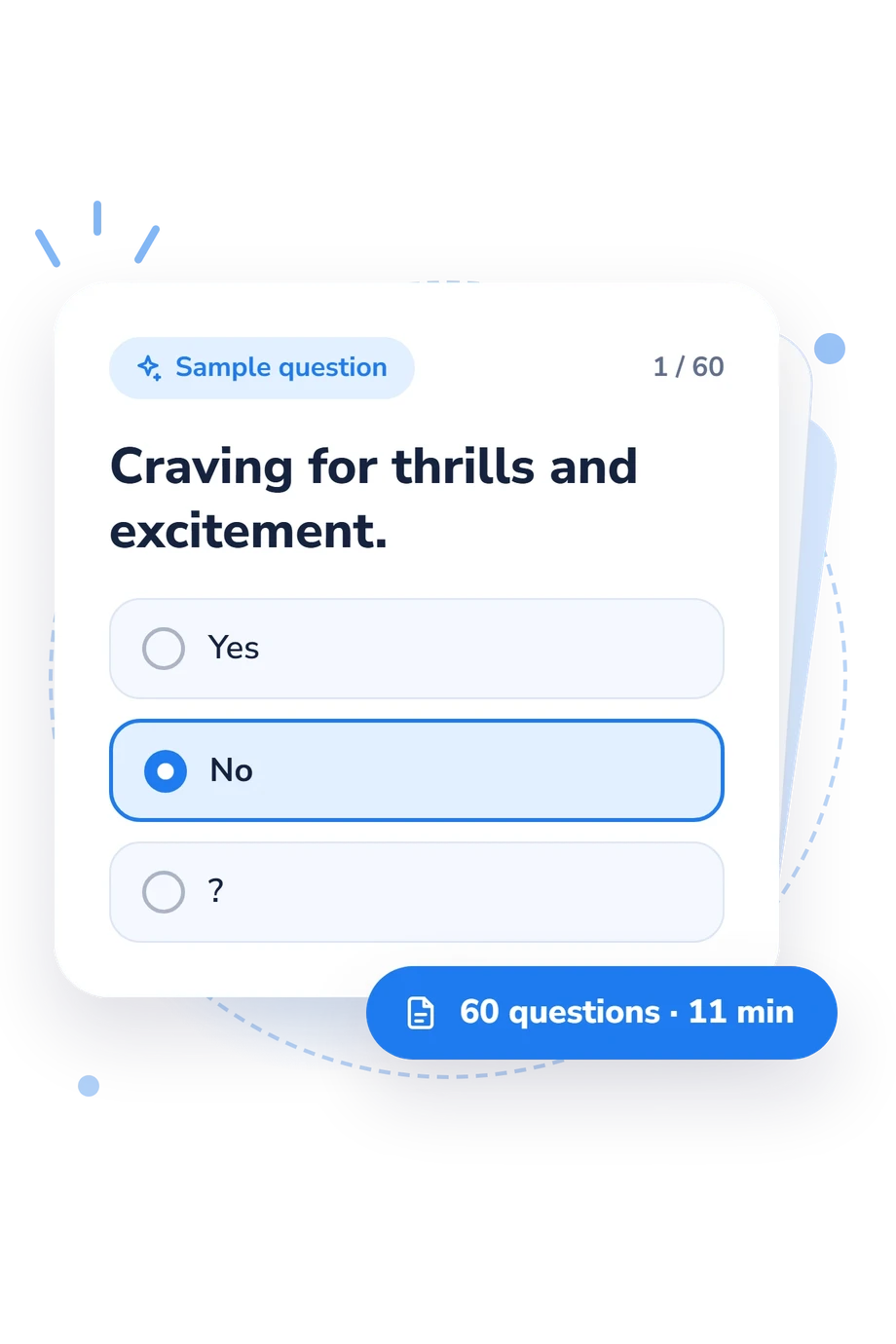
Please read each statement carefully. Select “Yes” if the described experience occurs frequently, and “No” if it occurs rarely or not at all. If you have significant difficulty answering an item, select “?” (Unable to answer).
    • Yes
    • No
    • ?
    • Yes
    • No
    • Unable to answer
    • Yes
    • No
    • ?
WHAT THE TEST MEASURES
About This Assessment
Assessment of Personality's Emotional Orientation Test

Personality Emotional Orientation Assessment Test - Symptoms and Signs

emotionality

This measure is designed to characterize an individual’s relative preferences for different emotionally rewarding experiences. The Personality Emotional Orientation Assessment is intended to support a descriptive profile of affective orientation that may inform case conceptualization and goal setting in counseling or related applied contexts.

Administration typically involves structured self-report responses that prioritize or rate a range of pleasant emotional states, emphasizing individual patterns rather than “good” versus “bad” results. The instrument includes 60 items and generally requires about 11 minutes to complete.

Interpretation focuses on identifying which emotional experiences are most salient to the respondent and how these preferences may relate to motivational themes and everyday functioning. The Personality Emotional Orientation Assessment is attributed to Robert Plutchik.

Author: Robert Plutchik
Literature: Super, D. E. A life-span, life-space approach to career development. Journal of Vocational Behavior. 1980.; Carver, C. S., & Scheier, M. F. On the self-regulation of behavior. Cambridge University Press. 1998.; Izard, C. E. Human emotions. Plenum Press. 1977.
Popular tests
Comments
Leave a Comment