
Almost Perfect Scale-Revised (APS-R) Test
How the Scales are Structured
Who Usually Takes This Test?
See How You Compare
Below is a preview of how scores are typically distributed across each scale.
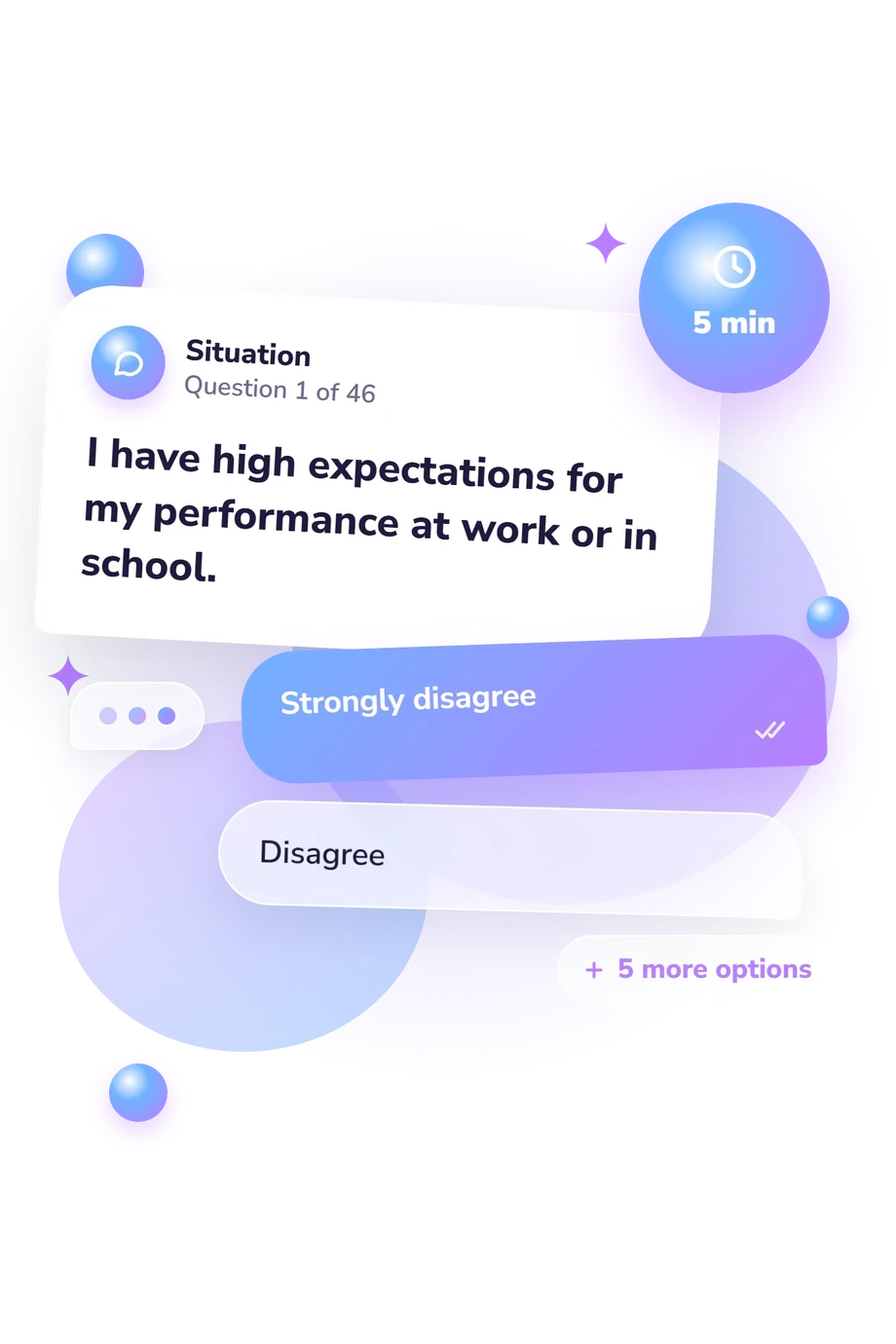
Example Questions From the Test
- Strongly disagree
- Disagree
- Somewhat disagree
- Neither agree nor disagree
- Somewhat agree
- Agree
- Strongly agree
- Strongly disagree
- Disagree
- Somewhat disagree
- Neutral
- Somewhat agree
- Agree
- Strongly agree
- Strongly disagree
- Disagree
- Somewhat disagree
- Neither agree nor disagree
- Somewhat agree
- Agree
- Strongly agree
Almost Perfect Scale-Revised (APS-R) Test - Description and methodology of the test
People seeking to understand how demanding, achievement-focused habits shape work, study, or everyday tasks can use the Almost Perfect Scale-Revised (APS-R) Test as a structured self-reflection exercise. It focuses on personal expectations, satisfaction with performance, and the need for order. As a perfectionism assessment, it shows whether striving is accompanied by dissatisfaction, worry, or a persistent sense of falling short.
What This Assessment Explores
Readers examining achievement, self-evaluation, and organization can use the questionnaire to reflect on demanding goals, dissatisfaction after performance, worry about falling short, and the value placed on order. A personal standards test can show whether striving is accompanied by a persistent sense of inadequacy or remains relatively comfortable.
This result profile contains three dimensions:
- Discrepancy (12-84) measures the perceived gap between high standards and perceived actual performance quality; Low discrepancy (12-35), Moderate discrepancy (36-59), and High discrepancy (60-84) are the displayed bands, with higher scores may indicate maladaptive manifestations of perfectionism.
- Standards (7-49) measures the level of personal demands set for tasks; Low standards (7-23), Moderate standards (24-36), and High standards (37-49) show the displayed bands.
- Order (4-28) measures the tendency to seek structure in daily life; Low order (4-12), Moderate order (13-20), and High order (21-28) show the displayed bands.
Methodology and Evidence Base
Each statement in this perfectionism questionnaire uses a seven-point agreement scale from Strongly disagree to Strongly agree, with a neutral midpoint. Results are reported as three separate scale scores with the displayed low, moderate, or high bands. These bands are descriptive rather than diagnostic. A perceived shortfall is best interpreted alongside the level of standards and the preference for order, rather than in isolation.
This online version is an administration of the published Almost Perfect Scale-Revised developed by Slaney and colleagues, which separates demanding goals and preference for organization from distress about falling short. The published scale has an evidence base; this version is not presented as newly standardized. Research by Flett and colleagues and Rice and colleagues examines psychometric issues in measuring and interpreting discrepancy, making that work relevant to how this profile should be read.
Answers depend on memory, honesty, current demands, and self-awareness, so scores may shift with context or self-presentation. Read them alongside the person’s circumstances rather than as a fixed label.
- Slaney, Robert B., Rice, Kenneth G., Mobley, Michael, Trippi, Joseph, and Ashby, Jeffrey S. (2001). The Revised Almost Perfect Scale. Measurement and Evaluation in Counseling and Development, 34(3), 130-145. 10.1080/07481756.2002.12069030
- Flett, Gordon L., Mara, Constance A., Hewitt, Paul L., Sirois, Fuschia, and Molnar, Danielle S. (2016). How Should Discrepancy Be Assessed in Perfectionism Research? A Psychometric Analysis and Proposed Refinement of the Almost Perfect Scale-Revised. Journal of Psychoeducational Assessment, 34(7), 718-732. 10.1177/0734282916651382
- Rice, Kenneth G., Gnilka, Philip B., Davis, Don E., and Ashby, Jeffrey S. (2019). Addressing Concerns About How Perfectionistic Discrepancy Should Be Measured With the Revised Almost Perfect Scale. Assessment, 26(3), 432-444. 10.1177/1073191117702241
Updated: