
Family Values Questionnaire Test
How the Scales are Structured
Who Usually Takes This Test?
See How You Compare
Below is a preview of how scores are typically distributed across each scale.
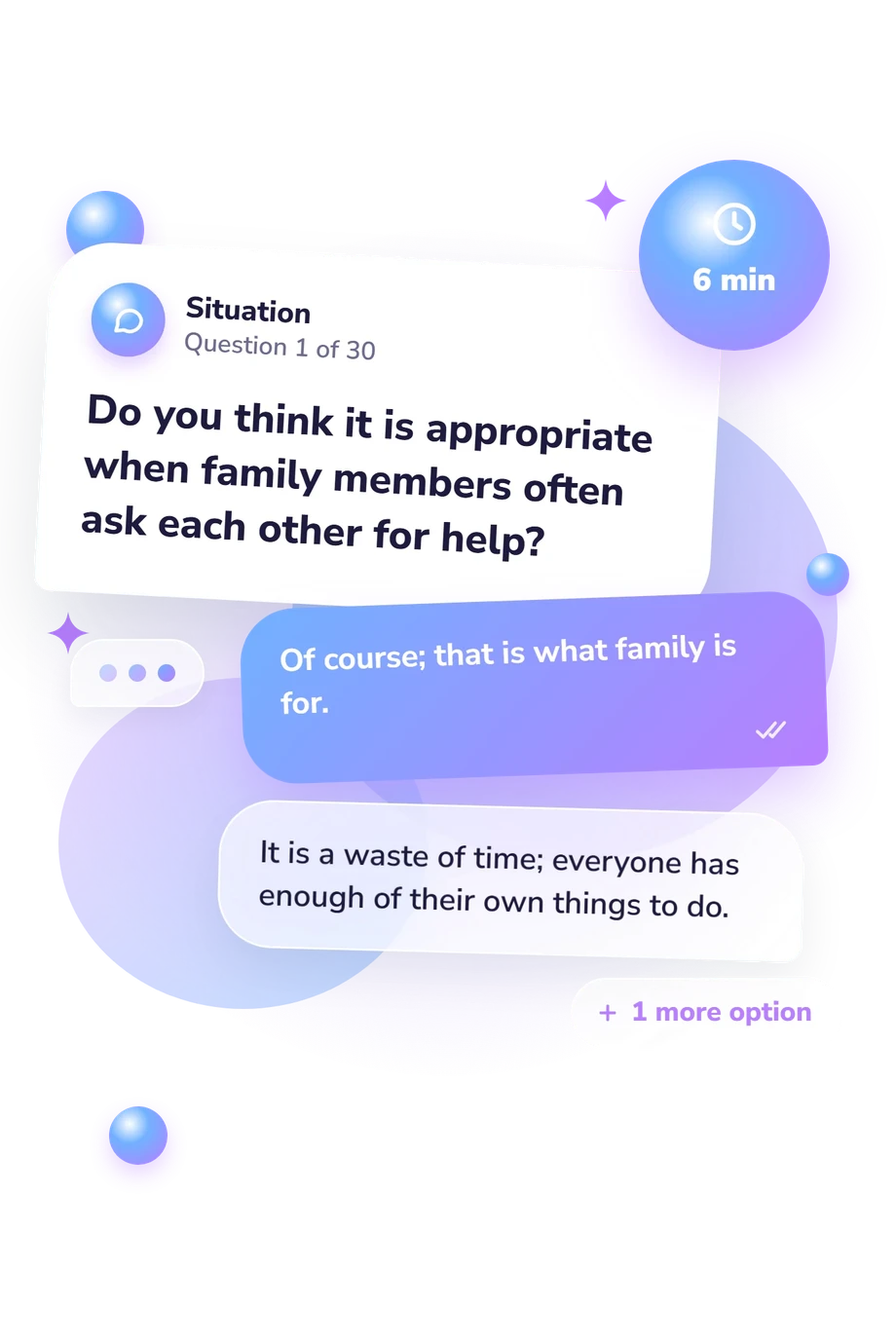
Example Questions From the Test
- Yes, all of them.
- No, everyone does what they want.
- It varies from family to family.
- Yes.
- No.
- I am not sure.
- Yes, I really like what my mother/father does.
- No, my parents' profession does not interest me.
- I don't know; I haven't thought about it.
Family Values Questionnaire Test - Description and methodology of the test
People who want to examine how family responsibilities and relationships fit into their personal priorities may find the Family Values Questionnaire Test useful. It functions as a family values test by assessing priorities in care, cooperation, emotional closeness, parenting, and intergenerational obligations through structured self-reflection. The result shows which values receive greater or lesser emphasis without presenting one family model as universally correct.
What This Assessment Explores
This family values assessment covers:
- Household Culture (0-10) measures household order; Low priority 0-4, Moderate priority 5-7, High priority 8-10.
- Care for Older Family Members (0-10) measures older-relative support; Low 0-4, Moderate 5-7, High 8-10.
- Care for Younger Family Members (0-10) measures younger-relative responsibility; Low 0-5, Moderate 6-8, High 9-10.
- Honoring Parents (0-10) measures parental respect; Low 0-4, Moderate 5-7, High 8-10.
- Continuation of the Family Line (0-10) measures family continuation through children; Low priority 0-4, Moderate priority 5-7, High priority 8-10.
- Love (0-10) measures closeness and support; Low priority 0-4, Moderate priority 5-7, High priority 8-10.
- Overall Score (0-60) reflects family-value emphasis; Lower emphasis 0-30, Moderate emphasis 31-49, High emphasis 50-60.
Methodology and Scientific Basis
Each item in this situational self-report presents a short question or family vignette with three answer choices. The options generally distinguish endorsement, rejection, or a conditional response rather than asking for a numerical rating. The online result combines responses into six displayed dimensions and an overall score; because the point contribution of each option is not specified, the ranges should not be reverse-engineered into an item-by-item scoring rule.
The questionnaire uses a family values survey format and is conceptually consistent with the Family Values Questionnaire studied by Konstantinova and Martynova in 2014, but it should not be described as a direct adaptation of that published material. The related 2021 study by Trubnikova, Malysheva, and Elkin provides context for examining attitudes toward family values, not norms for this online version.
Interpret the profile as a snapshot of self-reported priorities. The result displays descriptive emphasis bands rather than documented population norms or clinical thresholds, and responses can shift with culture, current relationships, mood, social desirability, or self-awareness. The scores describe the respondent’s stated emphasis; they do not by themselves establish a disorder or predict conduct in every family situation.
- Konstantinova, M. S., & Martynova, M. V. (2014). Diagnostic materials on the topic “Family values.” In E. V. Vergizova, T. S. Vorobeykova, & O. V. Erlikh (Eds.), Model of the Formation of Family Values in Children and Adolescents (pp. 49-67). Saint Petersburg: Svoe Izdatelstvo.
- Trubnikova, E., Malysheva, A., & Elkin, S. (2021). Attitude of High School and University Students to Family Values. In A. G. Shirin, M. V. Zvyaglova, O. A. Fikhtner, E. Y. Ignateva, & N. A. Shaydorova (Eds.), Education in a Changing World: Global Challenges and National Priorities, Vol. 114, European Proceedings of Social and Behavioural Sciences (pp. 429-438). European Publisher. 10.15405/epsbs.2021.07.02.51
Updated: