
Existential Crisis Experience Scale Test
How the Scales are Structured
Who Usually Takes This Test?
See How You Compare
Below is a preview of how scores are typically distributed across each scale.
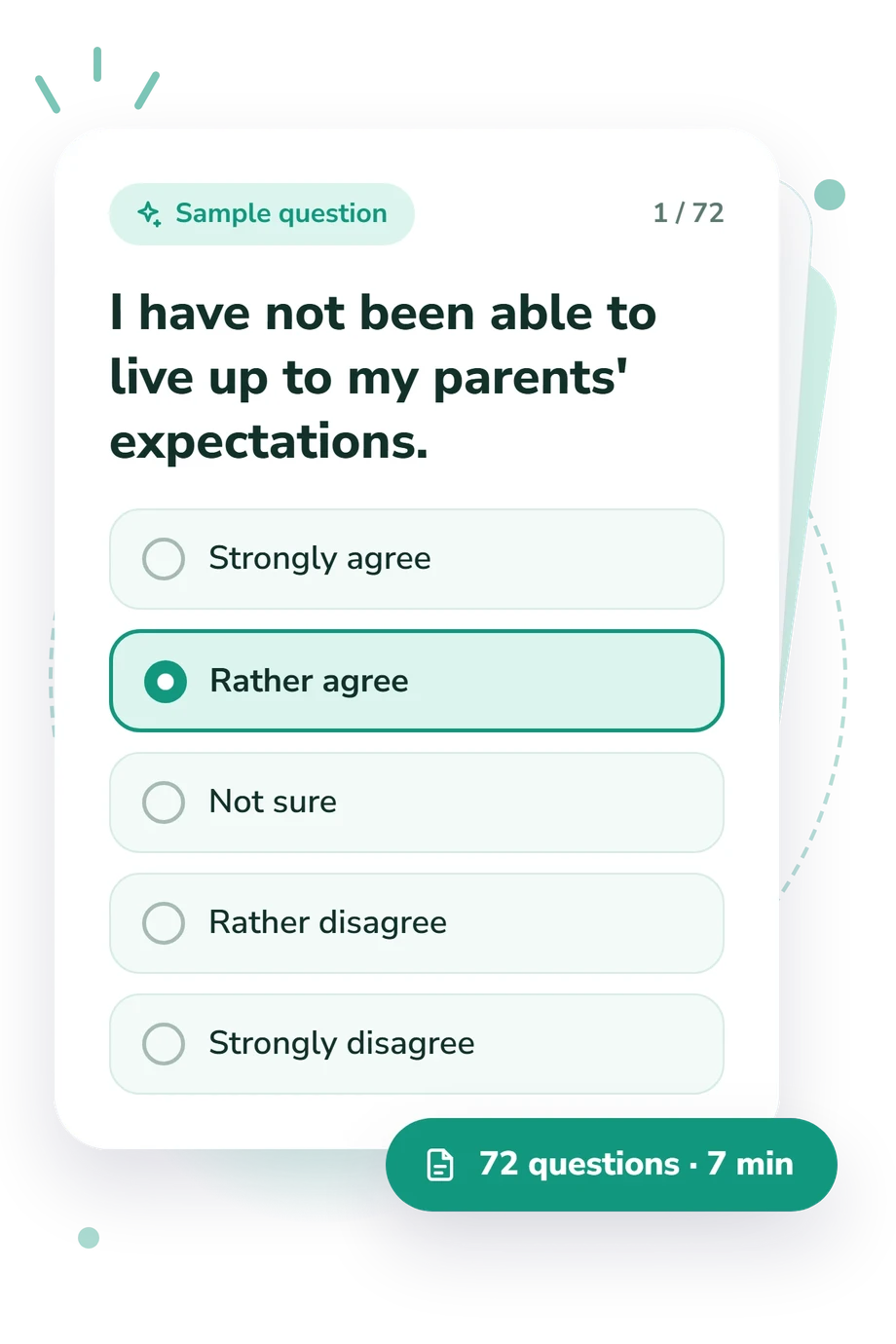
Example Questions From the Test
- Strongly agree
- Somewhat agree
- Unsure
- Somewhat disagree
- Strongly disagree
- Strongly agree
- Somewhat agree
- Not sure
- Somewhat disagree
- Completely disagree
- Strongly agree
- Somewhat agree
- Unsure
- Somewhat disagree
- Strongly disagree
Existential Crisis Experience Scale Test - Description and methodology of the test
People who feel overwhelmed by difficult emotions, disappointed by their circumstances, or uncertain about their place in relationships may use this assessment to organize those experiences. The Existential Crisis Experience Scale Test helps respondents see which areas currently deserve reflection and consider how these experiences fit together. This existential crisis self-assessment offers a structured starting point for that reflection.
What This Assessment Explores
The questions examine emotions, self-view, relationships, and life circumstances. Items address guilt, hopelessness, limited support, social disconnection, and devaluing trust or closeness, including communication perceived as lacking warmth or empathy, or as aggressive or intrusive. Purpose-related statements are themes, not a general-purpose measure of existential distress.
The dimensions and bands are:
- Despair, Suffering, and Guilt (-12-12) shows Low (-12--6), Moderate (-5-0), or Elevated (1-12) distress.
- Insecurity (-12-12) shows Low vulnerability (-12--6), Moderate (-5-0), or High (1-12).
- Loneliness (-12-12) shows Low (-12--6), Moderate (-5-0), or High (1-12).
- Dissatisfaction With One's Present Life (-12-12) shows Low (-12--6), Moderate (-5-0), or Elevated (1-12).
- Self-Dissatisfaction (-12-12) shows Low (-12--6), Moderate (-5-0), or High (1-12).
- Meaninglessness of Social Relationships (-12-12) shows Low (-12--6), Moderate (-5-0), or High (1-12) attitudes toward trust and closeness.
Methodology and Evidence Base
The example statements use a five-point agreement response, from Strongly agree through an uncertain middle option to Strongly disagree. The result is dimensional: scores are reported separately across the six scales, with interpretation bands displayed in the results. The exact point contribution of each response is not stated for this version, so totals should be interpreted through those bands rather than reverse-engineered.
Its conceptual lens is consistent with existential psychology, bringing together concerns about meaning, isolation, belonging, freedom, responsibility, identity, and difficult emotions. More specifically, the questionnaire is conceptually consistent with the published Experience of Existential Crisis Questionnaire (Yanysheva & Senkevich, 2021), but this online version is not presented as an adaptation of that source instrument.
Published work on the source questionnaire reports item-scale coherence, retest stability, and convergent relationships with meaningful-life measures. In practical terms, this online existential crisis profile offers a focused snapshot rather than a universal or clinical verdict: scores may shift with current circumstances, depend on honest self-report and self-awareness, and cannot alone explain causes or establish norms for this online version.
- Yanysheva, Vera Aleksandrovna, and Lyudmila Viktorovna Senkevich. “The Questionnaire ‘The Experience of Existential Crisis’: A Short Version.” Systems Psychology and Sociology, no. 1 (37), 2021, pp. 95-108. 10.25688/2223-6872.2021.37.1.8
- Senkevich, Lyudmila Viktorovna. “The Questionnaire ‘The Experience of Existential Crisis’: The First Stage of Approbation.” Systems Psychology and Sociology, vol. 4, no. 16, 2015, pp. 46-54.
- Senkevich, Lyudmila Viktorovna. “Phenomenological and Process Dynamic Characteristics of Existential Identity Crisis.” Global Media Journal, special issue 2, 2016, article 19.
Updated: