
Freudly+971 508685814hello@freudly.ai
Freudly
tendencies

Orientational-Diagnostic Interests Questionnaire Test
Take the online Orientational-Diagnostic Interests Questionnaire Test - AI psychologist FreudlyYou can take Orientational-Diagnostic Interests Questionnaire Testhere. Online version of a simple and accurate psychological test with interpretation.en
Discover what truly captures your attention in about 8 minutes. With 96 items across 16 domains, it clarifies motivations and supports career guidance, counseling, and fit decisions.
Start Online Test
Questions: 968 minutes
08:30
October 2, 2025
October 2, 2025
Material has been updated
October 2, 2025
Material has been published
17,906 views
1,088 completions
886 likes
Verified by Daniel Hall
Psychologist with 25 years of experience
Share
Scale Explorer

How the Scales are Structured

example score
4/12
History (H)
Measures interest in history, historical events, and analyzing the past as a marker of humanities-oriented preferences.
Low interest
Moderate interest
High interest
-120: Low interest | 17: Moderate interest | 812: High interest
A score of 4 suggests a moderate interest in history, with some engagement in past events and analysis without it being a dominant preference.
example score
-5/12
Geography and Geology (GaG)
Measures interest in geography, geology, and Earth science topics such as natural phenomena and Earth processes.
Low interest
Moderate interest
High interest
-12-6: Low interest | -54: Moderate interest | 512: High interest
A score of -5 falls in the Moderate interest range, suggesting occasional curiosity about geography and geology rather than a strong, sustained focus.
example score
-5/12
Medicine (M)
Measures interest in medicine, caregiving, and medical sciences.
Low interest
Moderate interest
High interest
-12-5: Low interest | -44: Moderate interest | 512: High interest
A score of -5 suggests a relatively low interest in medical and caregiving-related activities compared with other domains.
example score
3/12
Entrepreneurship (E)
Measures interest in entrepreneurial activities, business initiatives, and running one's own venture.
Low interest
Moderate interest
High interest
-120: Low interest | 17: Moderate interest | 812: High interest
A score of 3 indicates a moderate interest in entrepreneurship, suggesting occasional motivation toward business initiatives without a strong, consistent drive to start or run a venture.
example score
-4/12
Sports (S)
Measures interest in sports, physical activity, and striving for athletic achievements.
Low interest
Moderate interest
High interest
-12-5: Low interest | -44: Moderate interest | 512: High interest
A score of -4 suggests a moderate level of interest in sports and physical activity, with some openness but not a strong focus on athletic pursuits.
example score
9/12
Military Service (MS)
Measures interest in military affairs, service, and military-related professions.
Low interest
Moderate interest
High interest
-124: Low interest | 57: Moderate interest | 812: High interest
A score of 9 falls in the High interest range, suggesting a strong preference for military-related topics and roles compared with other areas.
example score
0/12
Domestic Services (DS)
Measures interest in household services and customer-facing work in everyday service situations.
Low interest
Moderate interest
High interest
-12-1: Low interest | 04: Moderate interest | 512: High interest
A score of 0 suggests a moderate, situational interest in household services and customer service work rather than a strong preference.
example score
-2/12
Education (E)
Assesses interest in teaching, education, and upbringing activities.
Low interest
Moderate interest
High interest
-12-6: Low interest | -54: Moderate interest | 512: High interest
A score of -2 falls in the Moderate interest range, suggesting some openness to educational or teaching-related activities without a strong preference for them.
example score
5/12
Art (A)
Measures interest in art, creativity, and aesthetic activities.
Low interest
Moderate interest
High interest
-120: Low interest | 14: Moderate interest | 512: High interest
A score of 5 indicates a high level of interest in artistic and creative pursuits, suggesting you may feel drawn to aesthetic activities and potentially art-related roles.
example score
-4/12
Philology and Journalism (PaJ)
Assesses interest in languages, literature, journalism, and text-based work.
Low interest
Moderate interest
High interest
-12-5: Low interest | -44: Moderate interest | 512: High interest
A score of -4 falls in the Moderate interest range, suggesting some openness to language and text-related activities but they are not a dominant preference.
example score
1/12
Biology (B)
Measures interest in biology, living organisms, and natural processes.
Low interest
Moderate interest
High interest
-120: Low interest | 17: Moderate interest | 812: High interest
A score of 1 suggests a moderate, situational interest in biological topics rather than a strongly pronounced preference.
example score
2/12
Chemistry (C)
Measures interest in chemistry, experimentation, and studying the properties and interactions of substances.
Low interest
Moderate interest
High interest
-120: Low interest | 17: Moderate interest | 812: High interest
A score of 2 suggests a moderate interest in chemistry, with some curiosity about chemical topics but not a strong focus on them.
example score
0/12
Technology (T)
Measures interest in technical sciences, mechanisms, and engineering-related activities.
Low
Moderate
High
-12-6: Low | -55: Moderate | 612: High
A score of 0 falls in the Moderate range, suggesting a balanced or situational interest in technical and engineering topics without a pronounced focus.
example score
3/12
Electronics and Radio Engineering (EaRE)
Measures interest in electronics and radio engineering, including working with devices, circuits, and technical equipment.
Low interest
Moderate interest
High interest
-120: Low interest | 14: Moderate interest | 512: High interest
A score of 3 indicates a moderate level of interest in electronics and radio engineering, suggesting occasional engagement with technical devices and circuitry without a strong, sustained focus.
example score
6/12
Mathematics (M)
Measures interest in mathematics, including logical problem-solving and comfort with abstract concepts.
Low interest
Moderate interest
High interest
-120: Low interest | 17: Moderate interest | 812: High interest
A score of 6 suggests a moderate interest in mathematics, with a generally positive attitude toward mathematical reasoning and problem-solving.
example score
3/12
Physics (P)
Measures interest in physics as a field of study, including curiosity about physical phenomena, experiments, and theory.
Low interest
Moderate interest
High interest
-120: Low interest | 17: Moderate interest | 812: High interest
A score of 3 indicates moderate interest in physics, suggesting occasional curiosity that may emerge in specific topics or contexts rather than being a central focus.
Start Online Test
just completed the test
DATA-BASED USER COHORTS

Who Usually Takes This Test?

Career-planning students
41%OF USERS
High school and university students take it to see which study paths and future professions match their strongest interests.
Job changers and explorers
34%OF USERS
Adults in a transition use it to clarify what genuinely motivates them before choosing a new role, course, or direction.
Counselors and HR trainers
25%OF USERS
Specialists administer it in individual or group settings to quickly map interest profiles for guidance, development, or assessment.
BASED ON AGGREGATED, ANONYMIZED DATA FROM TENS OF THOUSANDS OF FREUDLY USERS.
Benchmarking

See How You Compare

Once you complete the test, your results are compared with real-world data from people in your country.
Below is a preview of how scores are typically distributed across each scale.
History (H)
History (H)
Average
-5.7
Normal range
-9.6-1.9
min.
-12
max.
12
This curve shows how scores are typically distributed.
Once you complete the test, your result will appear on the scale so you can see how you compare.
Geography and Geology (GaG)
Average
3
Normal range
-0.66.7
min.
-12
max.
12
This curve shows how scores are typically distributed.
Once you complete the test, your result will appear on the scale so you can see how you compare.
Medicine (M)
Medicine (M)
Average
-4.4
Normal range
-8.5-0.3
min.
-12
max.
12
This curve shows how scores are typically distributed.
Once you complete the test, your result will appear on the scale so you can see how you compare.
Entrepreneurship (E)
Average
-3
Normal range
-6.70.7
min.
-12
max.
12
This curve shows how scores are typically distributed.
Once you complete the test, your result will appear on the scale so you can see how you compare.
Sports (S)
Sports (S)
Average
-2.1
Normal range
-5.21
min.
-12
max.
12
This curve shows how scores are typically distributed.
Once you complete the test, your result will appear on the scale so you can see how you compare.
Military Affairs (MA)
Average
0.9
Normal range
-2.84.6
min.
-12
max.
12
This curve shows how scores are typically distributed.
Once you complete the test, your result will appear on the scale so you can see how you compare.
Household Services (HS)
Average
-5.2
Normal range
-8.7-1.6
min.
-12
max.
12
This curve shows how scores are typically distributed.
Once you complete the test, your result will appear on the scale so you can see how you compare.
Pedagogy (P)
Pedagogy (P)
Average
5.5
Normal range
2.28.8
min.
-12
max.
12
This curve shows how scores are typically distributed.
Once you complete the test, your result will appear on the scale so you can see how you compare.
Art (A)
Art (A)
Average
0.1
Normal range
-4.44.6
min.
-12
max.
12
This curve shows how scores are typically distributed.
Once you complete the test, your result will appear on the scale so you can see how you compare.
Philology and Journalism (PaJ)
Average
-3.6
Normal range
-80.9
min.
-12
max.
12
This curve shows how scores are typically distributed.
Once you complete the test, your result will appear on the scale so you can see how you compare.
Biology (B)
Biology (B)
Average
-3.7
Normal range
-8.10.7
min.
-12
max.
12
This curve shows how scores are typically distributed.
Once you complete the test, your result will appear on the scale so you can see how you compare.
Chemistry (C)
Chemistry (C)
Average
-0.2
Normal range
-4.44.1
min.
-12
max.
12
This curve shows how scores are typically distributed.
Once you complete the test, your result will appear on the scale so you can see how you compare.
Technique (T)
Technique (T)
Average
-2.1
Normal range
-5.31
min.
-12
max.
12
This curve shows how scores are typically distributed.
Once you complete the test, your result will appear on the scale so you can see how you compare.
Electronics, Radio Engineering (ERE)
Average
4.1
Normal range
17.2
min.
-12
max.
12
This curve shows how scores are typically distributed.
Once you complete the test, your result will appear on the scale so you can see how you compare.
Mathematics (M)
Mathematics (M)
Average
4.9
Normal range
1.98
min.
-12
max.
12
This curve shows how scores are typically distributed.
Once you complete the test, your result will appear on the scale so you can see how you compare.
Physics (P)
Physics (P)
Average
-2.7
Normal range
-5.70.2
min.
-12
max.
12
This curve shows how scores are typically distributed.
Once you complete the test, your result will appear on the scale so you can see how you compare.
Featured On
SAMPLE QUESTIONS

Example Questions From the Test

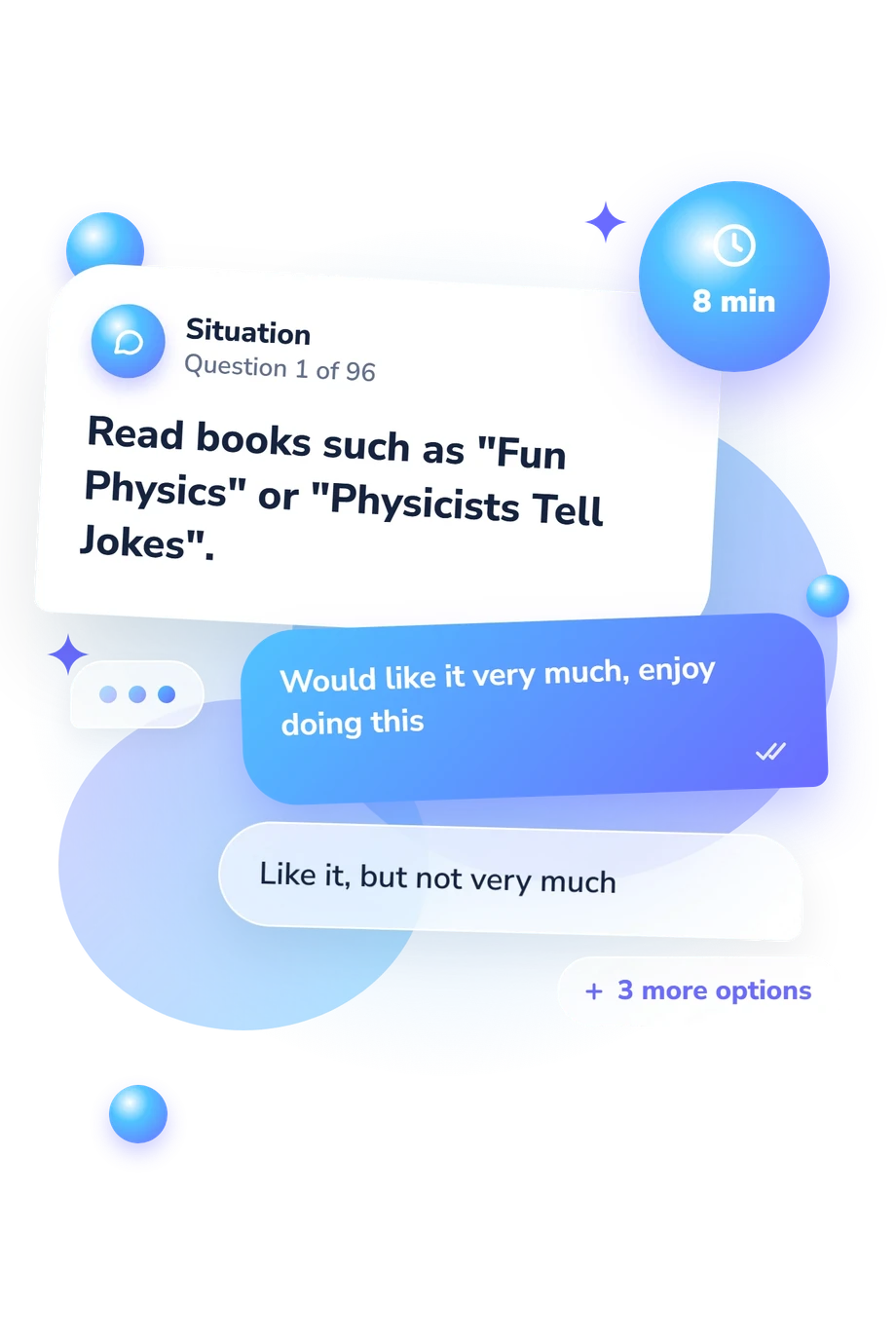
To identify your primary interests, the following list of questions is provided. Consider each question carefully before responding, and try to answer as accurately as possible.
    • Would like it very much, enjoy doing this
    • Like it, but not very much
    • Unsure
    • Would not like to, do not like it
    • Would strongly dislike it, do not like it at all
    • Would very much like to; like doing this
    • Like it, but not very much
    • Not sure
    • Would not like to; do not like it
    • Would very much not like to; do not like it at all
    • Would very much like to; enjoy doing this
    • Like it, but not very much
    • Difficult to say
    • Would not like to; do not enjoy it
    • Would very much not like to; do not enjoy it at all
WHAT THE TEST MEASURES
About This Assessment
Tentative Diagnostic Interests Questionnaire, TDIQ Test

Orientational-Diagnostic Interests Questionnaire Test - Symptoms and Signs

tendencies

This measure is designed to provide a brief snapshot of an individual’s interest profile across a range of life and career domains. The Orientational-Diagnostic Interests Questionnaire is commonly used in career counseling and vocational guidance to help organize stated preferences into interpretable areas (John L. Holland). It consists of 96 items and typically takes about 8 minutes to complete.

Responses are used to describe relative levels of interest across multiple broad domains (e.g., scientific/technical, creative, social, athletic, and entrepreneurial activities). Results from the Orientational-Diagnostic Interests Questionnaire are typically interpreted as descriptive indicators of motivational preferences and are best integrated with clinical interview data and other relevant assessment information.

Author: John L. Holland
Literature: Holland, J. L. Making vocational choices: A theory of vocational personalities and work environments. Prentice-Hall. 1985.
Popular tests
Comments
Leave a Comment