
Protest Activity Scale
How the Scales are Structured
Who Usually Takes This Test?
See How You Compare
Below is a preview of how scores are typically distributed across each scale.
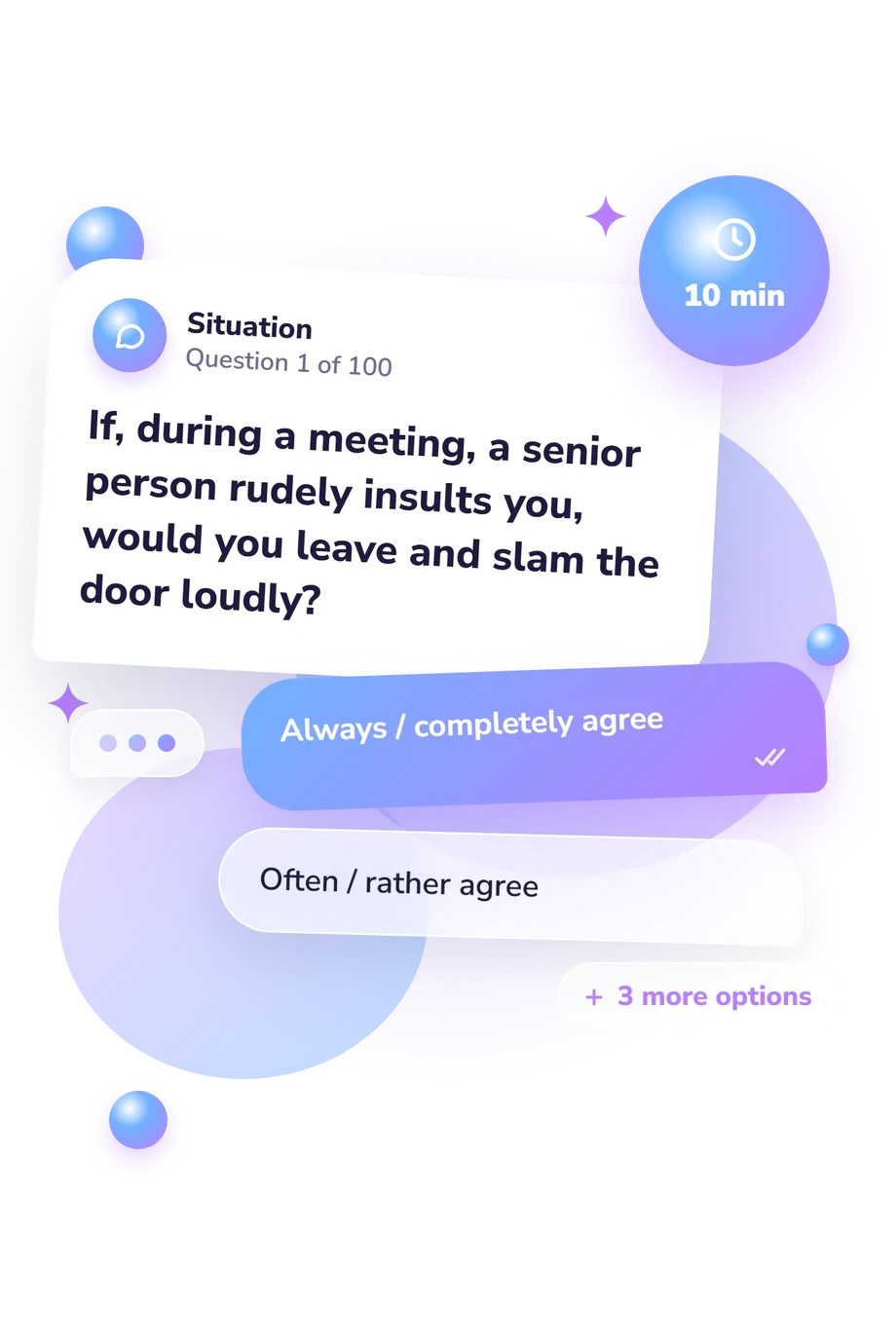
Example Questions From the Test
- Always / completely agree
- Often / somewhat agree
- Sometimes / neither agree nor disagree
- Rarely / somewhat disagree
- Never / completely disagree
- Always / completely agree
- Often / somewhat agree
- Sometimes / neither agree nor disagree
- Rarely / somewhat disagree
- Never / completely disagree
- Always / completely agree
- Often / mostly agree
- Sometimes / somewhere in between
- Rarely / mostly disagree
- Never / completely disagree
Protest Activity Scale - Description and methodology of the test
People who want to examine how they respond to authority, conflict, independence, and difficult social situations may find the Protest Activity Scale useful as a structured self-reflection exercise. Readers interested in a test of protest activity may find it useful as a structured self-reflection exercise. The result organizes these patterns into a profile that can support more deliberate reflection on behavior, values, and choices.
What This Assessment Measures
The items sample reactions to insult, unfairness, authority, retaliation, moral rules, autonomy, and retreat into fantasy or digital activity. The profile also describes protest-related behavior by showing whether responses lean toward confrontation, independence, withdrawal, or rejection of accepted norms.
The five result dimensions are:
- Escapism, 0-40 - Low 0-11; Moderate 12-21; High 22-40. It reflects withdrawal and difficulty engaging with problems.
- Nihilism, 0-32 - Low 0-5; Moderate 6-14; High 15-32. It reflects cynicism, lost meaning, and rejection of shared values.
- Opposition, 0-40 - Low 0-12; Moderate 13-22; High 23-40. It reflects conflict, dissatisfaction, aggression, and weak self-regulation.
- Emancipation, 0-24 - Low 0-13; Moderate 14-20; High 21-24. It reflects autonomy, assertiveness, leadership, and resistance to control.
- Negativism, 0-64 - Low 0-25; Moderate 26-35; High 36-64. It reflects rigidity, irritability, distrust, and resistance to novelty.
Methodology and Scientific Basis
The presented items use a five-point ordered agreement or frequency response, from "Always / completely agree" to "Never / completely disagree," although wording occasionally uses "strongly agree." Respondents indicate how closely a situation, belief, or behavior matches them; the answers are then combined into the displayed profile. The displayed ranges and bands do not provide a separate scoring formula; no point value should be inferred beyond the reported result.
The questionnaire functions as a protest assessment whose dimensions are conceptually consistent with the Protest Activity Questionnaire (Guseinov, 2015) and the 2017 interpretation by Guseinov, Ryabikina, Fomenko, and Shipovskaya; it is not presented as a validated adaptation of those published studies. Klenova (2019) offers supplementary context on related protest activity in a socio-political setting, not evidence that this online version is validated.
The displayed bands organize the prominence of each tendency into the questionnaire’s Low, Moderate, and High reporting categories. Interpretation is strongest when the full pattern is considered alongside the situations behind the answers. Self-report results can shift with honesty, self-awareness, current stress, and the setting a respondent has in mind, so the profile is descriptive rather than diagnostic.
- Guseinov, Aleksandr Sh. (2015). Questionnaire "Protest Activity of Personality": Development and Adaptation. Krasnodar: Kuban State University of Physical Culture, Sport and Tourism, 64 pp.
- Guseinov, Aleksandr Sh., Ryabikina, Zinaida I., Fomenko, Galina Yu., and Shipovskaya, Viktoriya V. (2017). The Phenomenon of Protest Activity: A Subjective-Existential Interpretation. Russian Psychological Journal, 14(4), 78-96. 10.21702/rpj.2017.4.4
- Klenova, Milena A. (2019). Protest Activity and its Psychological Content in the Context of Young People’s Socio-Political Activity. Izvestiya of Saratov University. Educational Acmeology. Developmental Psychology, 8(4), 362-367. 10.18500/2304-9790-2019-8-4-362-367
Updated: