
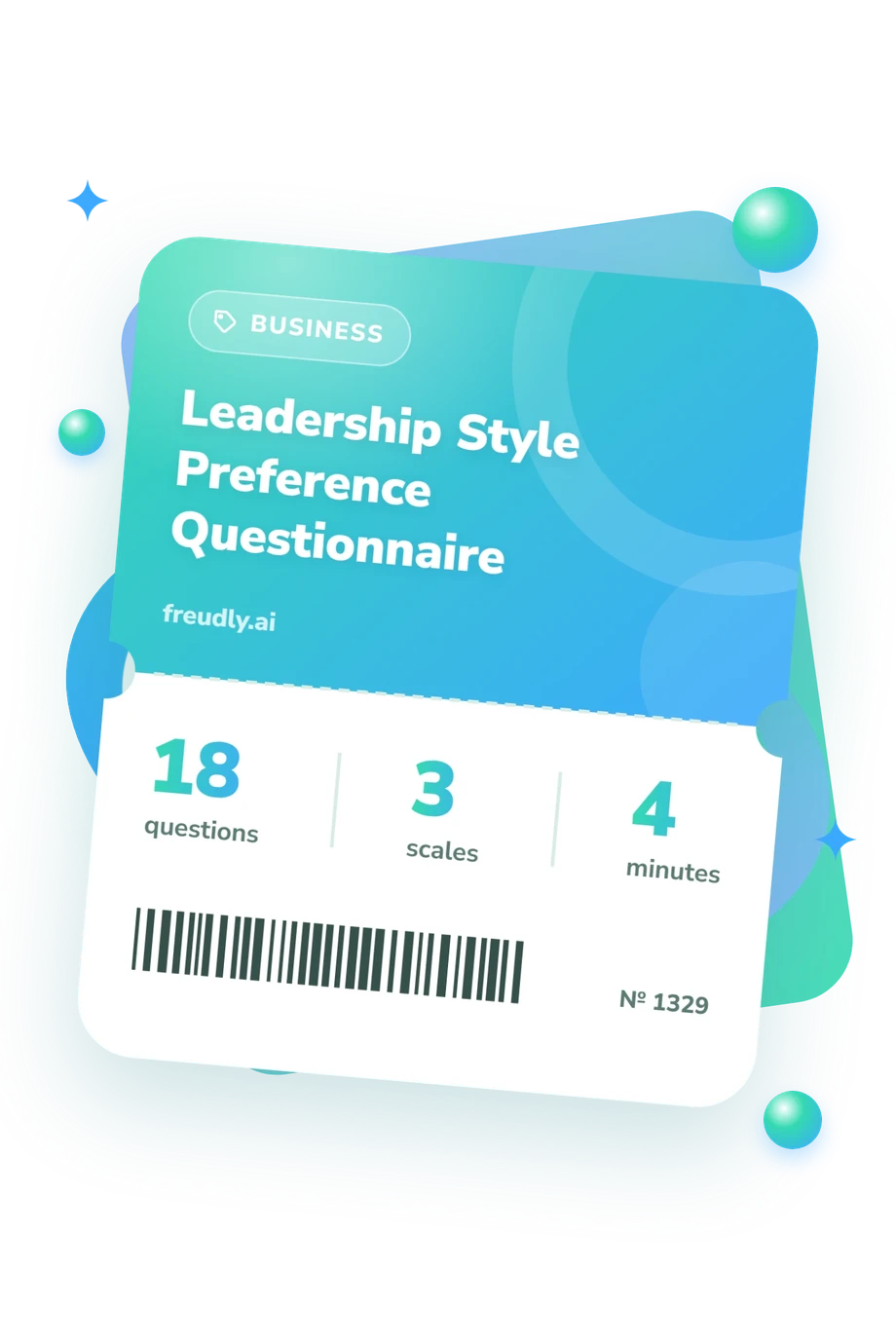
Leadership Style Preference Questionnaire Test
How the Scales are Structured
Who Usually Takes This Test?
See How You Compare
Below is a preview of how scores are typically distributed across each scale.
Example Questions From the Test
- a) consult with the team.
- b) try not to take responsibility for making the decision.
- c) make the decision on your own.
- a) you would closely monitor each of them;
- b) you would delegate monitoring to the subordinates themselves;
- c) you would consider monitoring unnecessary.
- a) you would consult with the team;
- b) you would take full charge yourself;
- c) you would rely entirely on the team’s leaders.
Leadership Style Preference Questionnaire Test - Description and methodology of the test
Managers, team leads, and people preparing for supervisory work can use this leadership style questionnaire to examine how they tend to direct, involve, or release responsibility within a group. The Leadership Style Preference Questionnaire Test links everyday leadership choices to three contrasting patterns, helping respondents see how strongly their answers reflect each tendency and where flexibility may be useful. It offers focused self-reflection rather than a fixed label.
What This Assessment Measures
The questions cover decisions, delegation, supervision, discipline, feedback, communication, workplace relationships, innovation, and uncertainty. These situations reveal whether a respondent tends to share authority, retain close control, or leave responsibility with the team. For people considering management responsibilities or workplace behavior, the result helps them assess their leadership style.
The result dimensions are:
- Liberal (0-18) measures permissiveness, limited oversight, shifted responsibility, and informal relationships; Low permissiveness (0-12) or High permissiveness (13-18) shows the displayed level.
- Democratic (0-18) measures shared decisions, delegation, initiative, and balanced oversight; Low (0-12) or Moderate (13-18) shows the displayed level.
- Autocratic (0-18) measures directive control, strict discipline, unilateral decisions, and limited employee initiative; Low directive (0-12) or High directive (13-18) shows the displayed level.
Read together, these dimensions show how strongly each preference appears rather than selecting one definitive leadership style.
Methodology and Evidence Base
Each item presents a workplace situation with three response options. The alternatives contrast consultation and delegation with close direction or minimal intervention, while also covering discipline, feedback, relationships, innovation, and pressure. Results are reported across the three scales with displayed bands for the strength of each tendency. Point assignment for individual options is unspecified, so the displayed scores cannot be reconstructed from the choices.
Conceptually, the questionnaire is consistent with Leadership Style Tendency (Ilyin & Nguyen, 1999), which connects leadership preferences with personality characteristics. Zhuravlev’s work on leadership and a collective’s social-psychological climate adds relevant context, while Lewin, Lippitt, and White provide a broader model of contrasting social climates. Together, these studies provide conceptual context for the questionnaire’s three leadership preference dimensions, but they do not establish standardization or validation for this online version.
Interpretation depends on honest self-report, self-awareness, current role demands, and imagined workplace culture. The result may show a preferred response pattern without capturing actual flexibility or behavior, so it is most useful alongside experience, feedback, and attention to the demands of a particular team.
- Nguyen, Ki Tuong. (2000). Leadership Style Tendencies of Physical Education Teachers: Candidate of Psychological Sciences Dissertation. Herzen State Pedagogical University, St. Petersburg.
- Ilyin, E. P., & Nguyen, Ki Tuong. (1999). Leadership Style Tendency and Personality Characteristics. In Psychological Problems of Personal Self-Realization, Vol. 3, pp. 102-112. St. Petersburg: St. Petersburg State University.
- Zhuravlev, A. L. (1979). Leadership Style for Managing the Socio-Psychological Climate of a Production Collective. In Socio-Psychological Climate of a Collective: Theory and Methods of Study, pp. 137-139. Moscow: Nauka.
- Lewin, Kurt, Lippitt, Ronald, & White, Ralph K. (1939). Patterns of Aggressive Behavior in Experimentally Created “Social Climates.” The Journal of Social Psychology, 10(2), 269-299. 10.1080/00224545.1939.9713366
Updated: