
Cyclothymic Tendency Scale Test
How the Scales are Structured
Who Usually Takes This Test?
See How You Compare
Below is a preview of how scores are typically distributed across each scale.
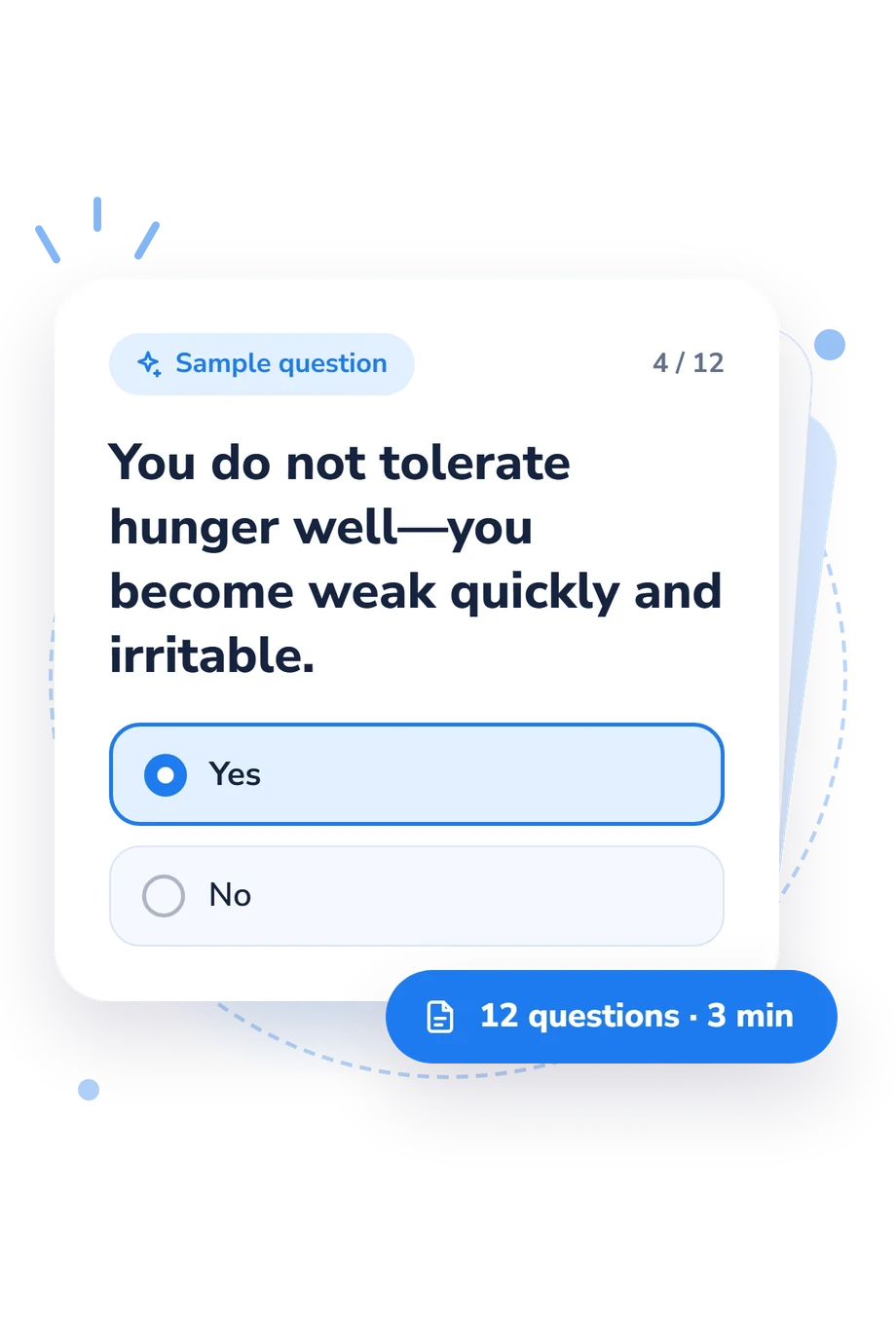
Example Questions From the Test
- Yes
- No
- Yes
- No
- Yes
- No
Cyclothymic Tendency Scale Test - Description and methodology of the test
For readers who notice recurring shifts in drive, mood, or initiative, this cyclothymia test offers a structured way to examine whether those changes form a recognizable personal pattern. It suits people reflecting on everyday functioning and can provide a starting point for a mood fluctuation assessment that considers recurring experiences over time, including episodic shifts. The result highlights the tendency represented by the answers, not a fixed identity.
What This Assessment Explores
Items examine alternating activation and slowing, unexplained mood changes, and movement between enthusiasm and lost initiative. Hunger, seasons, sleep, and work bursts are contexts through which the tendency may appear. The scale interprets alternating activity and positive or negative affect as primarily internally driven biochemical and psychophysiological fluctuations, rather than changes caused by external events. Concern about cyclothymic disorder makes this cyclothymia questionnaire useful for reflecting on a tendency.
The result uses one scale, Cyclothymic Tendency (0-12), with Low (0-4), Moderate (5-9), and High (10-12) bands. Higher bands indicate a stronger pattern match. Ordinary fluctuations should not interfere with functioning; persistent, pronounced ones may become a stable trait.
The themes are:
- Activation changes show alternating energy and initiative.
- Affect shifts show movement between positive and negative mood.
- Contexts show work, sleep, hunger, and seasons accompanying shifts; they are not separately scored.
Methodology and Scientific Basis
Each statement is answered Yes or No, asking whether the experience fits. Items sample energy, initiative, mood, irritability, sleep, and activity rhythm rather than a narrative history. Interpretation follows the displayed total and band; the questionnaire provides no indication that items receive extra weighting.
Boyko's 1996 work on emotional energy in communication offers a conceptual comparison for alternating mood and activity; this questionnaire is not presented as its adaptation. Leonhard's account of accentuated personalities provides a temperament framework for shifts in activation and affect, while TEMPS-I (Akiskal et al., 1998) offers a relevant comparison with cyclothymic temperament traits in a nonpatient population. These references support conceptual interpretation; they do not establish validation or clinical status for this questionnaire.
In practice, this cyclothymic tendency assessment is most informative when answers represent recurring experiences over time, including the episodic shifts in the items. Stress, sleep loss, expectations, and limited self-observation can influence responses. The bands are descriptive rather than population norms or clinical cutoffs, so a high result signals a stronger match to the questionnaire's pattern, not a diagnosis or confirmed cause.
- Boyko, Viktor Vasilievich. Energy of Emotions in Communication: A Look at Oneself and Others. Moscow: Filin, 1996. ISBN 5-900855-60-0.
- Leonhard, Karl. Accentuated Personalities. 2nd revised ed. Stuttgart: Fischer, 1976. ISBN 3-437-10447-0.
- Akiskal, Hagop S., G. F. Placidi, Icro Maremmani, S. Signoretta, A. Liguori, R. Gervasi, G. Mallya, and V. R. Puzantian. “TEMPS-I: Delineating the Most Discriminant Traits of the Cyclothymic, Depressive, Hyperthymic and Irritable Temperaments in a Nonpatient Population.” Journal of Affective Disorders 51, no. 1 (1998): 7-19. 10.1016/S0165-0327(98)00152-9.
Updated: