
HIV Stigma Scale (BHSS) Test
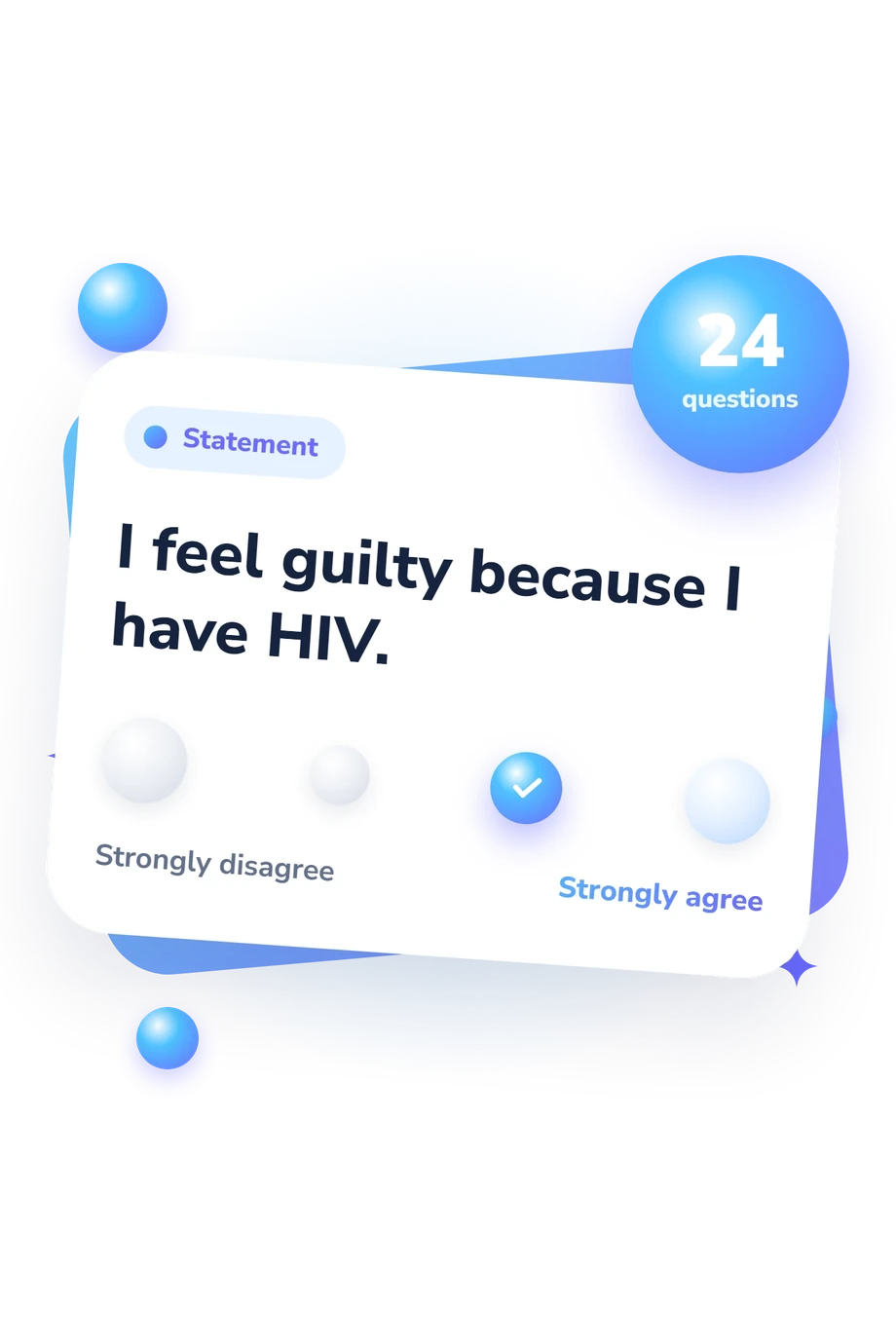
How the Scales are Structured
Who Usually Takes This Test?
See How You Compare
Below is a preview of how scores are typically distributed across each scale.
Example Questions From the Test
- Strongly disagree
- Disagree
- Agree
- Strongly agree
- Strongly disagree
- Disagree
- Agree
- Strongly agree
- Strongly disagree
- Disagree
- Agree
- Strongly agree
HIV Stigma Scale (BHSS) Test - Description and methodology of the test
For people living with HIV who want to reflect on stigma-related experiences, the HIV Stigma Scale (BHSS) Test organizes responses for structured personal reflection. Interpreting results from this HIV stigma assessment can help a respondent recognize patterns in their answers, prepare questions for further reflection, and place individual ratings in the context of current circumstances.
What This Assessment Explores
Rather than assessing medical markers, it maps emotional and social experiences around HIV stigma. Responses to this HIV stigma questionnaire show which dimension is most prominent.
The result separates these dimensions:
- Negative Self-Image (3-12) measures guilt and shame; Low 3-3.8, Moderate 3.9-8.6, and High 8.7-12 indicate increasing self-rejection or self-blame.
- Public Attitudes (3-12) measures perceived social prejudice; Low perceived stigma 3-5, Moderate perceived stigma 6-10, and High perceived stigma 11-12 indicate increasing perceived stigma.
- Disclosure Concerns (3-12) measures status concealment; Low concealment 3-5, Moderate concealment 6-10, and High concealment 11-12 indicate increasing concern about negative reactions.
- Personalized Stigma (3-12) measures anticipated judgment or discrimination; Low 3-4, Moderate 5-9, and High 10-12 indicate increasing fear of consequences.
- Overall HIV Stigma (12-48) combines these dimensions; Low 12-23, Moderate 24-35, and High 36-48 indicate greater overall perceived stigma.
Methodology and Scientific Basis
The closest methodological reference is HIV Stigma Scale-12 (Reinius et al., 2017), a published short form developed from the Berger HIV Stigma Scale. This questionnaire is conceptually consistent with that work, but its online presentation does not necessarily reproduce the research instrument's administration, norms, or validation conditions.
Each statement uses four ordered responses: Strongly disagree, Disagree, Agree, or Strongly agree. Twelve statements cover four three-item areas. It displays dimension results and an overall index; higher values may indicate stronger endorsement. Displayed bands provide descriptive categories for reading the profile.
Because this HIV stigma test relies on self-report, interpretation depends on honest reporting and current context. Current stress, fear of disclosure, social context, and limited self-awareness can influence responses. Berger, Ferrans, and Lashley (2001) introduced the original scale and evaluated its measurement properties, while Wanjala et al. (2021) summarize psychometric evidence for Berger-based versions. Together, these sources clarify the questionnaire's construct coverage, but they do not validate every online score for every population. Results are best considered alongside wider circumstances and any broader assessment relevant to the person's needs.
- Reinius, Maria, Lena Wettergren, Maria Wiklander, Veronica Svedhem, Anna Mia Ekström, and Lars E. Eriksson. Development of a 12-item short version of the HIV stigma scale. Health and Quality of Life Outcomes, 15, 115 (2017). 10.1186/s12955-017-0691-z
- Berger, Barbara E., Carol E. Ferrans, and Felissa R. Lashley. Measuring stigma in people with HIV: Psychometric assessment of the HIV stigma scale. Research in Nursing & Health, 24(6), 518-529 (2001). 10.1002/nur.10011
- Wanjala, Stanley W., Ezra K. Too, Stanley Lüchters, and Amina Abubakar. Psychometric Properties of the Berger HIV Stigma Scale: A Systematic Review. International Journal of Environmental Research and Public Health, 18(24), 13074 (2021). 10.3390/ijerph182413074
Updated: