
Love and Liking Scales Test
How the Scales are Structured
Who Usually Takes This Test?
See How You Compare
Below is a preview of how scores are typically distributed across each scale.
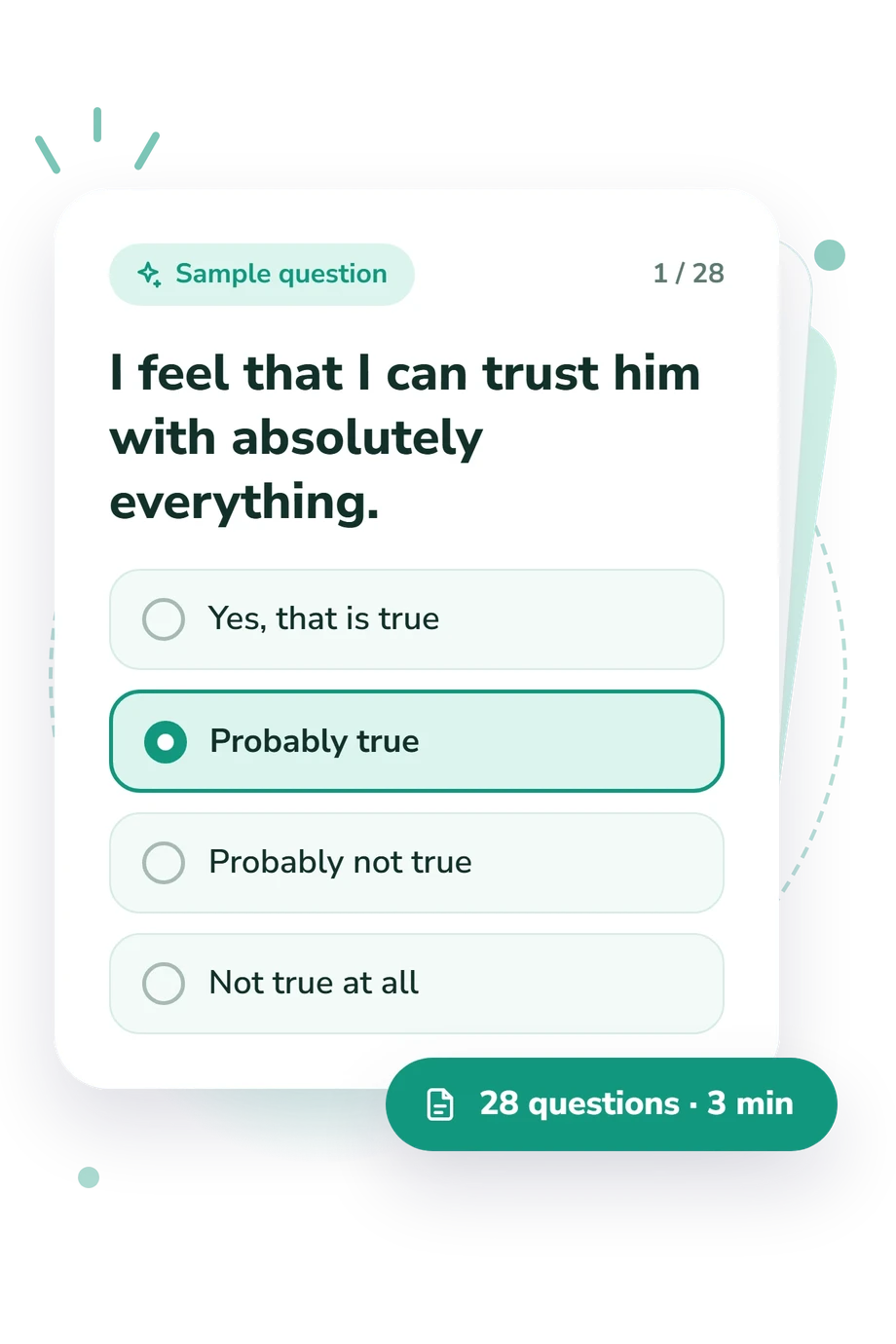
Example Questions From the Test
- Yes, this is true
- This is probably true
- This is probably not true
- This is not true at all
- Yes, that is true
- Probably true
- Probably not true
- Not at all true
- Yes, that is true
- Probably true
- Probably not true
- Not true at all
Love and Liking Scales Test - Description and methodology of the test
People considering the emotional quality of a close relationship may use the Love and Liking Scales Test to organize impressions that are difficult to name. For someone weighing whether to explore a feeling or discuss a concern, this love and liking test offers a structure for reflection without demanding an immediate conclusion. The result helps clarify what deserves further thought in the relationship.
What This Assessment Explores
People use this assessment to reflect on a particular relationship through statements about trust, shared moods, emotional disclosure, responsibility, similarity, admiration, exclusivity, and perceived reciprocity. It is intended for examining a real dyad rather than judging an abstract idea of love.
As a love and liking questionnaire, it distinguishes positive regard for someone from attachment and intimacy, then combines them into an overall picture. The displayed result has three dimensions:
- Liking Scale (7-28) measures respect, admiration, and perceived similarity: Low likeability (7-13), Moderate likeability (14-20), or High likeability (21-28).
- Love (7-28) measures attachment, care, and intimacy: Lower love intensity (7-13), Moderate love intensity (14-21), or High love intensity (22-28).
- Overall Level of Emotional Relationship (14-56) reflects the dyad's total bond: Weak connection (14-27), Moderate connection (28-42), or Strong connection (43-56).
Methodology and Evidence Base
Each statement offers four ordered choices, from clear endorsement to rejection. Although wording differs slightly, the task is to judge how accurately each statement describes the relationship and the person rated. This romantic attachment assessment uses graded self-report rather than an interview or observer rating.
Responses are converted into displayed totals, with higher totals indicating more positive regard, stronger attachment, or a stronger overall bond. The dimensions can vary: admiration and similarity may be strong when intimacy is less prominent, or attachment may exceed positive evaluation.
The named framework is Rubin Love and Liking Scales (Rubin, 1970), which distinguishes liking from love in close relationships. This questionnaire uses that conceptual distinction in an online format. Graham and Christiansen (2009) offer broader evidence about the reliability of romantic-love measures, while Hatfield, Bensman, and Rapson (2012) place passionate-love measurement in historical context.
Because responses are self-reported and can shift with mood, relationship context, and self-awareness, scores are descriptive indicators; displayed ranges are interpretive bands rather than clinical norms, and this online questionnaire is not separately standardized.
- Rubin, Z. (1970). Measurement of romantic love. Journal of Personality and Social Psychology, 16(2), 265-273. 10.1037/h0029841
- Graham, J. M., & Christiansen, K. (2009). The reliability of romantic love: A reliability generalization meta-analysis. Personal Relationships, 16(1), 49-66. 10.1111/j.1475-6811.2009.01209.x
- Hatfield, E., Bensman, L., & Rapson, R. L. (2012). A brief history of social scientists' attempts to measure passionate love. Journal of Social and Personal Relationships, 29(2), 143-164. 10.1177/0265407511431055
Updated: