
Relationship Scales Questionnaire (RSQ) Test
How the Scales are Structured
Who Usually Takes This Test?
See How You Compare
Below is a preview of how scores are typically distributed across each scale.
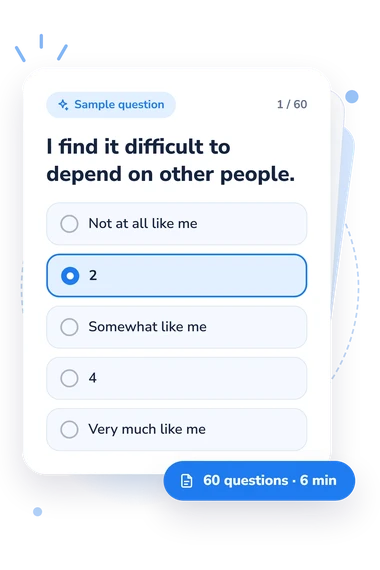
Example Questions From the Test
- Not at all like me
- 2
- Somewhat like me
- 4
- Very much like me
- Not at all like me
- 2
- Somewhat like me
- 4
- Very much like me
- Not at all like me
- 2
- Somewhat like me
- 4
- Very much like me
Relationship Scales Questionnaire (RSQ) Test - Description and methodology of the test
People who want to understand how they handle closeness, independence, trust, and reassurance can use the Relationship Scales Questionnaire (RSQ) Test as a structured self-reflection exercise. An attachment questionnaire about close relationships can give language to expectations about the self and other people, helping readers consider recurring interpersonal tendencies without reducing their relationships to a single label.
What This Assessment Explores
Assessment examines closeness, dependence, trust, autonomy, abandonment, and expected support. This relationship attachment assessment identifies patterns, not labels.
The displayed dimensions are:
- Fearful (1-5) reflects low self-worth, distrust, and expected negative attitudes; Low 1-2.4, Moderate 2.5-3.6, High 3.7-5.
- Avoidant (1-5) reflects a positive view of self, a negative view of others, and independence through avoiding closeness; Low avoidant 1-2.3, Moderate avoidant 2.4-3.6, High avoidant 3.7-5.
- Anxious (1-5) reflects low self-worth, doubt about being lovable, positive views of others, and seeking approval; Low 1-2.3, Moderate 2.4-3.6, High 3.7-5.
- Secure (1-5) reflects self-worth and the expectation that people are kind and responsive; Lower security 1-2.4, Moderate 2.5-3.6, Higher security 3.7-5.
Methodology and Scientific Basis
Each statement uses a five-point self-description scale: 1 and 5 mark its endpoints, while 3 means Somewhat like me. Items address dependence, intimacy, abandonment, partner availability, and independence. Ratings are combined into four displayed scale scores; the displayed bands apply separately to each scale, not a single overall score.
The pattern of this attachment style test is conceptually consistent with the Relationship Scales Questionnaire (Griffin & Bartholomew, 1994) and the four-category model tested by Bartholomew and Horowitz (1991). That framework organizes adult attachment through views of self and others. This online questionnaire uses a different administration format, and its evidence base is distinct from the original instrument's.
Scharfe and Bartholomew (1994) examined how consistently adult attachment patterns held over time, but that work does not directly validate this online questionnaire. The version presented here has no stated independent norming or standardization. Results can vary with current relationship circumstances, interpretation of wording, self-awareness, and willingness to answer candidly, so read them as a reflective snapshot rather than a diagnosis.
- Dale W. Griffin and Kim Bartholomew (1994). Models of the self and other: Fundamental dimensions underlying measures of adult attachment. Journal of Personality and Social Psychology, 67(3), 430-445. 10.1037/0022-3514.67.3.430
- Kim Bartholomew and Leonard M. Horowitz (1991). Attachment styles among young adults: A test of a four-category model. Journal of Personality and Social Psychology, 61(2), 226-244. 10.1037/0022-3514.61.2.226
- Elaine Scharfe and Kim Bartholomew (1994). Reliability and stability of adult attachment patterns. Personal Relationships, 1(1), 23-43. 10.1111/j.1475-6811.1994.tb00053.x