
Ethnonational Attitudes Scale Test
How the Scales are Structured
Who Usually Takes This Test?
See How You Compare
Below is a preview of how scores are typically distributed across each scale.
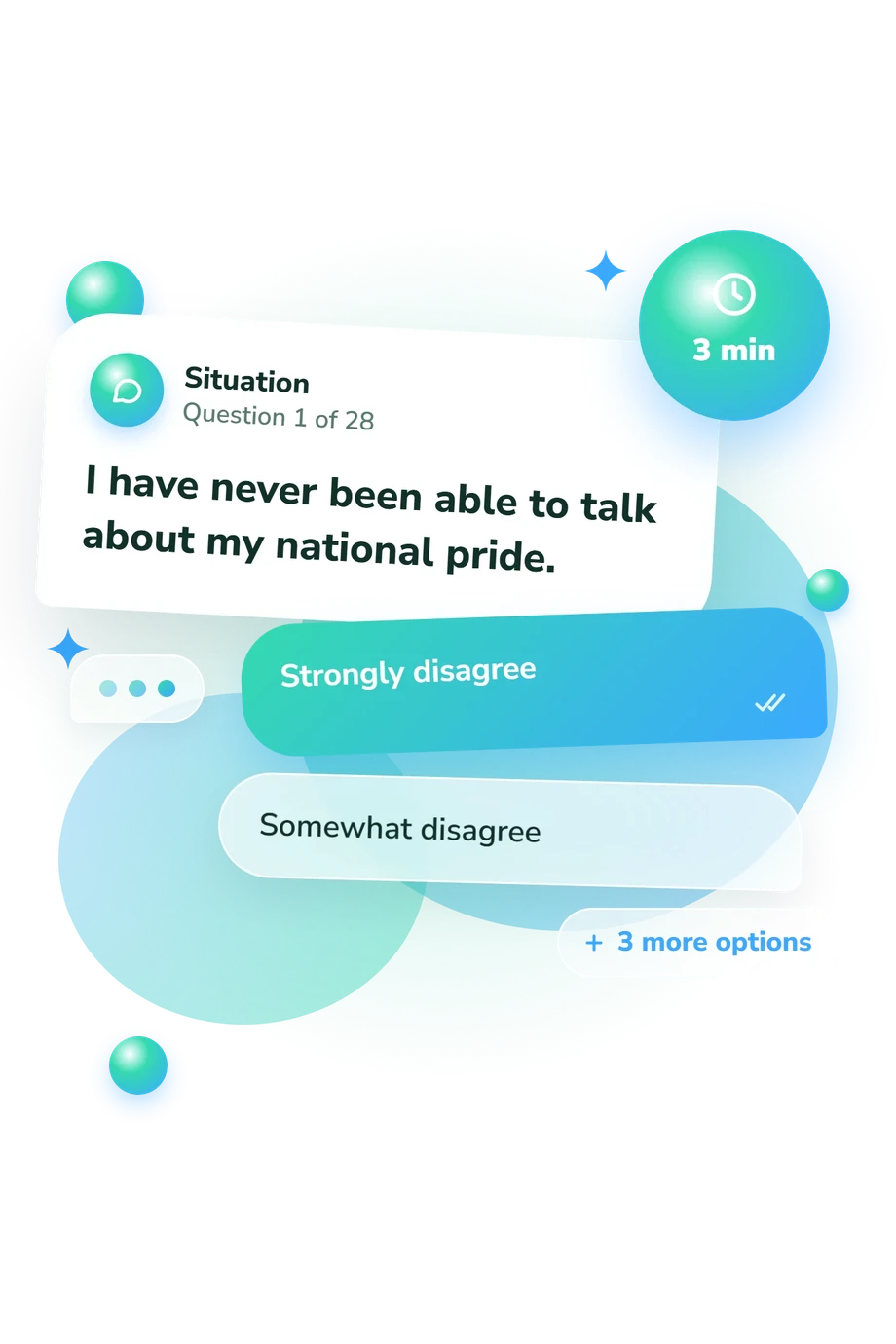
Example Questions From the Test
- Strongly disagree
- Somewhat disagree
- Neither agree nor disagree
- Somewhat agree
- Strongly agree
- Strongly disagree
- Rather disagree
- Neither agree nor disagree
- Rather agree
- Strongly agree
- Strongly disagree
- Somewhat disagree
- Neither agree nor disagree
- Somewhat agree
- Strongly agree
Ethnonational Attitudes Scale Test - Description and methodology of the test
People who want to examine how national identity shapes feelings about belonging, difference, and other groups may find the Ethnonational Attitudes Scale Test useful. It is designed for personal reflection rather than for assigning a single identity label. An ethnonational attitudes assessment helps readers consider whether their responses lean toward pride, indifference, rejection of national affiliation, or hostility toward other nationalities.
What This Assessment Explores
The questionnaire explores whether nationality feels meaningful, positive, irrelevant, or linked with negative judgments about other groups. It helps readers consider belonging, social boundaries, and reactions to people from other nationalities. The profile separates tendencies that may coexist instead of reducing the result to one label, so the questionnaire about ethnonational attitudes can show mixed patterns.
The result profile contains these dimensions:
- Negativistic Ethnonational Attitudes (1-5) measures rejection of national affiliation: Low rejection (1-2.3), Moderate rejection (2.4-3.6), High rejection (3.7-5).
- Neutral Ethnonational Attitudes (1-5) measures indifference to affiliation: Concerned (1-2.4), Somewhat neutral (2.5-3.4), Indifferent (3.5-5).
- Patriotic Attitudes (1-5) reflects pride and connection with one’s nationality: Low (1-2.3), Moderate (2.4-3.6), High (3.7-5).
- Nationalistic Attitudes (1-5) measures hostility toward other nationalities: Low (1-2.3), Moderate (2.4-3.6), High (3.7-5).
Methodology and Evidence Base
The statements use a five-point agreement format, from strong disagreement to strong agreement. This captures degrees of endorsement rather than a yes-or-no choice. Items address pride, belonging, the importance of nationality, indifference, rejection of national divisions, and hostile generalizations.
Responses are grouped into four dimensions and presented as a separate profile rather than one overall score, allowing the test of ethnonational attitudes to show where tendencies diverge. The bands describe the direction and strength of each tendency, not universal clinical cutoffs.
Its conceptual reference is the Ethno-National Attitudes Scale developed by Khukhlaev and colleagues. This online questionnaire is conceptually consistent with that instrument, not necessarily identical in wording, administration, or validation sample. Related studies by Khukhlaev and colleagues and by Novikova and colleagues provide evidence on ethnic attitudes, social identity, and intercultural competence, but do not establish norms for this version.
Interpretation remains descriptive. Self-report results may shift with current experiences, self-awareness, cultural context, and pressure to appear socially acceptable. The profile is most useful for examining specific beliefs and reactions, especially when pride in one’s group coexists with indifference or negative views of outsiders.
- Khukhlaev, O.E., Kuznetsov, I.M., Tkachenko, N.V. Development and Adaptation of the Ethno-National Attitudes Scale. Psychology. Journal of the Higher School of Economics, 2018, 15(3), 527-541. 10.17323/1813-8918-2018-3-527-541
- Khukhlaev, O.E., Minazova, V.M., Pavlova, O.S., Zykov, E.V. Social Identity and Ethnic Attitudes in Students from Chechnya. Social Psychology and Society, 2015, 6(4), 23-40. 10.17759/sps.2015060403
- Novikova, I.A., Gridunova, M.V., Novikov, A.L., Shlyakhta, D.A. Ethno-National Attitudes as Intercultural Competence Predictors in University Students: Gender Differences. Behavioral Sciences, 2020, 10(2), 56. 10.3390/bs10020056
Updated: