
Sub-Organizational Identity Questionnaire Test
How the Scales are Structured
Who Usually Takes This Test?
See How You Compare
Below is a preview of how scores are typically distributed across each scale.
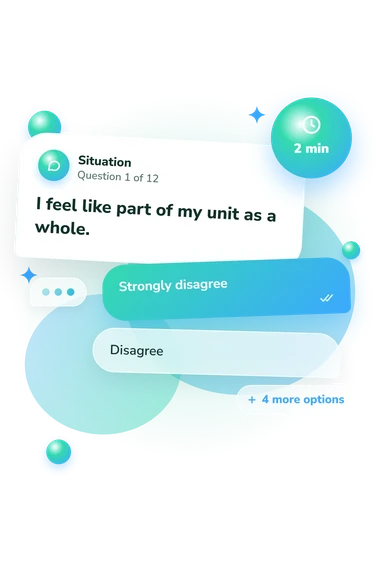
Example Questions From the Test
- Completely disagree
- Disagree
- Somewhat disagree
- Somewhat agree
- Agree
- Completely agree
- Completely disagree
- Disagree
- Somewhat disagree
- Somewhat agree
- Agree
- Completely agree
- Strongly disagree
- Disagree
- Somewhat disagree
- Somewhat agree
- Agree
- Strongly agree
Sub-Organizational Identity Questionnaire Test - Description and methodology of the test
Employees who want to understand their relationship with a particular department, team, or organizational unit can use the Sub-Organizational Identity Questionnaire Test to examine whether that connection feels meaningful and personally relevant. It is especially useful when you are reflecting on belonging, shared outcomes, satisfaction with local norms, or the prospect of leaving, and want a focused work unit identity assessment rather than a broad job review.
What This Assessment Explores
Two dimensions describe work-unit identification. As a sub-organizational identity questionnaire, it links belonging and involvement with perceived fit, shared outcomes, and current character. Its statements ask whether you feel part of it, care what happens, feel satisfied with its rules and relationships, share successes or failures, enjoy working there, and regret leaving.
The result separates these dimensions:
- Affective Component (3-18) measures positivity, felt connection, and personal congruence with the unit, including personal experience of events involving it. Bands: Low 3-9; Moderate 10-16; High 17-18.
- Cognitive Component (3-18) measures belonging and integrative connection with the unit, plus how you perceive yourself or it in its current form. Bands: Low 3-8; Moderate 9-15; High 16-18.
A higher band indicates a stronger expression of that component in your answers, not a cause or explanation for it.
Methodology and Scientific Basis
Six statements use ordered response choices that move from disagreement to agreement, asking you to locate your current view of the unit along that continuum. The questionnaire reports separate component results, interpreted through their displayed result bands rather than as a single overall score. The result is a profile of identification, not a single verdict.
The questionnaire is conceptually consistent with the Organizational and Sub-Organizational Identification Questionnaire described by Sidorenkov et al. (2019) and with Ashforth and Mael’s social-identity framework. Sidorenkov, Borokhovski, and Stroh’s 2022 study considers multiple identification foci, while Ashforth and Mael’s social identity theory describes identification as perceived oneness with a group. Published studies do not by themselves validate this online questionnaire or establish how its displayed component results are calculated.
For an organizational identification assessment, the result is a current self-report snapshot. Scores can shift with team events, personal expectations, self-awareness, and the wish to describe one’s workplace favorably, so interpret the profile in light of the circumstances behind each answer.
- Sidorenkov, A. V., Shipitko, O. Yu., Shtilnikov, D. E., & Stroh, W. (2019). Development of tools for the study of employee identity in the organization (in Russian). Organizational Psychology, 9(3), 74-102.
- Sidorenkov, A. V., Borokhovski, E. F., & Stroh, W. A. (2022). Multiple Identifications of Employees in an Organization: Salience and Relationships of Foci and Dimensions. Behavioral Sciences, 12(6), 182. 10.3390/bs12060182
- Ashforth, B. E., & Mael, F. (1989). Social Identity Theory and the Organization. Academy of Management Review, 14(1), 20-39. 10.5465/AMR.1989.4278999