
Cognitive Representations of Illness Questionnaire Test
How the Scales are Structured
Who Usually Takes This Test?
See How You Compare
Below is a preview of how scores are typically distributed across each scale.
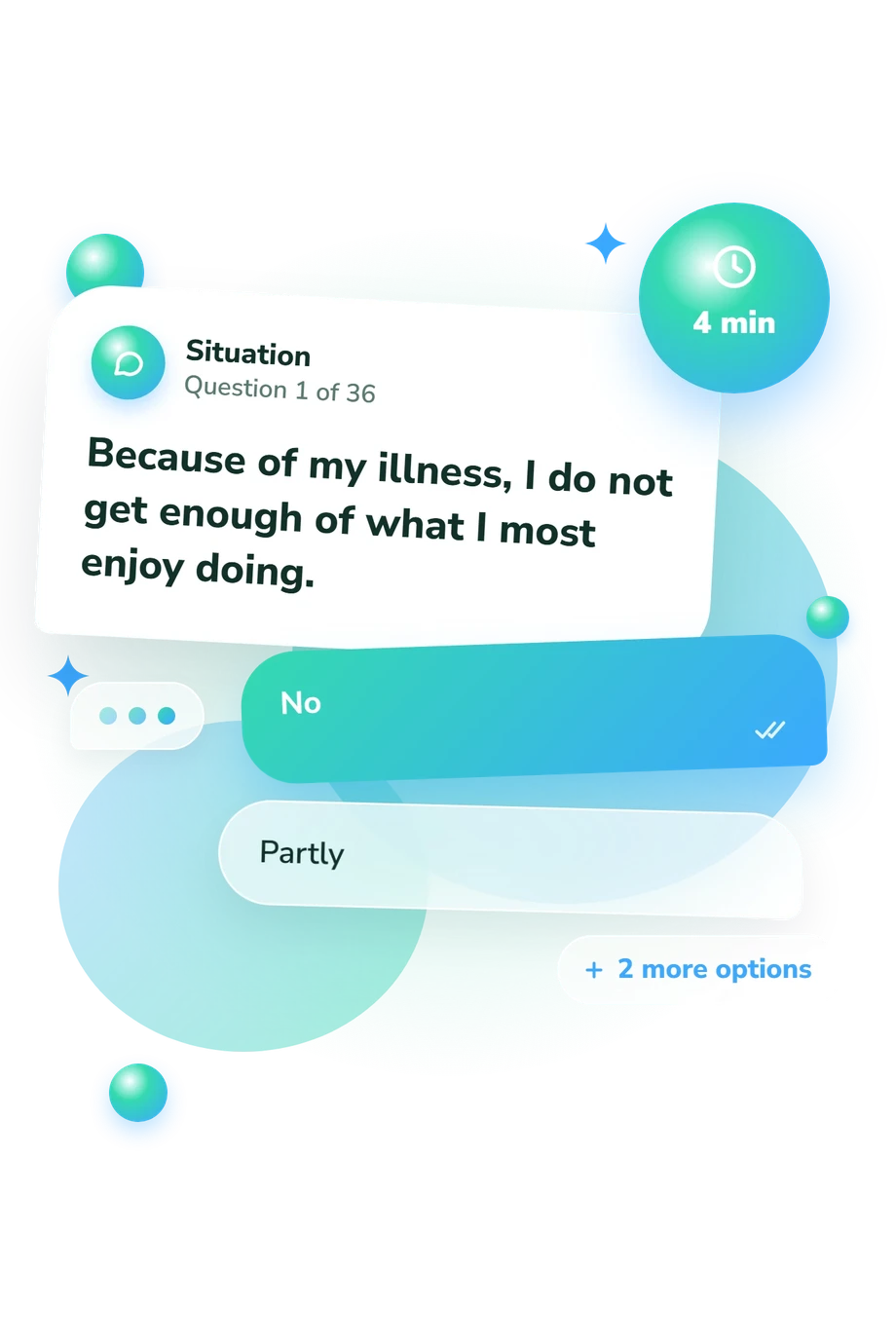
Example Questions From the Test
- No
- Partly
- To a great extent
- Completely agree
- No
- Partly
- To a large extent
- Completely agree
- No
- Partly
- To a great extent
- Completely agree
Cognitive Representations of Illness Questionnaire Test - Description and methodology of the test
People living with illness may want to examine how they understand limits, change, and demands without reducing that experience to symptoms alone. The Cognitive Representations of Illness Questionnaire Test focuses on the meanings attached to illness and how they relate to coping. This emphasis keeps attention on illness-related meaning. As an illness coping assessment, it describes patterns of illness interpretation.
What This Assessment Explores
The items examine how illness is understood through control, loss, change, and adaptation. They ask about limits, helplessness, managing problems, accepting restrictions, and noticing growth or renewed priorities. This illness representation questionnaire presents the result as a profile of coping-related meanings rather than a single judgment.
The three displayed scales are:
- Helplessness (6-24) shows a negative, uncontrollable, and unchangeable view of illness, with weaker psychosocial adjustment; Low helplessness 6-11, Moderate helplessness 12-17, High helplessness 18-24.
- Perceived Benefits (6-24) shows positive reappraisal and recognition of growth; Limited benefit-finding 6-11, Some benefit-finding 12-17, Strong benefit-finding 18-24.
- Illness Acceptance (6-24) shows accepting illness and adapting while reducing its negative impact; Low acceptance 6-12, Moderate acceptance 13-18, High acceptance 19-24.
Together, the profile shows which meanings are more prominent.
Methodology and Scientific Basis
Each statement uses a four-step response format, moving from No and Partly to stronger agreement. The wording varies slightly between to a great extent and to a large extent, but the task is consistent: choose the response that best matches your experience. The result is reported on the three displayed scales, with the listed ranges and bands describing each dimension.
The 18 items and three dimensions closely correspond to the Illness Cognition Questionnaire, a published instrument associated with Evers and colleagues. Later cross-sample work by Lauwerier and colleagues examined its structure in chronic pain and chronic fatigue samples. The approach also fits Leventhal, Meyer, and Nerenz’s common-sense model, in which illness representations shape coping and adjustment. Related Russian-language work by Sirota and Moskovchenko provides additional psychodiagnostic context.
This online test of cognitive representations of illness closely corresponds to the Illness Cognition Questionnaire; the relationship should be described as correspondence rather than assumed translation or adaptation. The displayed bands are descriptive labels for the three results, and current symptoms, circumstances, and self-perception can influence self-report.
- Evers, A. W. M., Kraaimaat, F. W., van Lankveld, W., Jongen, P. J. H., Jacobs, J. W. G., & Bijlsma, J. W. J. (2001). Beyond unfavorable thinking: The illness cognition questionnaire for chronic diseases. Journal of Consulting and Clinical Psychology, 69(6), 1026-1036. 10.1037/0022-006X.69.6.1026
- Lauwerier, E., Crombez, G., Van Damme, S., Goubert, L., Vogelaers, D., & Evers, A. (2010). The construct validity of the illness cognition questionnaire: The robustness of the three-factor structure across patients with chronic pain and chronic fatigue. International Journal of Behavioral Medicine, 17(2), 90-96. 10.1007/s12529-009-9059-z
- Sirota, N. A., & Moskovchenko, D. V. (2014). Psychodiagnostics of cognitive representations of illness. National Psychological Journal, 2014(2), 72-81. 10.11621/npj.2014.0209
- Leventhal, H., Meyer, D., & Nerenz, D. (1980). The common sense representation of illness danger. In S. Rachman (Ed.), Contributions to Medical Psychology (Vol. 2, pp. 7-30). Pergamon Press.
Updated: