
Pre-Start States Questionnaire Test
How the Scales are Structured
Who Usually Takes This Test?
See How You Compare
Below is a preview of how scores are typically distributed across each scale.
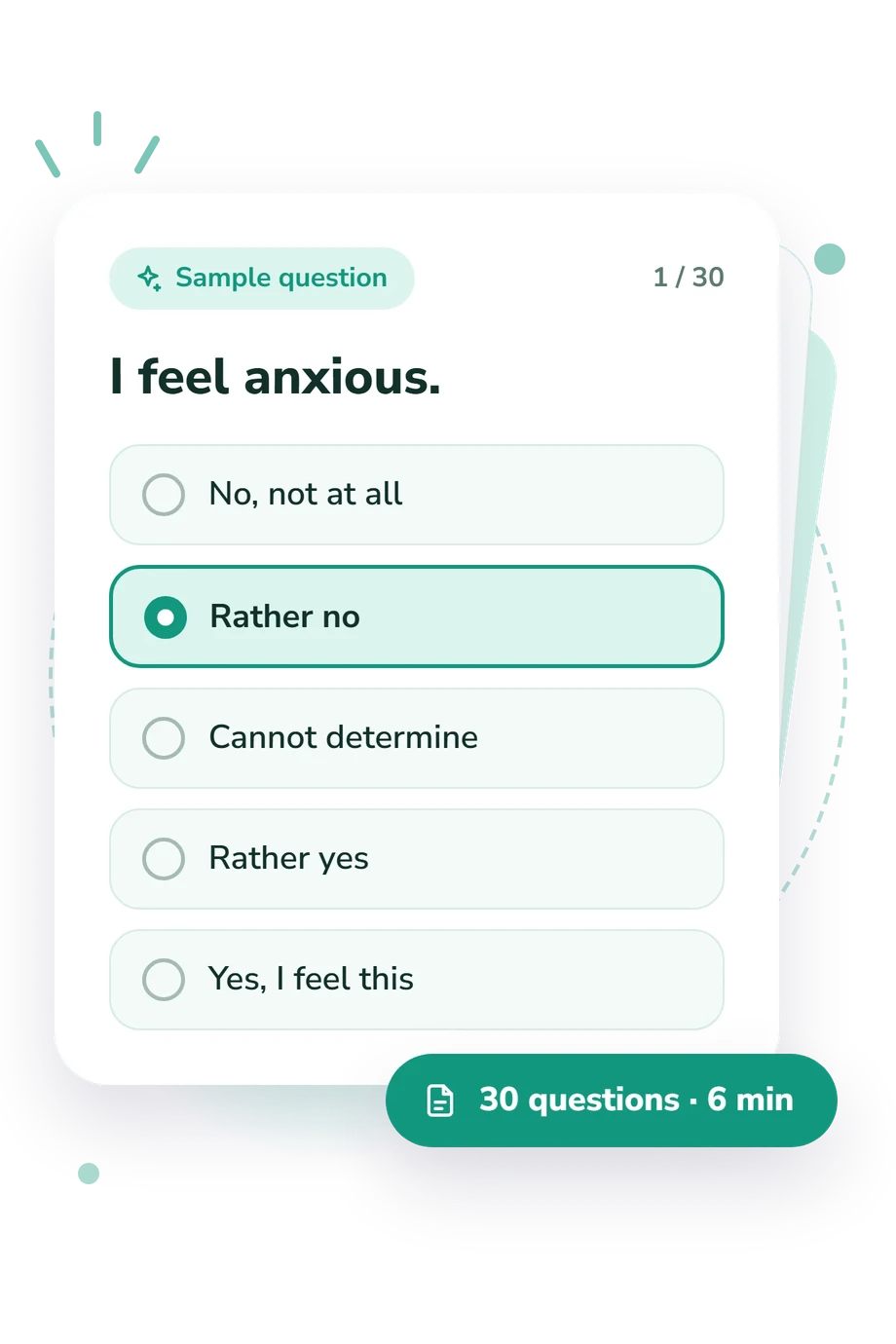
Example Questions From the Test
- No, not at all
- Rather no
- Cannot determine
- Rather yes
- Yes, I feel this
- No, not at all
- Rather no
- Cannot say
- Rather yes
- Yes, I feel this
- No, not at all
- Rather no
- Cannot say
- Rather yes
- Yes, I feel this
Pre-Start States Questionnaire Test - Description and methodology of the test
Competitors preparing for training or competition can use this questionnaire to examine their current profile and notice what may help or hinder focus before action. The Pre-Start States Questionnaire Test is useful when you want a snapshot of how you are approaching the next session or event, rather than a judgment about skill. An athlete readiness profile can guide self-observation and show what to monitor before practice or competition.
What This Assessment Explores
Items cover emotional and bodily experiences. Anxiety, fatigue, alertness, and energy indicate activation. The pre-start questionnaire distinguishes under-activated, balanced, and high-tension states. Four dimensions organize the profile:
- Emotional Stability (8-40) measures relaxation or insufficient engagement versus stress and high motivation: Calm / under-activated 8-18, Balanced activation 19-29, High tension / arousal 30-40.
- Physical Readiness (7-35) measures low energy or motivation versus optimal readiness and self-regulation: Low readiness 7-17, Moderate readiness 18-26, High readiness 27-35.
- Emotional Stability Scale (8-40) measures complacency or underestimation versus pre-start fever, anxiety, and arousal: Low activation 8-18, Balanced 19-29, High anxiety 30-40.
- Physiological Readiness (7-35) contrasts apathy, low muscle tone, and avoidance motivation to prevent failure with confidence, optimal muscle tone, and achievement motivation: Low readiness 7-16, Moderate readiness 17-25, High readiness 26-35.
Methodology and Scientific Basis
Each item has five ordered responses, from no endorsement through an uncertain middle choice to clear endorsement. Anxiety and disorganization represent uncomfortable activation, while alertness, interest, and determination represent performance-oriented activation. Four scores combine responses; ranges show possible totals, but the questionnaire does not specify answer weighting. For pre-training readiness or competition preparation, bands show its result categories.
Puni (1949) connects pre-start condition with emotional activation, bodily readiness, and motivation for action. His later work develops this framework. Ryba, Stambulova, and Wrisberg (2005) place it within Russian sport psychology; Martens, Vealey, and Burton (1990) relate competitive anxiety to performance arousal. The online questionnaire is conceptually consistent with Puni's work, not a translation or adaptation of his publication.
Displayed bands are descriptive categories used for this questionnaire; they do not by themselves establish percentiles, clinical thresholds, or population comparisons. Sleep, fatigue, injury, event importance, confidence, and honest self-report can shift the profile. Repeated results are more useful for tracking personal patterns than treating one score as a fixed trait.
- Avksenty Cezarevich Puni (1949). To the Psychological Characteristics of the Athlete's Pre-Start Condition. Theory and Practice of Physical Culture, no. 7, pp. 519-526.
- Avksenty Cezarevich Puni (1969). Psychological Preparation for Competition in Sport. Moscow: Physical Culture and Sport.
- Tatiana V. Ryba, Natalia B. Stambulova, and Craig A. Wrisberg (2005). The Russian Origins of Sport Psychology: A Translation of an Early Work of A. C. Puni. Journal of Applied Sport Psychology, 17(2), 157-169. 10.1080/10413200590932461.
- Rainer Martens, Robin S. Vealey, and Damon Burton (1990). Competitive Anxiety in Sport. Champaign, IL: Human Kinetics. ISBN 0-87322-264-4.
Updated: