
Trait Emotional Intelligence Questionnaire–Adolescent Short Form (TEIQue-ASF) Test
How the Scales are Structured
Who Usually Takes This Test?
See How You Compare
Below is a preview of how scores are typically distributed across each scale.
Example Questions From the Test
- Strongly disagree
- Disagree
- Mostly disagree
- Not sure
- Mostly agree
- Agree
- Strongly agree
- Strongly disagree
- Disagree
- Tend to disagree
- Not sure
- Tend to agree
- Agree
- Strongly agree
- Strongly disagree
- Disagree
- Somewhat disagree
- Not sure
- Somewhat agree
- Agree
- Strongly agree
Trait Emotional Intelligence Questionnaire–Adolescent Short Form (TEIQue-ASF) Test - Description and methodology of the test
People who want to examine how they understand feelings, manage reactions, and relate to others can use the Trait Emotional Intelligence Questionnaire-Adolescent Short Form (TEIQue-ASF) Test as a structured self-reflection exercise. This emotional intelligence questionnaire for adolescents focuses on everyday experiences rather than abstract reasoning. The result offers a profile of emotional regulation, outlook, and interpersonal functioning, helping readers identify patterns they may want to explore further.
What This Assessment Explores
The questionnaire covers emotional awareness, reaction control, adaptability, confidence, social understanding, relationships, motivation, and life satisfaction. Its statements describe coping with stress, expressing care, reading another person’s perspective, standing up for oneself, handling change, and maintaining hope. As a trait emotional intelligence test, it captures perceived tendencies rather than ability performance.
The displayed result organizes these themes into three scales:
- Emotion and Behavior Regulation (12-84) shows control of emotions and behavior and coping with difficulties; Needs support (12-35), Developing (36-60), and Strong (61-84) are the displayed bands.
- Positive Outlook on Life (12-84) reflects optimism, well-being, and maintaining a good mood during difficulty; Low (12-35), Moderate (36-60), and High (61-84) are the displayed bands.
- Global Emotional Intelligence (30-210) reflects recognizing, understanding, and managing emotions while relating effectively; Developing (30-89), Moderate (90-149), and High (150-210) are the displayed bands.
Methodology and Scientific Basis
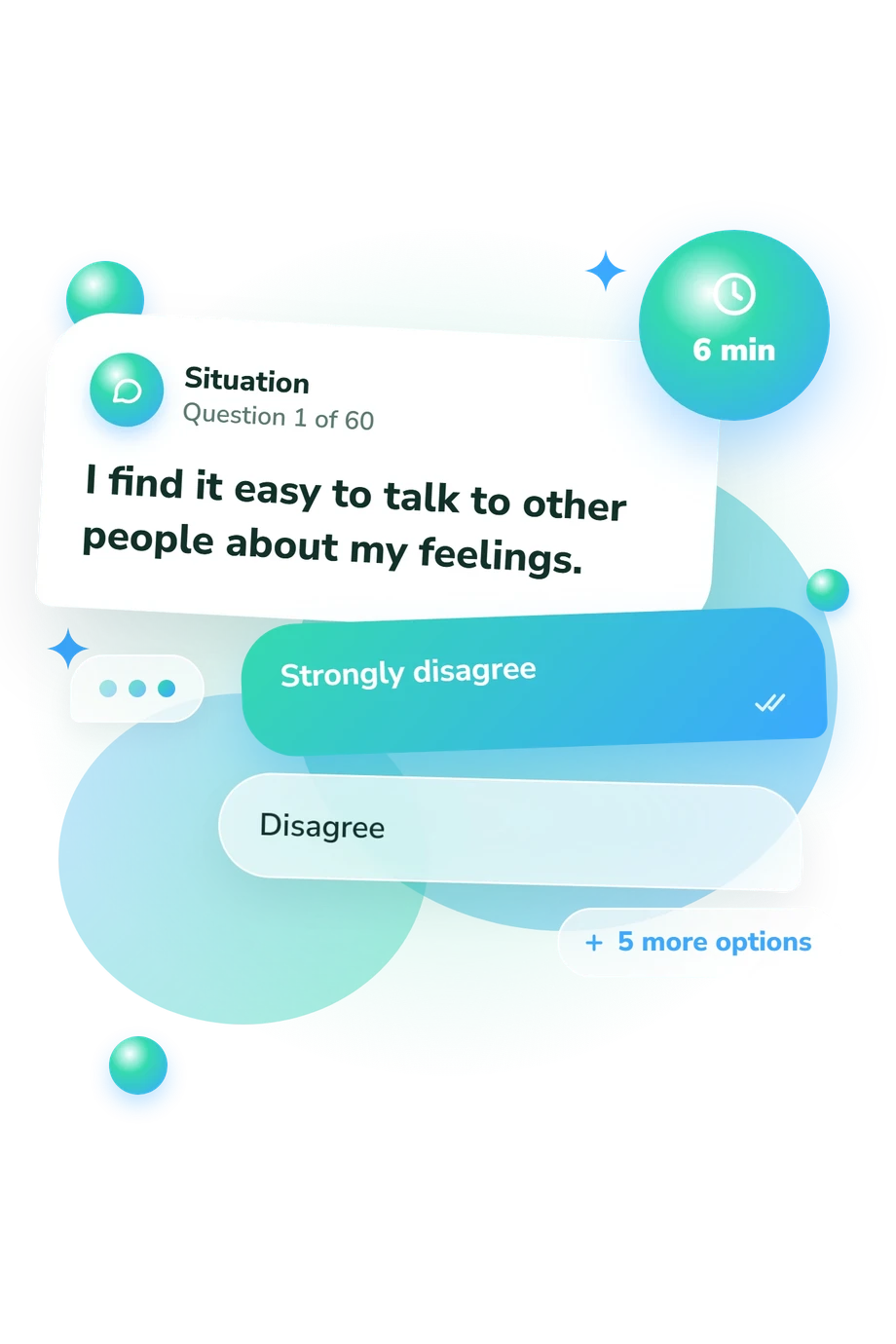
Each item is a self-report statement answered on a seven-point agreement scale, from Strongly disagree to Strongly agree. Because the wording covers strengths and difficulties, answer for your usual experience rather than an exceptional day. Results use the displayed scales; the response labels alone do not show how many points each answer contributes.
The questionnaire is conceptually consistent with TEIQue-ASF (Stamatopoulou et al., 2018), while Petrides’ TEIQue framework treats emotional self-perceptions and dispositions as personality-related characteristics. Petrides, Sangareau, Furnham, and Frederickson (2006) linked related emotional dispositions with peer relations at school, explaining the attention to empathy, communication, and getting along. The online questionnaire uses this trait-based perspective as a self-report profile, not a score obtained under the published validation study’s procedures.
This emotional self-regulation questionnaire yields a profile of current self-perception. The published adolescent form has psychometric evidence from its studied context, but online scores should not be assumed to have norms across languages, ages, or settings. Present circumstances and response bias affect self-report, making scores useful for reflection rather than judgments about personality or functioning.
- Stamatopoulou, M., Galanis, P., Tzavella, F., Petrides, K. V., & Prezerakos, P. (2018). Trait Emotional Intelligence Questionnaire-Adolescent Short Form: A Psychometric Investigation in Greek Context. Journal of Psychoeducational Assessment, 36(5), 436-445. 10.1177/0734282916687706
- Petrides, K. V., Sangareau, Y., Furnham, A., & Frederickson, N. (2006). Trait Emotional Intelligence and Children's Peer Relations at School. Social Development, 15(3), 537-547. 10.1111/j.1467-9507.2006.00355.x
- Petrides, K. V. (2009). Psychometric Properties of the Trait Emotional Intelligence Questionnaire (TEIQue). In C. Stough, D. H. Saklofske, & J. D. A. Parker (Eds.), Advances in the Assessment of Emotional Intelligence (pp. 85-101). Springer, New York. 10.1007/978-0-387-88370-0_5
Updated: