
Displaced Aggression Questionnaire (DAQ) Test
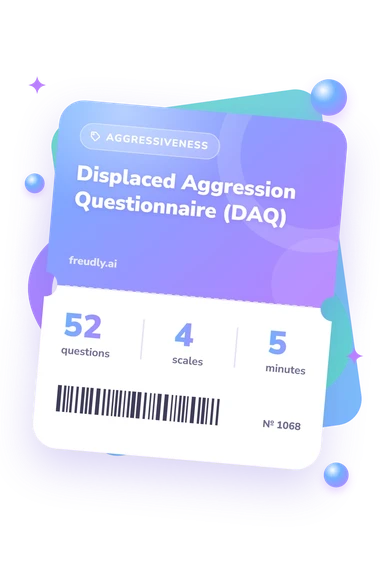
How the Scales are Structured
Who Usually Takes This Test?
See How You Compare
Below is a preview of how scores are typically distributed across each scale.
Example Questions From the Test
- Strongly disagree
- Disagree
- Somewhat disagree
- Neither agree nor disagree
- Somewhat agree
- Agree
- Strongly agree
- Strongly disagree
- Disagree
- Somewhat disagree
- Cannot decide
- Somewhat agree
- Agree
- Strongly agree
- Strongly disagree
- Disagree
- Somewhat disagree
- Neither agree nor disagree
- Somewhat agree
- Agree
- Strongly agree
Displaced Aggression Questionnaire (DAQ) Test - Description and methodology of the test
People who want to understand how provocation affects their thoughts, feelings, and behavior can use the Displaced Aggression Questionnaire (DAQ) Test as a structured self-reflection exercise. A displaced aggression test can be useful when anger seems to spill into unrelated interactions. The resulting profile helps readers consider whether their reactions in these situations deserve closer attention.
What This Assessment Explores
This questionnaire examines reactions, including directing aggressive behavior toward uninvolved people who were not the source of provocation, replaying frustrating events, imagining retaliation, and remaining focused on perceived wrongdoing. It is intended for people who want to reflect on these patterns in ordinary life; the profile describes tendencies rather than a permanent identity. As an anger rumination questionnaire, it distinguishes mental persistence from redirected behavior and revenge-oriented thinking. The reported dimensions are:
- Displaced Aggression (10-70) measures the tendency to direct aggressive behavior toward uninvolved people after provocation: Low 10-15; Moderate 16-38; High 39-70.
- Revenge Planning (6-42) measures resentment and retaliation plans: Low 6-14; Moderate 15-21; High 22-42.
- Anger Rumination (10-70) measures prolonged anger focus and regulation difficulty: Low 10-31; Moderate 32-58; High 59-70.
- Total Score (26-182) summarizes affective, cognitive, and behavioral displaced aggression: Low 26-56; Moderate 57-109; High 110-182.
Methodology and Evidence Base
Each statement uses a seven-point scale from Strongly disagree to Strongly agree, with a neutral midpoint. Items cover recurring thoughts, revenge fantasies, and taking frustration out on others. Because this anger response assessment relies on self-report, answers reflect reactions rather than observed behavior; current mood, memory, insight, and willingness to acknowledge aggression may affect them.
Responses form subscale and total scores; higher values indicate stronger tendencies. The closest published instrument is the Displaced Aggression Questionnaire, developed by Denson and colleagues, which separates displaced behavior, revenge-related thinking, and anger rumination. The evidence concerns that instrument: this online questionnaire is conceptually consistent with it, but its scoring has not been standardised against population norms.
Its themes are conceptually consistent with Miller and colleagues’ triggered displaced-aggression model, linking provocation, lingering anger, and blocked retaliation with aggression toward another target. They also align with Bushman and colleagues’ findings that rumination can intensify triggered displaced aggression, although these studies do not establish this online version’s personal cutoffs or predict individual conduct.
Displayed Low, Moderate, and High bands are catalogue categories, not clinical or individual predictions.
- Denson, Thomas F., William C. Pedersen, and Norman Miller. (2006). The Displaced Aggression Questionnaire. Journal of Personality and Social Psychology, 90(6), 1032-1051. 10.1037/0022-3514.90.6.1032
- Bushman, Brad J., Angelica M. Bonacci, William C. Pedersen, Eduardo A. Vasquez, and Norman Miller. (2005). Chewing on It Can Chew You Up: Effects of Rumination on Triggered Displaced Aggression. Journal of Personality and Social Psychology, 88(6), 969-983. 10.1037/0022-3514.88.6.969
- Miller, Norman, William C. Pedersen, Mitchell Earleywine, and Vicki E. Pollock. (2003). A Theoretical Model of Triggered Displaced Aggression. Personality and Social Psychology Review, 7(1), 57-97. 10.1207/S15327957PSPR0701_5