
Organizational Commitment Questionnaire (OCQ) Test
How the Scales are Structured
Who Usually Takes This Test?
See How You Compare
Below is a preview of how scores are typically distributed across each scale.
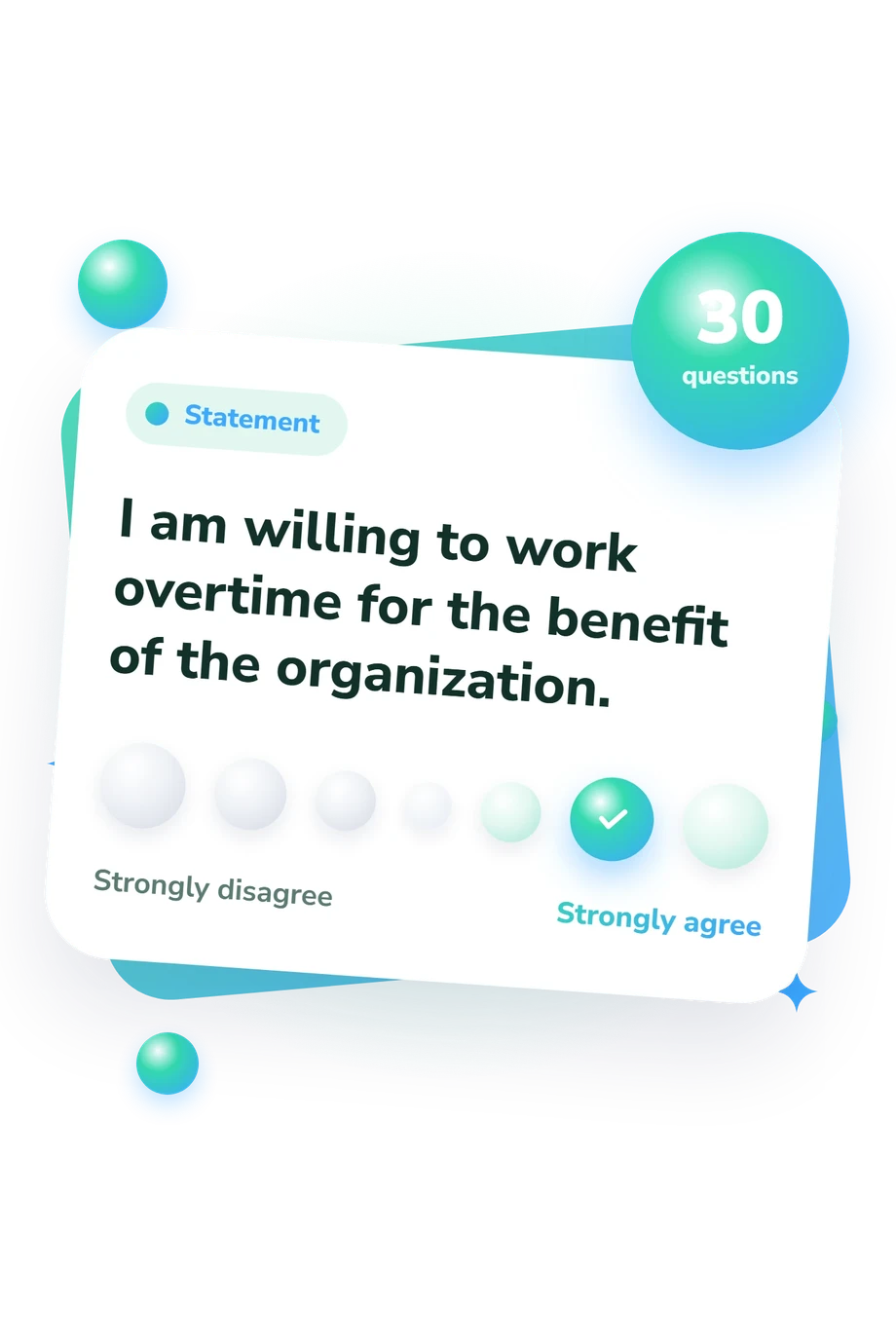
Example Questions From the Test
- Strongly disagree
- Disagree
- Somewhat disagree
- Neither agree nor disagree
- Somewhat agree
- Agree
- Strongly agree
- Strongly disagree
- Disagree
- Somewhat disagree
- Neither agree nor disagree
- Somewhat agree
- Agree
- Strongly agree
- Strongly disagree
- Disagree
- Somewhat disagree
- Neither agree nor disagree
- Somewhat agree
- Agree
- Strongly agree
Organizational Commitment Questionnaire (OCQ) Test - Description and methodology of the test
Employees who want to reflect on their relationship with a workplace can use this assessment to examine attachment, identification, and willingness to support the organization. The Organizational Commitment Questionnaire (OCQ) Test offers a structured view of those attitudes rather than a verdict about job performance. This employee commitment questionnaire can help clarify whether alignment, contribution, and a wish to remain currently describe the respondent’s experience.
What This Assessment Explores
The questions examine value alignment, pride in belonging, concern for the organization’s future, and willingness to invest effort. Other items introduce policy disagreement, replaceability, pay sensitivity, regret, and thoughts of leaving. The result concerns identification and loyalty, not productivity alone.
The result is reported as Organizational Commitment, on a 1-7 scale: Low loyalty (1-3.5), Moderate loyalty (3.6-5.4), or High loyalty (5.5-7). Higher results indicate stronger identification and support; lower results may reflect reduced engagement or openness to leaving. This organizational commitment assessment summarizes the respondent’s current work relationship.
The question themes can be understood through three practical dimensions:
- Shared values and pride show whether belonging feels meaningful and aligned.
- Effort and support indicate readiness to contribute beyond the minimum.
- Retention and alternatives capture attachment, replaceability, and willingness to remain.
Methodology and Scientific Basis
Each statement uses a seven-point agreement response, from Strongly disagree to Strongly agree, with a neutral midpoint. The items cover involvement and detachment, so respondents should answer from current experience rather than an idealized employee role. The wording addresses attitudes and intentions, not objective attendance, performance, or turnover.
This online questionnaire is conceptually consistent with the published Organizational Commitment Questionnaire (OCQ), whose items address identification with organizational values, willingness to exert effort, and desire to remain a member.
The displayed result summarizes the response pattern. The questionnaire reports a single banded score, but no item-level weighting, reverse-scoring rule, norms, or standardization status is stated; the bands therefore describe this questionnaire’s reporting scheme rather than universal employment cutoffs. Because this is an organizational commitment survey, results are sensitive to honest self-report, self-awareness, workplace events, and the respondent’s current relationship with the employer. Use the profile to identify themes for reflection alongside workplace context.
- Mowday, R. T., Steers, R. M., & Porter, L. W. (1979). The measurement of organizational commitment. Journal of Vocational Behavior, 14(2), 224-247. 10.1016/0001-8791(79)90072-1
- Mowday, R. T., Porter, L. W., & Steers, R. M. (1982). Employee-Organization Linkages: The Psychology of Commitment, Absenteeism, and Turnover. Academic Press. 10.1016/C2013-0-11207-X
Updated: