
Obsessive Beliefs Questionnaire (OBQ) Test
How the Scales are Structured
Who Usually Takes This Test?
See How You Compare
Below is a preview of how scores are typically distributed across each scale.
Example Questions From the Test
- Completely disagree
- Mostly disagree
- Somewhat disagree
- Neither agree nor disagree
- Somewhat agree
- Mostly agree
- Completely agree
- Completely disagree
- Mostly disagree
- Somewhat disagree
- Neither agree nor disagree
- Somewhat agree
- Mostly agree
- Completely agree
- Completely disagree
- Mostly disagree
- Somewhat disagree
- Neither agree nor disagree
- Somewhat agree
- Mostly agree
- Completely agree
Obsessive Beliefs Questionnaire (OBQ) Test - Description and methodology of the test
People who notice recurring doubt, inflated responsibility, perfectionistic standards, or distress about unwanted thoughts may use the Obsessive Beliefs Questionnaire (OBQ) Test to organize these experiences. As an obsessive beliefs assessment, it describes patterns that can make uncertainty and intrusive mental content feel significant. The result offers a profile of tendencies, helping readers reflect on what may sustain anxiety and how their beliefs are organized.
What This Assessment Explores
The questionnaire examines beliefs that make intrusive thoughts, uncertainty, mistakes, or possible harm personally significant. It suits readers exploring rigid standards, overestimated danger, or pressure to prevent negative outcomes. Four areas are reported by the OBQ test:
- Importance of Controlling Thoughts (12-84) measures the need to control unwanted thoughts and the consequences attributed to having them; Lower 12-35, Moderate 36-59, Higher 60-84.
- Perfectionism and Certainty (16-112) measures absolute standards, fear of mistakes, rigidity, and intolerance of uncertainty; Low 16-47, Moderate 48-79, High 80-112.
- Responsibility and Threat Estimation (16-112) measures responsibility for preventing harm, threat estimation, and perceived consequences of inaction; Lower 16-47, Moderate 48-79, Higher 80-112.
- Total Score (44-308) reflects the overall severity of obsessive beliefs associated with the obsessive-compulsive spectrum; higher scores may indicate greater endorsement of those beliefs. Lower range 44-132, Moderate range 133-220, Higher range 221-308.
Methodology and Scientific Basis
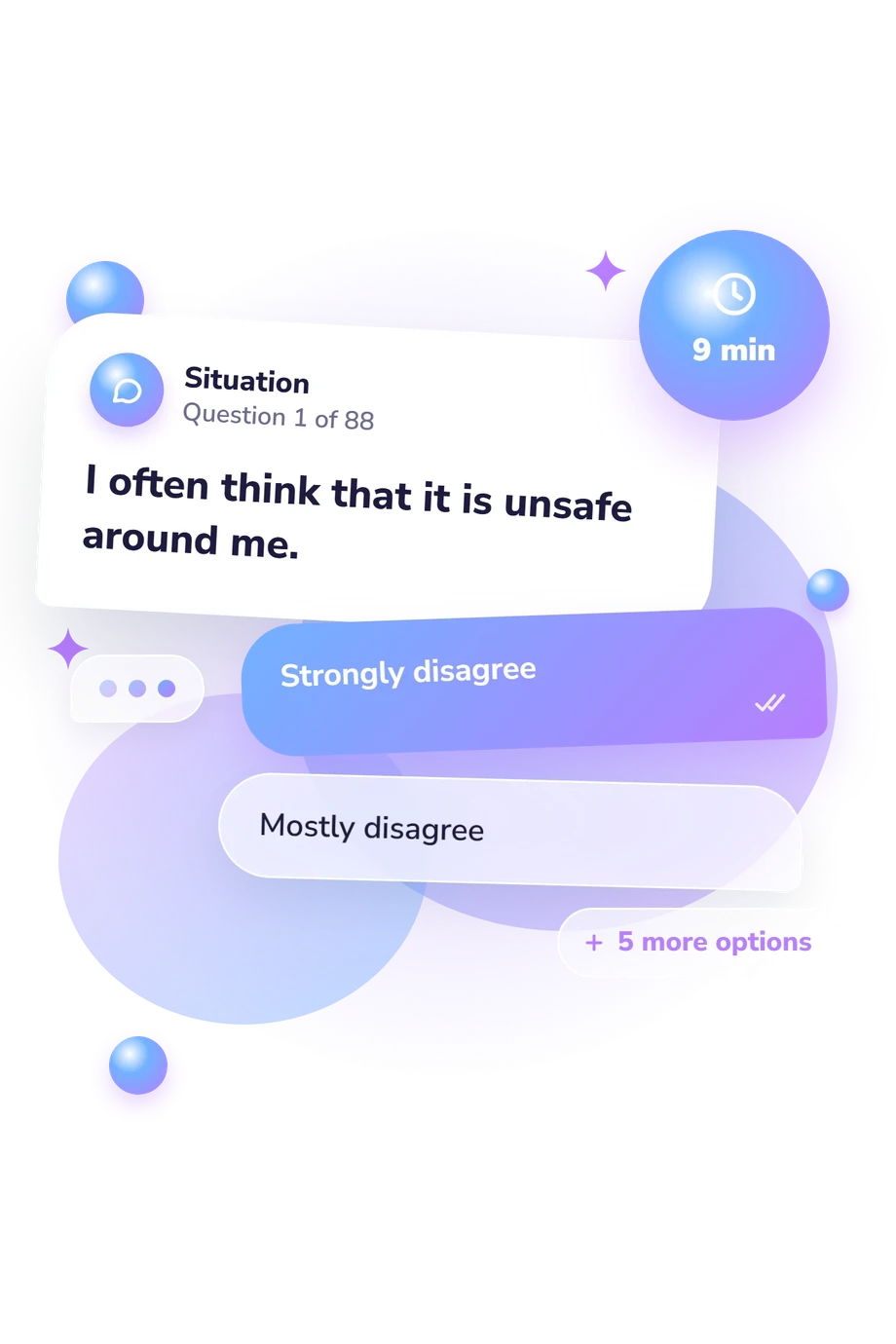
Each statement uses a seven-point agreement scale, from strong or complete disagreement to strong or complete agreement. Items address unwanted thoughts, feared consequences, responsibility, safety, perfectionistic demands, certainty, and threat. Responses are summarized as domain scores and a total score; higher results may indicate stronger endorsement of the relevant beliefs.
The evidence base is the Obsessive Beliefs Questionnaire-44 (OBQ-44). Steketee and colleagues examined its factor structure and psychometric performance in two validation studies, including a brief version. Myers, Fisher, and Wells later studied relationships between its belief domains and obsessive-compulsive symptoms. These studies support the published OBQ-44 conceptually; they do not establish that this online questionnaire is identical to, validated as, or normed like that instrument.
For interpretation, these questionnaire results are best read as a pattern: one elevated area may indicate an appraisal style, while a higher total may indicate greater endorsement of obsessive beliefs associated with the obsessive-compulsive spectrum. Results can shift with stress, mood, insight, and self-report consistency. The online questionnaire is a structured reflection tool; read its score in context rather than as a diagnosis.
- Steketee, G., Frost, R., Bhar, S., et al. (2005). Psychometric validation of the obsessive belief questionnaire and interpretation of intrusions inventory-Part 2: Factor analyses and testing of a brief version. Behaviour Research and Therapy, 43(11), 1527-1542. 10.1016/j.brat.2004.07.010
- Steketee, G., Frost, R., Bhar, S., et al. (2003). Psychometric validation of the Obsessive Beliefs Questionnaire and the Interpretation of Intrusions Inventory: Part I. Behaviour Research and Therapy, 41(8), 863-878. 10.1016/S0005-7967(02)00099-2
- Myers, S. G., Fisher, P. L., and Wells, A. (2007). Belief domains of the Obsessive Beliefs Questionnaire-44 (OBQ-44) and their specific relationship with obsessive-compulsive symptoms. Journal of Anxiety Disorders, 22(3), 475-484. 10.1016/j.janxdis.2007.03.012
Updated: