
Questionnaire for Assessing the Subjective Concept of Morbidity Test
How the Scales are Structured
Who Usually Takes This Test?
See How You Compare
Below is a preview of how scores are typically distributed across each scale.
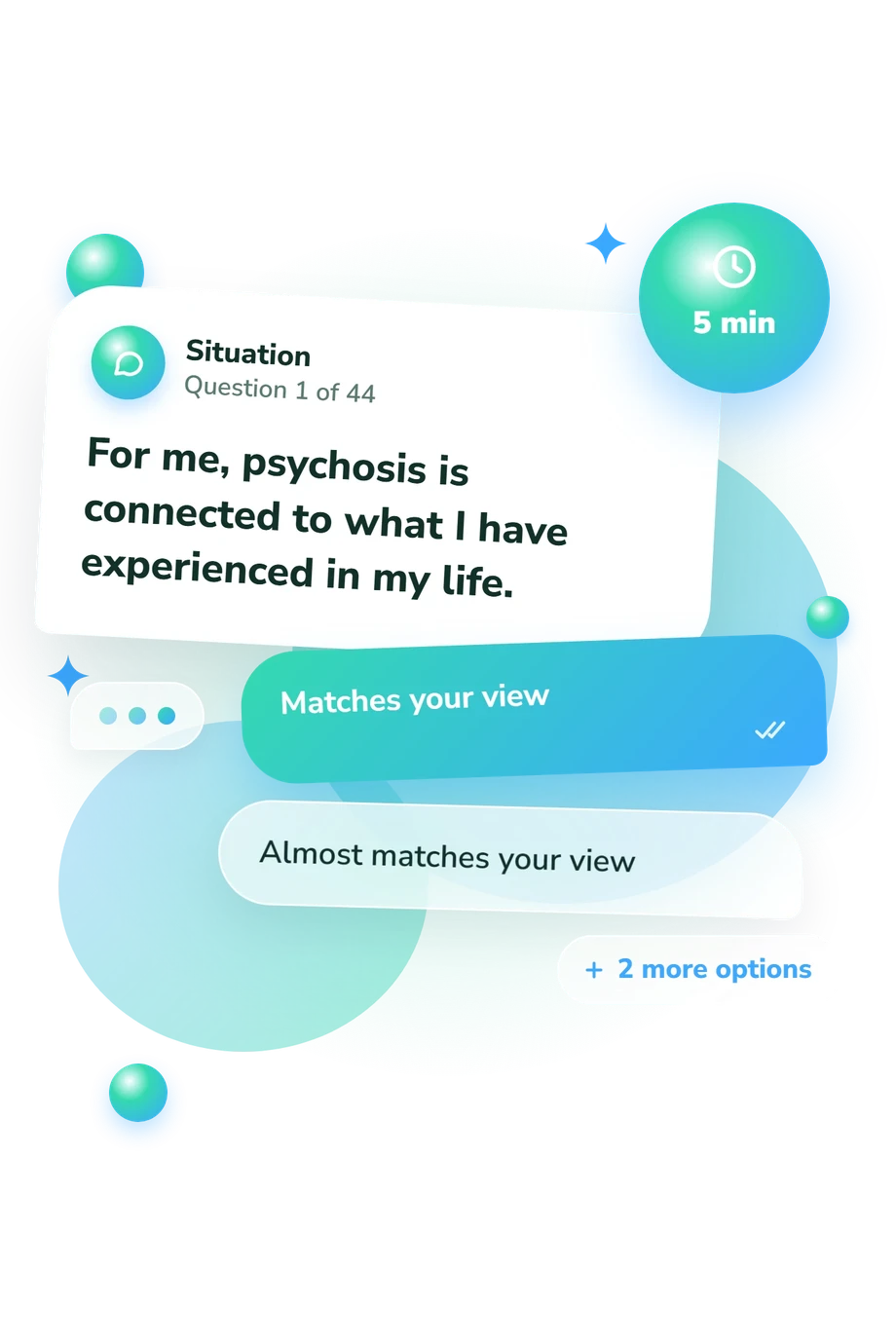
Example Questions From the Test
- Matches your view
- Almost matches your view
- Does not quite match your view
- Does not match your view at all
- Matches your view
- Almost matches your view
- Does not quite match your view
- Does not match your view at all
- Matches your view
- Almost matches your view
- Does not quite match your view
- Does not match your view at all
Questionnaire for Assessing the Subjective Concept of Morbidity Test - Description and methodology of the test
For people reflecting on a past or current psychotic experience, this assessment is useful when different interpretations of what happened are difficult to compare. The Questionnaire for Assessing the Subjective Concept of Morbidity Test can help examine whether an experience is understood mainly through burden, meaning, personal change, or connections with earlier circumstances. It offers a structured psychosis self-assessment for comparing these perspectives and identifying which ones feel most prominent.
What This Assessment Explores
It examines psychosis, symptoms, onset, and consequences as a subjective concept of morbidity. The five dimensions are:
- Destructive Consequences of Psychosis (-3-3) measures perceived harm to life prospects: Minimal/No destructive impact (-3-0) or Elevated destructive impact (1-3).
- Constructive Consequences of Psychosis (-3-3) measures positive reinterpretation: Low constructive view (-3--1), Neutral/mixed view (0-0), or High constructive view (1-3).
- Negative Experience of Symptoms (-3-3) measures perceived burden: Low burden (-3--1), Neutral/mixed (0-0), or High burden (1-3).
- Positive Experience of Symptoms (-3-3) measures personal enrichment: Low positive meaning (-3--1), Mixed/neutral meaning (0-0), or High positive meaning (1-3).
- Onset of Psychosis (-3-3) measures perceived links with prior experience: Less pronounced pattern (-3--1), Typical/neutral (0-0), or More pronounced pattern (1-3).
Methodology and Scientific Basis
Each statement asks how closely an experience matches the respondent’s view. Options generally move from agreement to disagreement, with some unsure choices, so the format captures appraisal rather than factual knowledge.
Five signed results are reported. Positive values generally show stronger expression of the named tendency; negative values show a lower or opposite tendency where defined. The online profile presents descriptive bands, not clinical cutoffs. A psychosis experience questionnaire is best read dimension by dimension, because positive and negative appraisals may coexist.
The questionnaire is conceptually consistent with the 2020 study by Lutova and colleagues on subjective morbidity concepts, the SUSE work by Klapheck and colleagues, and the SuSi project by Bock and colleagues. It is not presented as an adaptation of those instruments. Together, these works support interpreting the five dimensions as complementary perspectives on the subjective meaning of psychosis: burden can coexist with meaning, and destructive consequences with constructive change.
Memory, current mood, honesty, and self-awareness can shape responses, so the result describes a perspective rather than a standalone clinical conclusion.
- Lutova NB, Sorokin MY, Makarevich OV, Wied VD. The subjective concept of morbidity: its assessment and connection with the motivation for treatment in persons who underwent psychosis. VM Bekhterev Review of Psychiatry and Medical Psychology. 2020;(2):73-79. 10.31363/2313-7053-2020-2-73-79
- Bock T, Brysinski T, Klapheck K, Bening U, Lenz A, Naber D. On subjective meaning of psychoses: construction, validation and first application of a new questionnaire-the SuSi Project (Hamburg). Psychiatrische Praxis. 2010;37(6):285-291. 10.1055/s-0030-1248424
- Klapheck K, Nordmeyer S, Cronjäger H, Naber D, Bock T. Subjective experience and meaning of psychoses: the German Subjective Sense in Psychosis Questionnaire (SUSE). Psychological Medicine. 2012;42(1):61-71. 10.1017/S0033291711001103
Updated: