
Professional Identity Questionnaire for Psychology Students Test
How the Scales are Structured
Who Usually Takes This Test?
See How You Compare
Below is a preview of how scores are typically distributed across each scale.
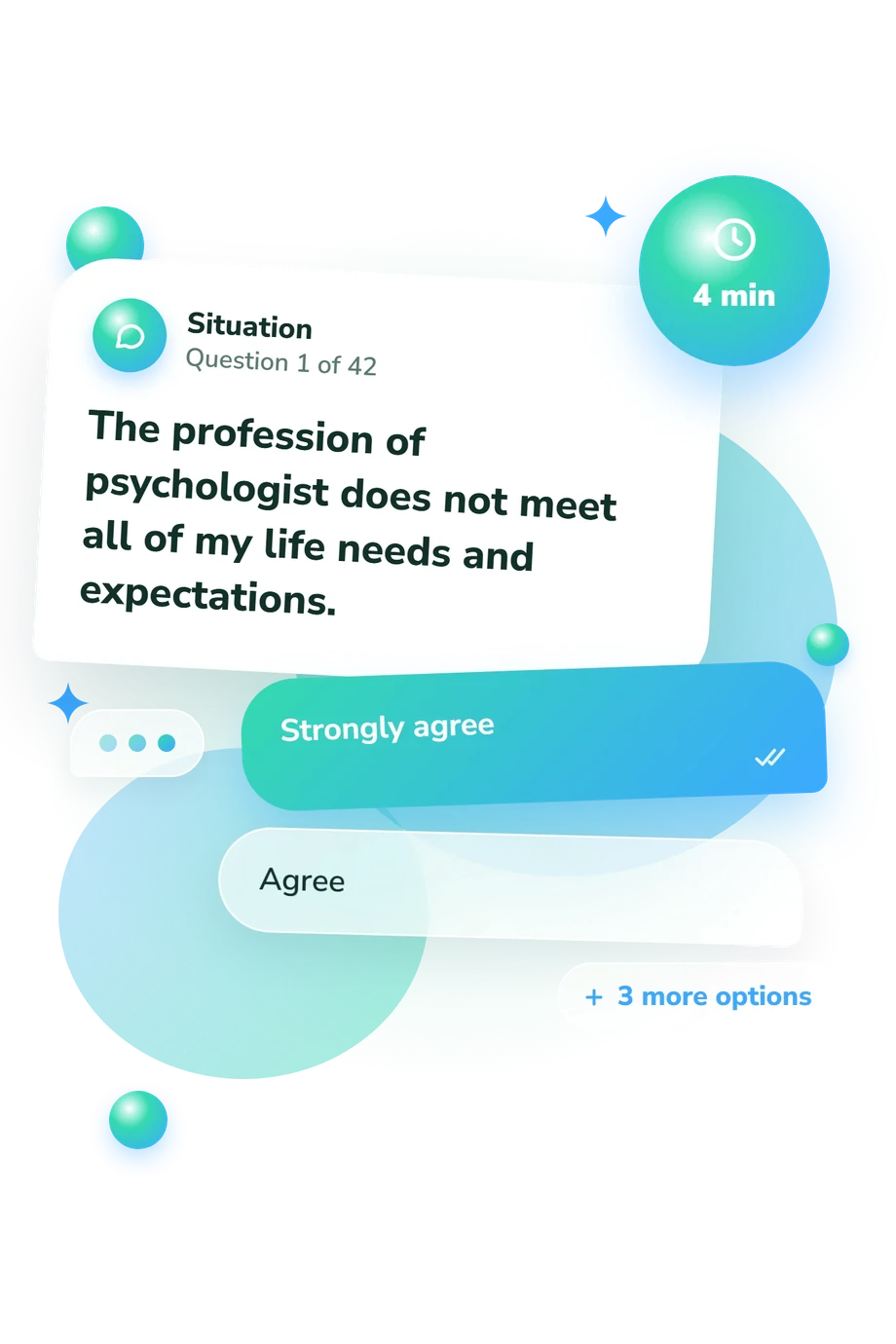
Example Questions From the Test
- Strongly agree
- Agree
- Have not thought about this / do not know
- Disagree
- Strongly disagree
- Strongly agree
- Agree
- Have not thought about it / do not know
- Disagree
- Strongly disagree
- Strongly agree
- Agree
- Have not thought about it / do not know
- Disagree
- Strongly disagree
Professional Identity Questionnaire for Psychology Students Test - Description and methodology of the test
Students considering how psychology fits their future work may use the Professional Identity Questionnaire for Psychology Students Test to examine the meaning they attach to the profession. Students considering a psychology career can use it for self-reflection when motivation, career plans, or uncertainty about development need clearer language. The result offers a structured profile for considering professional direction.
What This Assessment Measures
Questions touch on motivation, career planning, ideas about calling, practical preparation, and feelings about becoming psychologists, but these themes provide context for the scales rather than separate outcomes. The profile functions as a professional identity assessment, describing a student's active or passive stance and emotional attitude toward a future role. The six dimensions are read through the displayed result bands:
- Passive Attitude Position (6-30) measures passivity: Active stance 6-13; Mixed/variable stance 14-22; Passive stance 23-30.
- Active Attitude Position (0-30) measures aspiration: Low engagement 0-6; High engagement 7-30.
- Negative Emotions (0-30) measures negative feeling: Low 0-6; Elevated 7-30.
- Positive Emotions (0-30) measures positive feeling: Low 0-6; Moderate-High 7-30.
- Conscious Activity (-24-24) measures deliberate engagement: Passive stance -24--1; Neutral / average 0-0; Active engagement 1-24.
- Emotional Attitude (-24-24) measures overall valence: Negative attitude -24--1; Neutral baseline 0-0; Positive attitude 1-24.
Methodology and Scientific Basis
Each statement uses five response choices from strong agreement to strong disagreement, with a middle option for uncertainty or not having considered the issue. The items cover study, career choice, planning, practical experience, self-realization, and feelings about the profession. Responses are combined into displayed scale scores; the listed ranges and bands guide interpretation, without a stated universal clinical cutoff or per-answer point rule.
Rodygina’s 2007 work on student professional identity, alongside her 2006 study of future psychologists, is the closest named source for these dimensions; this online questionnaire is conceptually consistent with that work, not presented as an adaptation. Erikson’s identity framework places career choice within broader identity formation. Bekhter, Gagarin, and Grechko (2023) provide a later comparison involving future psychologists and related professional-attitude themes.
The result is best read as a pattern in emerging professional identity and emotional attitude: active engagement with positive emotion may indicate a positive orientation toward a future professional role, while mixed scores may show issues still being worked through. Self-report answers can shift with current mood, social expectations, and self-awareness, so the profile describes present perceptions rather than fixed ability or professional suitability.
- Rodygina, U.S. (2006). Diagnosis of Professional Identity of Students-Future Psychologists. In Modern Technologies and Active Methods of Teaching at a University as a Condition for Specialist Training: Proceedings of the 4th Interregional Interuniversity Scientific-Methodological Conference (pp. 45-50). Kirov: Kirov Branch of the Moscow Humanitarian-Economic Institute.
- Rodygina, U.S. (2007). Psychological Features of Professional Identity in Students. Psychological Science and Education, 12(4), 39-51.
- Bekhter, A.A., Gagarin, A.V., and Grechko, A.A. (2023). Professional Identity and Hardiness of Future Psychologists Before and After the COVID-19 Pandemic. Professional Education in the Modern World, 13(1), 124-133. 10.20913/2618-7515-2023-1-15
- Erikson, E.H. (1968). Identity: Youth and Crisis. New York: W.W. Norton & Company.
Updated: