
Reproductive Motives Questionnaire Test
How the Scales are Structured
Who Usually Takes This Test?
See How You Compare
Below is a preview of how scores are typically distributed across each scale.
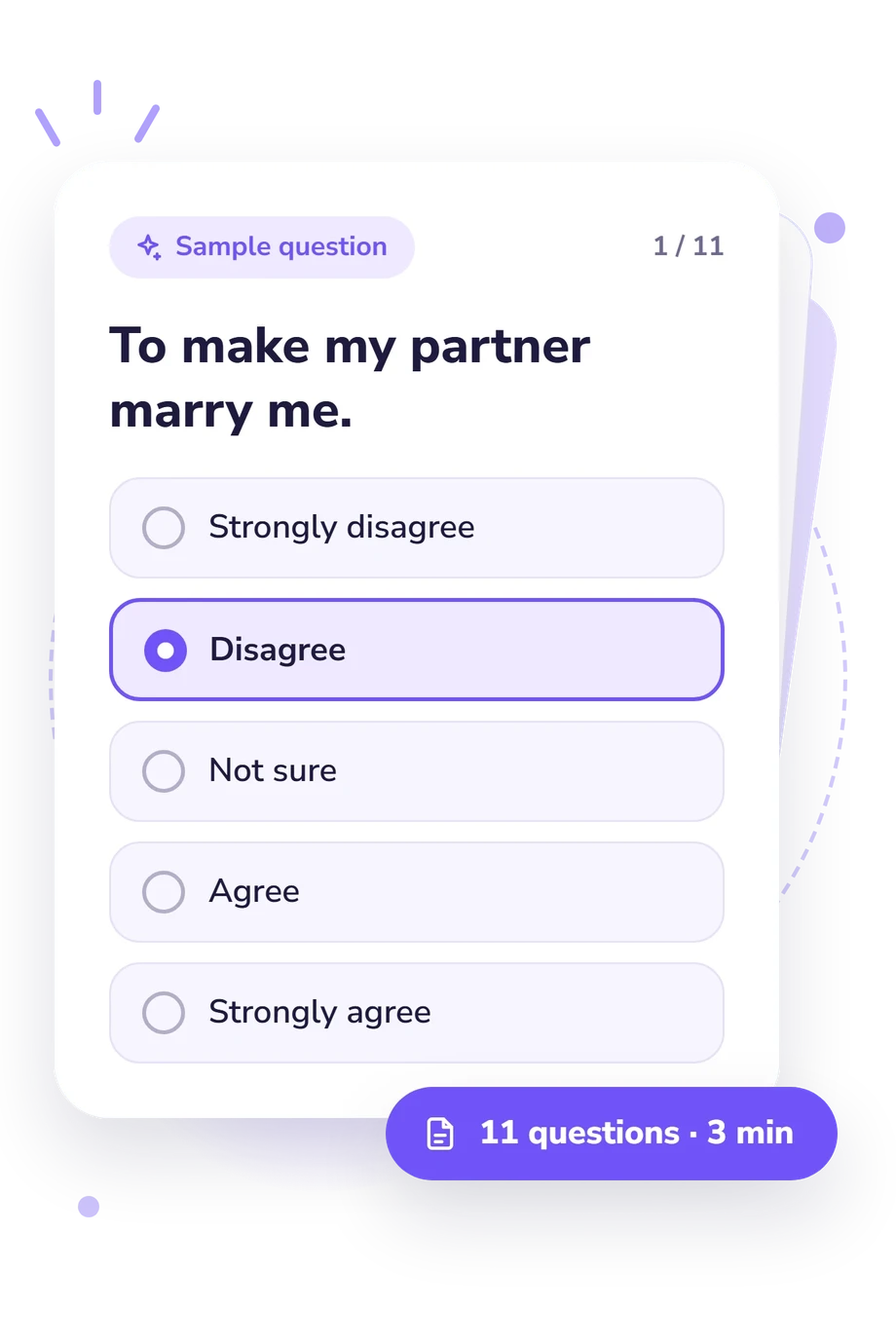
Example Questions From the Test
- Strongly disagree
- Disagree
- Not sure
- Agree
- Strongly agree
- Strongly disagree
- Disagree
- Not sure
- Agree
- Strongly agree
- Strongly disagree
- Disagree
- Not sure
- Agree
- Strongly agree
Reproductive Motives Questionnaire Test - Description and methodology of the test
People preparing to discuss parenthood with a partner or family member may benefit from a structured way to examine mixed expectations. The Reproductive Motives Questionnaire Test can help a respondent notice which reasons feel central and identify topics worth discussing before making decisions. As a reproductive motivation questionnaire, this assessment offers a private starting point for reflecting on personal priorities and emotionally significant assumptions.
What This Assessment Explores
This assessment focuses on motives behind parenthood, not fertility, parenting skill, or relationship quality. Items cover welcoming a child, expressing gratitude, meaning, and motives involving marriage, housing, status, family approval, health, or material gain. As a parenthood motivation test, this questionnaire can indicate whether parenthood is valued as an end in itself, treated as a means to another outcome, or reflects both.
The two displayed scales are:
- Constructive Motives (1-5) measures positive motivation toward motherhood, with the child valued as an end in itself and family development supported. Bands: Low 1-2.3, Moderate 2.4-3.6, High 3.7-5.
- Destructive Motives (1-5) measures destructive reproductive motives, with motherhood treated as a means to another goal. Predominance of these motives may negatively affect the family system. Bands: Low 1-2.3, Moderate 2.4-3.6, High 3.7-5.
Together, they show motive tendencies, not fixed traits.
Methodology and Scientific Basis
Each statement presents a possible reason for having a child, and respondents select one of five ordered options from Strongly disagree to Strongly agree. One item uses Completely disagree/agree wording, but the same five-step format applies. Results display two scale scores, with bands indicating the level shown for each score. For this online questionnaire, the displayed bands are descriptive ranges rather than diagnostic thresholds, and no norms or standardization are stated. Current circumstances, response bias, interpretation of wording, and willingness to disclose sensitive motives can affect self-report.
The structure is conceptually consistent with the Reproductive Motives Questionnaire (Morozova et al., 2014), the closest named source for these themes. Kornienko, Radosteva, and Kharlamova (2017) examine the same two-part framework, while Radosteva (2013) relates reproductive attitudes to family relationships. Guedes et al. (2015) provide a related but separately developed measure of childbearing motivations; this supports topical comparison, not a claim that the online questionnaire is adapted from it.
Viewed as a parenthood motives questionnaire, this assessment supports self-reflection, while a respondent's broader context remains important.
- Morozova, I. S., Belogay, K. N., Borisenko, Yu. V., & Ott, T. O. (2014). Testing of “Reproductive Motives” Questionnaire. Bulletin of Kemerovo State University, 3(59), 140-145. EDN REOUTQ.
- Kornienko, D. S., Radosteva, A. G., & Kharlamova, T. M. (2017). Psychometric evaluation of the questionnaire of destructive and constructive reproductive motives. Bulletin of Perm State Humanitarian Pedagogical University. Series 1: Psychological and Pedagogical Sciences, 1, 122-132.
- Radosteva, A. G. (2013). The influence of family relations to parental attitudes. Fundamental Research, 8(5), 1238-1242.
- Guedes, M., Pereira, M., Pires, R., Carvalho, P., & Canavarro, M. C. (2015). Childbearing Motivations Scale: Construction of a New Measure and its Preliminary Psychometric Properties. Journal of Child & Family Studies, 24(1), 180-194. 10.1007/s10826-013-9824-0
Updated: