
Social Media Self-Presentation Questionnaire Test
How the Scales are Structured
Who Usually Takes This Test?
See How You Compare
Below is a preview of how scores are typically distributed across each scale.
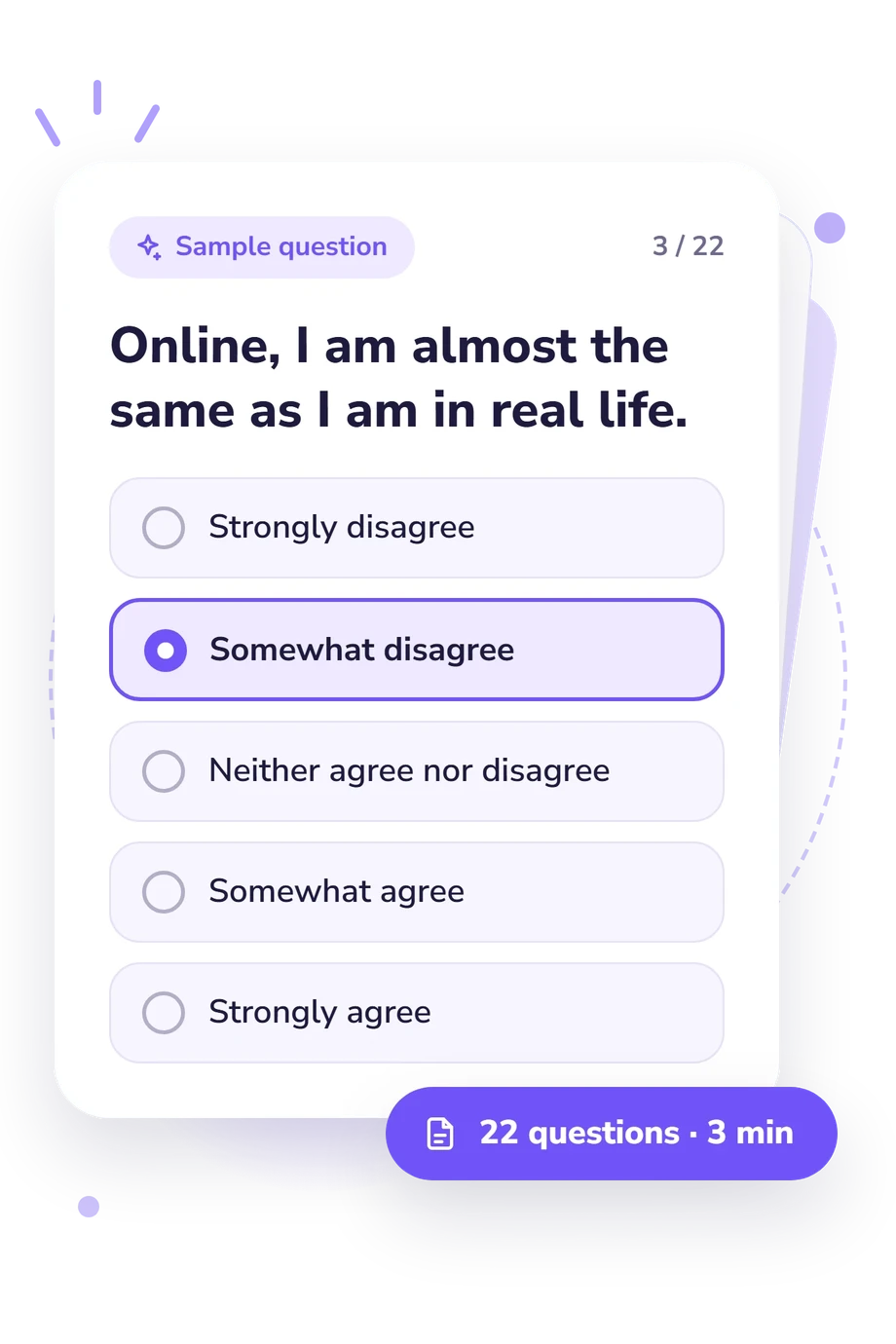
Example Questions From the Test
- Strongly disagree
- Somewhat disagree
- Neither agree nor disagree
- Somewhat agree
- Strongly agree
- Completely disagree
- Somewhat disagree
- Neither agree nor disagree
- Somewhat agree
- Completely agree
- Strongly disagree
- Rather disagree
- Neither agree nor disagree
- Rather agree
- Strongly agree
Social Media Self-Presentation Questionnaire Test - Description and methodology of the test
For people thinking about how their online identity relates to everyday behaviour, the Social Media Self-Presentation Questionnaire Test offers a focused way to examine that relationship. It is suitable for anyone who wants to reflect on the impression their posts, profile images, beliefs, and personal disclosures may create. An online self-presentation test can highlight whether digital expression feels consistent, selective, or deliberately altered.
What This Assessment Explores
The questionnaire examines two connected tendencies: presenting an altered identity and expressing different aspects of an authentic identity. Statements address self-knowledge, beliefs, profile photos, efforts to impress, and feeling the same or different online and offline. The result describes a self-presentation pattern, not a fixed personality label.
The displayed scales are:
- False Deceptive Self (5-25) assesses the tendency to present an unrealistic self-image or to present oneself as a different person. The bands are Mostly genuine (5-11), Mixed presentation (12-18), and More deceptive (19-25).
- Authentic Expressive Self (6-30) assesses generally authentic self-presentation on social media, reflecting an intention to openly demonstrate different aspects of one’s personality. The bands are Low (6-13), Moderate (14-22), and High (23-30).
Used as a snapshot, the result is most useful for considering how you describe your social media identity at the time of completion.
Methodology and Scientific Basis
Each item is a first-person statement rated on a five-point scale from disagreement to agreement. The wording covers continuity with offline behaviour and deliberate image management, while responses allow degrees of endorsement. The result reports two dimensions; the item-level weighting and any reverse scoring are not specified, so no further scoring rule should be inferred.
Conceptually, it aligns with Self-Presentation on Facebook Questionnaire (Michikyan et al., 2015), which distinguishes real, ideal, and false online self-presentation. Michikyan, Subrahmanyam, and Dennis (2014) link online presentation with personality patterns, while Leary’s framework explains impression management in interpersonal settings. These sources support the construct, but this questionnaire is not a verified adaptation of those instruments.
When considering how authentic your online self-presentation feels, results are best read descriptively: each tendency measured by the result indicates how endorsed statements align with it. The displayed bands are descriptive reporting categories, so they should not be generalized as universal or clinical thresholds. Self-awareness, honesty, audience, platform habits, and current circumstances can affect answers, so scores may change over time and should not be treated as a diagnosis.
- Michikyan, M., Dennis, J., & Subrahmanyam, K. (2015). Can You Guess Who I Am? Real, Ideal, and False Self-Presentation on Facebook Among Emerging Adults. Emerging Adulthood, 3(1), 55-64. 10.1177/2167696814532442
- Michikyan, M., Subrahmanyam, K., & Dennis, J. (2014). Can You Tell Who I Am? Neuroticism, Extraversion, and Online Self-Presentation Among Young Adults. Computers in Human Behavior, 33, 179-183. 10.1016/j.chb.2014.01.010
- Leary, M. R. (1995). Self-Presentation: Impression Management and Interpersonal Behavior. Madison, WI: Brown & Benchmark Publishers.
Updated: