
Perceptual Polymodality Questionnaire Test
How the Scales are Structured
Who Usually Takes This Test?
See How You Compare
Below is a preview of how scores are typically distributed across each scale.
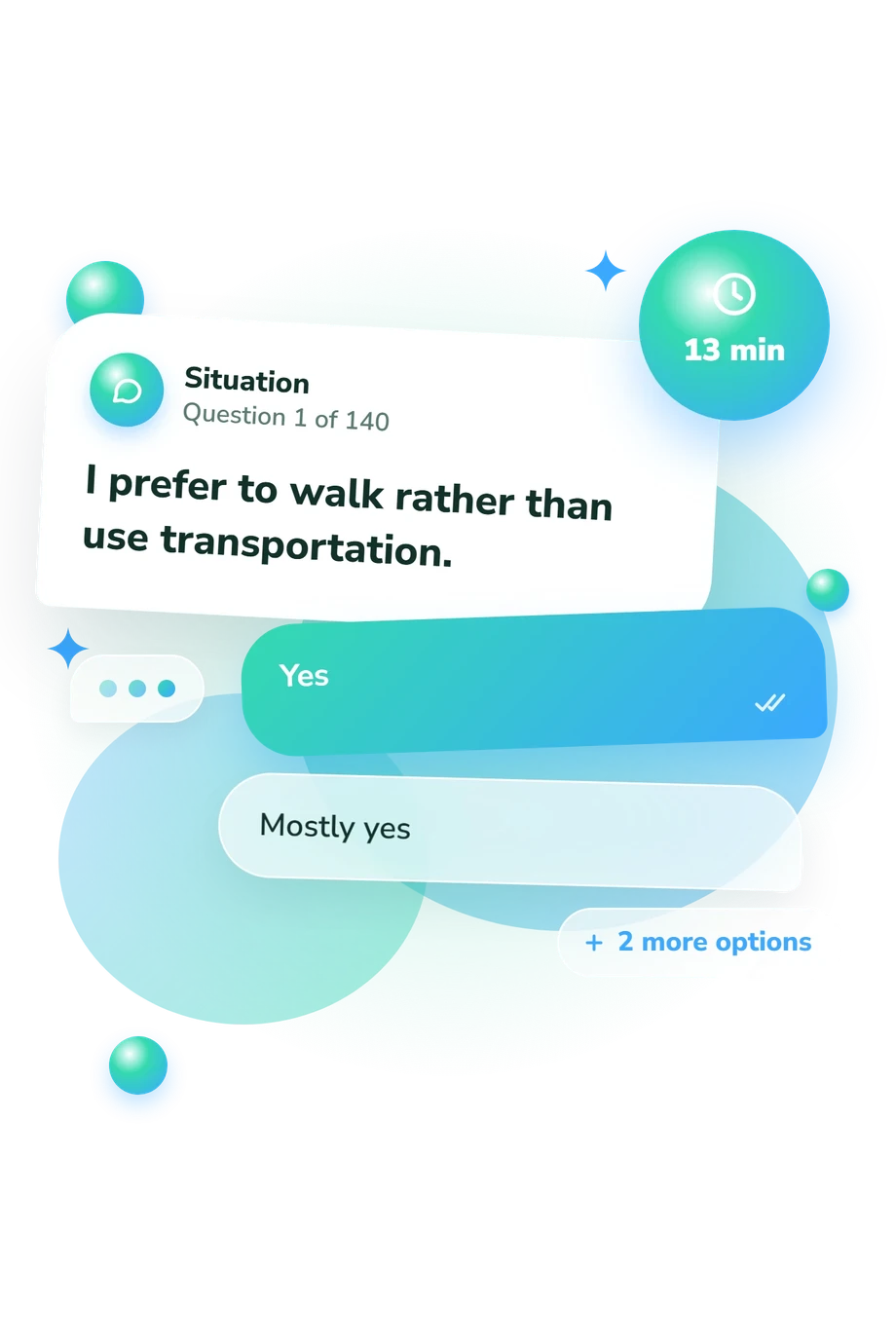
Example Questions From the Test
- Yes
- Mostly yes
- Mostly no
- No
- Yes
- Almost yes
- Almost no
- No
- Yes
- Almost yes
- Almost no
- No
Perceptual Polymodality Questionnaire Test - Description and methodology of the test
People who notice strong differences in how they respond to sounds, tastes, touch, movement, images, or bodily sensations may use the Perceptual Polymodality Questionnaire Test to examine how sensory cues shape everyday attention, memory, preferences, or interactions. It is suited to people seeking a clearer picture of those everyday patterns. As a sensory perception questionnaire, it turns familiar experiences into a structured profile.
What This Assessment Measures
This assessment examines how readily a person notices and uses sensory channels in everyday experience. The questions address visual form and movement, sound, touch, bodily states, taste, smell, and activity. They also ask whether sensory cues contribute to memory, relaxation, preferences, and impressions of other people. This perceptual polymodality questionnaire describes breadth and flexibility in perceptual experience rather than one sensory skill.
Results are reported on the Perceptual Polymodality scale from 0-100: Low (0-33), Moderate (34-66), and High (67-100). These thematic areas show what the result draws on:
- Visual attention reflects noticing color, shape, space, and movement.
- Auditory awareness reflects remembering and interpreting sounds or voices.
- Tactile and bodily awareness reflects contact, temperature, comfort, and inner states.
- Taste and smell reflect sensitivity, preferences, distinctions, and sensory memory.
- Cross-modal flexibility reflects using more than one route to understand experience.
Methodology and Evidence Base
Each statement uses four ordered choices, such as Yes, Mostly yes, Mostly no, and No; some use Almost yes or Almost no. This format records degree of endorsement, while combined responses produce the displayed profile. Because no item-level weighting rule is stated, the score should not be reverse-engineered from the answer range.
The questionnaire is conceptually consistent with Bandurka's 2005 discussion of perceptual polymodality, which treats perception as coordinated use of several sensory routes. Bandurka (2010) connects this perspective with learning and educational experience. Research on polymodality of perception helps explain its conceptual basis, but the online questionnaire is not presented as a direct adaptation or revalidation.
The displayed bands are descriptive categories rather than population norms, so the result is an indicative description of reported tendencies. Higher scores indicate greater flexibility, diversity, and reliance on multiple perceptual modalities; lower scores indicate less varied use. Attention, memory, mood, context, and interpretation can affect answers. Read the result as a reflective profile rather than a fixed psychological type.
- Razvalyaeva, A. Y. (2024). Adaptation of the Plymouth Sensory Imagery Questionnaire in a Russian Sample. Experimental Psychology, 17(3), 144-157. 10.17759/exppsy.2024170310
- Bandurka, T. N. (2005). Polymodality of Perception in Learning: How to Broaden the Boundaries of Cognition. Irkutsk: Ottisk, 204 pp.
- Bandurka, T. N. (2010). Experimental Study of Perceptual Polymodality in Subjects of the Educational Process. In V. A. Barabanshchikov (Ed.), Experimental Psychology in Russia: Traditions and Perspectives (pp. 213-218). Moscow: Institute of Psychology of the Russian Academy of Sciences and Moscow City University of Psychology and Education.
Updated: