
Viral Threat Perception Questionnaire Test
How the Scales are Structured
Who Usually Takes This Test?
See How You Compare
Below is a preview of how scores are typically distributed across each scale.
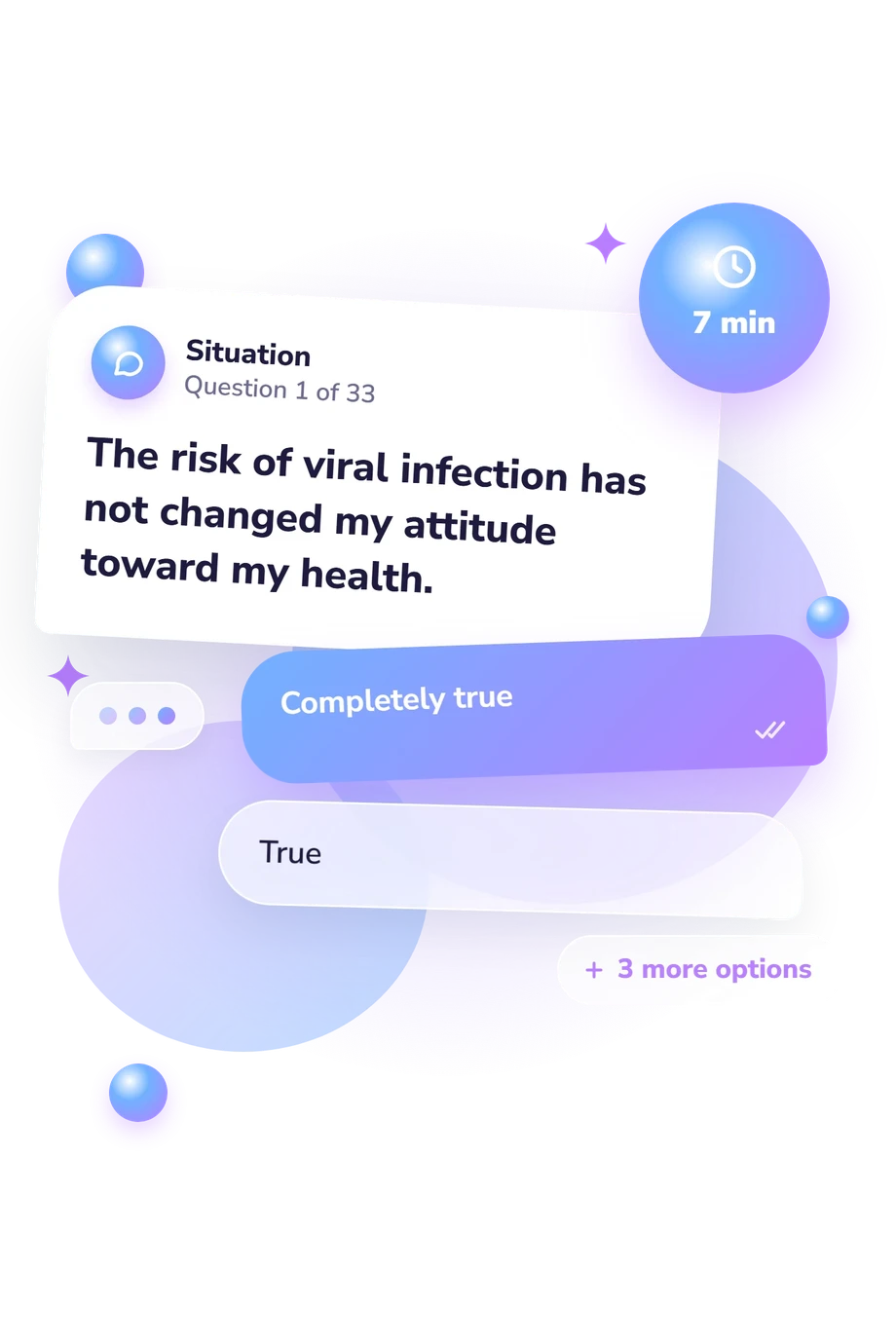
Example Questions From the Test
- Completely true
- True
- Somewhat true
- Untrue
- Completely untrue
- Completely true
- True
- Somewhat true
- Untrue
- Completely untrue
- Completely true
- True
- Somewhat true
- Untrue
- Completely untrue
Viral Threat Perception Questionnaire Test - Description and methodology of the test
For readers who want to understand how an epidemic may affect their emotions and daily life, the Viral Threat Perception Questionnaire Test offers a focused self-report measure of viral-threat-related anxiety and worry. This viral threat questionnaire summarizes anxiety and worry across situations involving safety, information, relationships, and routine changes, helping respondents see how perceived danger is affecting everyday experience.
What This Assessment Measures
Rather than measuring infection itself, the assessment examines how a person experiences a perceived viral threat and how that perception enters daily life. Items address fear for personal and family health, perceived vulnerability, confidence in public protection, frustration with restrictions, reactions to others, and changes in routines. This focus remains on subjective experience and related behavior.
The Viral Threat Experience Scale (33-165) assesses anxiety and worry about perceived viral threats. Bands are Low distress (33-94), Moderate distress (95-121), and High distress (122-165); lower results suggest a calmer attitude, while higher results suggest stronger concern.
The items cover these situations:
- Personal and family impact captures fear about health, infection, and consequences for close relationships.
- Protection and uncertainty reflect confidence in services, rules, science, and available information.
- Daily disruption records changes in contact, plans, routines, hobbies, and emotional reactions.
Methodology and Evidence Base
The questionnaire uses self-report statements with five graded truth-value choices, ranging from completely true to completely untrue, with wording variations across items. Some statements are phrased as denials, so judge each sentence as written rather than treating agreement as distress.
Responses are combined into one displayed result. The response wording alone does not establish a point value for every option, so scoring is best understood through the reported band and score direction. The result summarizes anxiety about viral infection across the situations covered by the items.
The Viral Threat Experience Questionnaire, described in a 2022 questionnaire-development study by Bykhovets, provides the closest conceptual comparison. A 2021 study by Kazymova connects viral-threat experience with psychological resilience, while Bykhovets's 2023 work examines stress associated with invisible information threats.
The online version is conceptually consistent with these works, not a direct adaptation of any one study. Because responses depend on self-report and current circumstances, the questionnaire reports the three displayed descriptive bands and the scale's stated score direction; these results describe reported distress rather than establishing a clinical condition.
- Bykhovets, Yulia V. (2022). Creating a Questionnaire about the Experience of a Viral Threat. World of Science. Pedagogy and Psychology, 10(2), 6-28. (In Russian, English abstract).
- Kazymova, Nadezhda N. (2021). Viral Threat Experiencing and Psychological Resilience of a Person. World of Science. Pedagogy and Psychology, 9(6), Article 81PSMN621. (In Russian, English abstract).
- Bykhovets, Yulia V. (2023). Stress of Invisible Information Threats and Its Consequences. Counseling Psychology and Psychotherapy, 31(3), 132-166. 10.17759/cpp.2023310307
Updated: