
Sexism Structure Questionnaire Test
How the Scales are Structured
Who Usually Takes This Test?
See How You Compare
Below is a preview of how scores are typically distributed across each scale.
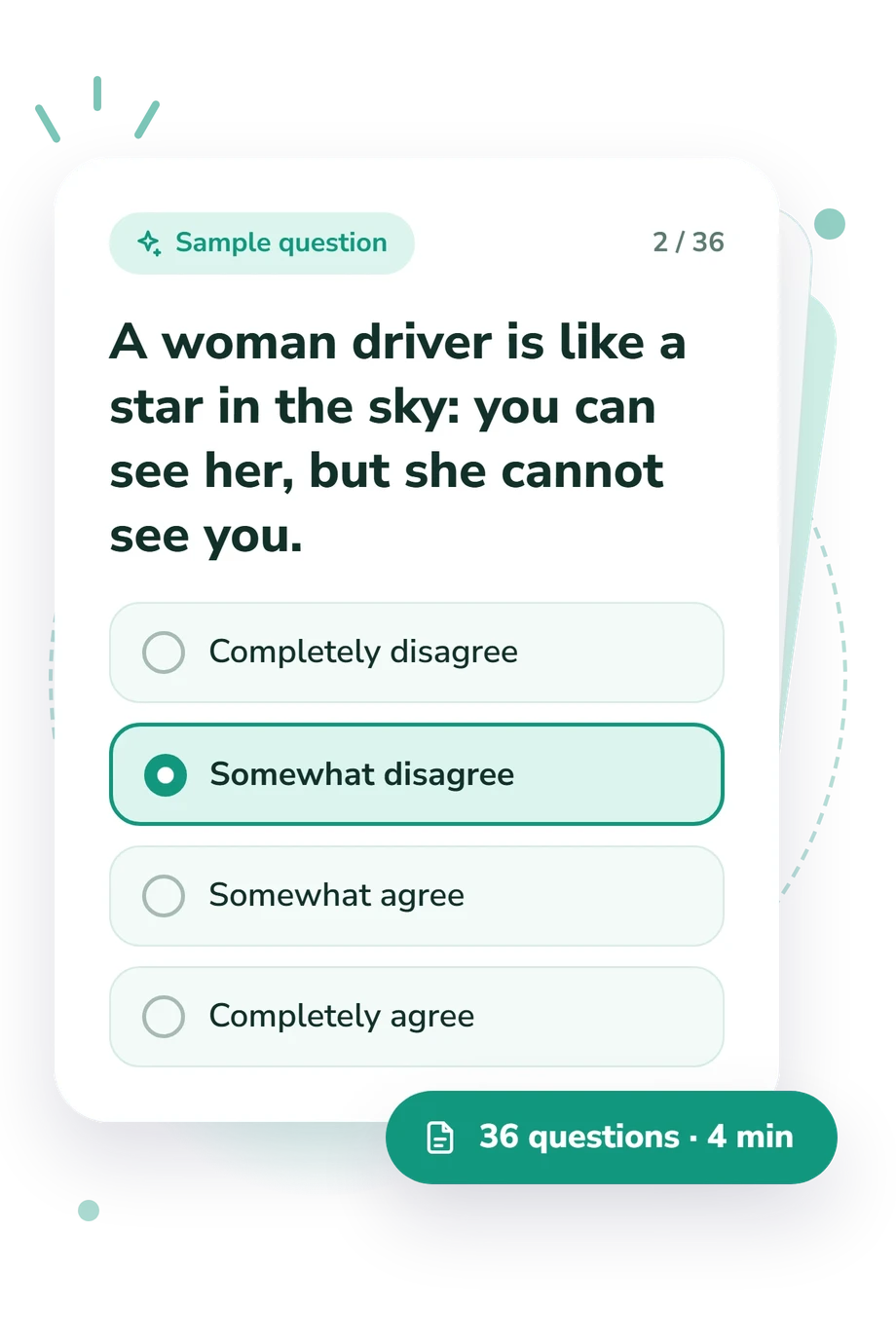
Example Questions From the Test
- Completely disagree
- Somewhat disagree
- Somewhat agree
- Completely agree
- Strongly disagree
- Rather disagree
- Rather agree
- Strongly agree
- Strongly disagree
- Somewhat disagree
- Somewhat agree
- Strongly agree
Sexism Structure Questionnaire Test - Description and methodology of the test
People who want to examine their reactions to gendered generalizations can use this questionnaire as a structured self-reflection exercise. It is not an implicit association test: respondents read explicit statements and indicate how much they agree or disagree. As a sexism questionnaire, it helps a reader notice whether particular stereotypes are weakly, moderately, or strongly endorsed across several related themes.
What This Assessment Measures
Explicit statements target beliefs about women’s egoism, honesty, consistency, and competence, with driving used as a recurring example. The profile reflects endorsement of these stereotypes, making the tool useful for a gender stereotype assessment without reducing a respondent to one label.
These are the four result dimensions:
- Egoism (0-18) indicates perceived greater egoism in women than men: Low endorsement 0-5; Moderate endorsement 6-11; High endorsement 12-18.
- Deceitfulness and Inconstancy (0-18) indicates agreement with negative stereotypes about women’s honesty and consistency: Low endorsement 0-6; Moderate endorsement 7-12; High endorsement 13-18.
- Incompetence Stereotype (Women Drivers) (0-18) indicates prejudice about women’s abilities: Low bias 0-6; Moderate bias 7-12; High bias 13-18.
- Sexism Level (0-54) indicates overall sexist attitudes across the tested areas: Low 0-18; Moderate 19-36; High 37-54.
Methodology and Evidence Base
Each item offers four ordered agreement responses. Results are reported as totals for the displayed dimensions, with higher totals indicating stronger endorsement of the relevant stereotype or sexist attitude.
The closest published reference is Sexism Structure Inventory (Zizevskaia & Shchukina, 2019), while Shchukina and Zizevskaia (2017) describe an earlier method for examining the structure of sexism. The online questionnaire is conceptually consistent with this work, but that connection does not establish it as a standardized adaptation with published norms, reliability estimates, or diagnostic validity.
Interpret scores as a pattern of stated attitudes, not a fixed identity. Current context, social desirability, self-awareness, and reactions to provocative wording can affect answers, and endorsement may not predict how consistently a person acts on a belief. The profile is most informative when its dimensions are considered together rather than in isolation. As a sexist attitudes questionnaire, it is best used alongside reflection on real-world behavior.
- Zizevskaia, E. S., & Shchukina, M. A. (2019). Sexism Structure Inventory (SSI): Developing and evaluation of psychometric properties. Psychological Studies, 12(64), Article 4. 10.54359/ps.v12i64.232
- Shchukina, M. A., & Zizevskaia, E. S. (2017). Development of a method for psychological diagnosis of the structure of sexism. In A. L. Zhuravleva & V. A. Koltsova (Eds.), Fundamental and Applied Research in Modern Psychology: Results and Prospects for Development (pp. 888-896). Institute of Psychology of the Russian Academy of Sciences.
Updated: