
Freudly+971 508685814hello@freudly.ai
Freudly
self-regulation

Conscious Self-Regulation of Learning Activity Questionnaire Test
Take the online Conscious Self-Regulation of Learning Activity Questionnaire Test - AI psychologist FreudlyYou can take Conscious Self-Regulation of Learning Activity Questionnaire Testhere. Online version of a simple and accurate psychological test with interpretation.en
Understand how students plan, monitor, and adjust their learning in about 8 minutes. Get a clear snapshot of self-regulation strengths and gaps to guide coaching, counseling, or research.
Start Online Test
Questions: 408 minutes
08:30
October 2, 2025
October 2, 2025
Material has been updated
October 2, 2025
Material has been published
18,364 views
1,558 completions
1,353 likes
Verified by Daniel Hall
Psychologist with 25 years of experience
Share
Scale Explorer

How the Scales are Structured

example score
8/16
Decision-Making (DM)
Measures how consciously and independently a student makes and takes responsibility for decisions in learning activities.
Low
Moderate
High
48: Low | 912: Moderate | 1316: High
A score of 8 falls in the Low range, suggesting decision-making in learning may be more impulsive or reliant on external guidance and can be harder to sustain independently.
example score
11/16
Adjustment (A)
Assesses how effectively a student makes timely and appropriate adjustments to their learning activities when conditions or progress change.
Low correction
Moderate correction
High correction
48: Low correction | 912: Moderate correction | 1316: High correction
A score of 11 indicates a moderate ability to adjust study actions, suggesting generally adequate flexibility with some situations still requiring extra effort to modify plans or strategies.
example score
9/16
Evaluation of Results (EoR)
Measures how consistently and adequately a student evaluates the outcomes of their academic activities using stable criteria.
Unstable evaluation
Situational evaluation
Stable evaluation
48: Unstable evaluation | 912: Situational evaluation | 1316: Stable evaluation
A score of 9 suggests evaluation of learning results is generally possible but may vary by situation and be influenced by external cues.
example score
13/16
Monitoring (M)
Measures how well a student monitors and controls their learning process and evaluates outcomes against clear success criteria.
Low control
Moderate control
High control
48: Low control | 912: Moderate control | 1316: High control
A score of 13 falls in the High control range, suggesting well-developed criteria for success and consistent monitoring of learning outcomes.
example score
10/16
Planning (P)
Measures how well a student plans learning activities by selecting methods and steps to reach study goals.
Low planning
Moderate planning
High planning
48: Low planning | 912: Moderate planning | 1316: High planning
A score of 10 indicates a moderate level of planning, with some structured goal-setting and method selection but room for more detailed and consistent planning.
example score
8/16
Planning (P)
Assesses how coherently and realistically a student constructs plans for their learning activities.
Low
Moderate
High
48: Low | 912: Moderate | 1316: High
A score of 8 falls in the Low range, suggesting planning may be more situational and less organized than consistently structured.
example score
7/16
Forecasting (F)
Assesses how well a student anticipates likely events and outcomes in their academic activities to guide planning and decisions.
Low
Moderate
High
48: Low | 912: Moderate | 1316: High
A score of 7 falls in the Low range, suggesting forecasting of study-related outcomes is less developed and may be used inconsistently during learning.
example score
10/16
Modeling (M)
Modeling measures how well a student consciously identifies, analyzes, and organizes the conditions that affect their learning activities.
Low
Moderate
High
48: Low | 912: Moderate | 1316: High
A score of 10 falls in the Moderate range, suggesting a generally adequate ability to assess learning conditions with some inconsistencies in differentiating or systematizing them.
example score
13/16
Goal Setting (GS)
Assesses how consistently a student sets, organizes, and maintains goals for their learning activities.
Low
Moderate
High
48: Low | 912: Moderate | 1316: High
A score of 13 falls in the High range, suggesting well-developed goal setting with generally stable, clearly formulated learning goals.
example score
8/16
Meaning Comprehension (MC)
Measures how clearly a student understands the personal meaning and significance of their educational activities.
Low
Moderate
High
48: Low | 912: Moderate | 1316: High
A score of 8 falls in the Low range, suggesting the meaning of studying may be experienced as unclear or only superficially connected to personal goals.
example score
94/160
Overall Level of Self-Regulation (OLoSR)
Measures the overall development of conscious self-regulation in learning activities, including planning, monitoring, and adjusting study actions toward goals.
Low
Moderate
High
4095: Low | 96130: Moderate | 131160: High
A score of 94 falls in the Low range, suggesting less consistent conscious control and adjustment of learning activities relative to goals.
Start Online Test
just completed the test
DATA-BASED USER COHORTS

Who Usually Takes This Test?

University students improving study habits
46%OF USERS
They want to see how well they plan, monitor, and adjust their learning to study more effectively and stay motivated.
Students struggling with motivation
34%OF USERS
They take it to understand why they procrastinate or lose focus and which self-regulation skills need strengthening.
Educators and student counselors
20%OF USERS
They use the results to spot common self-regulation gaps and tailor support strategies for learners.
BASED ON AGGREGATED, ANONYMIZED DATA FROM TENS OF THOUSANDS OF FREUDLY USERS.
Benchmarking

See How You Compare

Once you complete the test, your results are compared with real-world data from people in your country.
Below is a preview of how scores are typically distributed across each scale.
Decision Making (DM)
Average
11.5
Normal range
9.313.7
min.
4
max.
16
This curve shows how scores are typically distributed.
Once you complete the test, your result will appear on the scale so you can see how you compare.
Correction (C)
Correction (C)
Average
7.1
Normal range
5.19
min.
4
max.
16
This curve shows how scores are typically distributed.
Once you complete the test, your result will appear on the scale so you can see how you compare.
Assessment of Results (AoR)
Average
10
Normal range
8.112
min.
4
max.
16
This curve shows how scores are typically distributed.
Once you complete the test, your result will appear on the scale so you can see how you compare.
Control (C)
Control (C)
Average
10.5
Normal range
8.312.6
min.
4
max.
16
This curve shows how scores are typically distributed.
Once you complete the test, your result will appear on the scale so you can see how you compare.
Programming (P)
Programming (P)
Average
7.3
Normal range
5.39.4
min.
4
max.
16
This curve shows how scores are typically distributed.
Once you complete the test, your result will appear on the scale so you can see how you compare.
Planning (P)
Planning (P)
Average
12.4
Normal range
10.913.9
min.
4
max.
16
This curve shows how scores are typically distributed.
Once you complete the test, your result will appear on the scale so you can see how you compare.
Forecasting (F)
Forecasting (F)
Average
8.9
Normal range
6.811
min.
4
max.
16
This curve shows how scores are typically distributed.
Once you complete the test, your result will appear on the scale so you can see how you compare.
Modeling (M)
Modeling (M)
Average
11.2
Normal range
9.512.8
min.
4
max.
16
This curve shows how scores are typically distributed.
Once you complete the test, your result will appear on the scale so you can see how you compare.
Goal Setting (GS)
Goal Setting (GS)
Average
9.2
Normal range
7.710.7
min.
4
max.
16
This curve shows how scores are typically distributed.
Once you complete the test, your result will appear on the scale so you can see how you compare.
Understanding Meaning (UM)
Average
8.3
Normal range
6.510.1
min.
4
max.
16
This curve shows how scores are typically distributed.
Once you complete the test, your result will appear on the scale so you can see how you compare.
Overall Regulation Level (ORL)
Average
74.2
Normal range
59.489.1
min.
40
max.
160
This curve shows how scores are typically distributed.
Once you complete the test, your result will appear on the scale so you can see how you compare.
Featured On
SAMPLE QUESTIONS

Example Questions From the Test

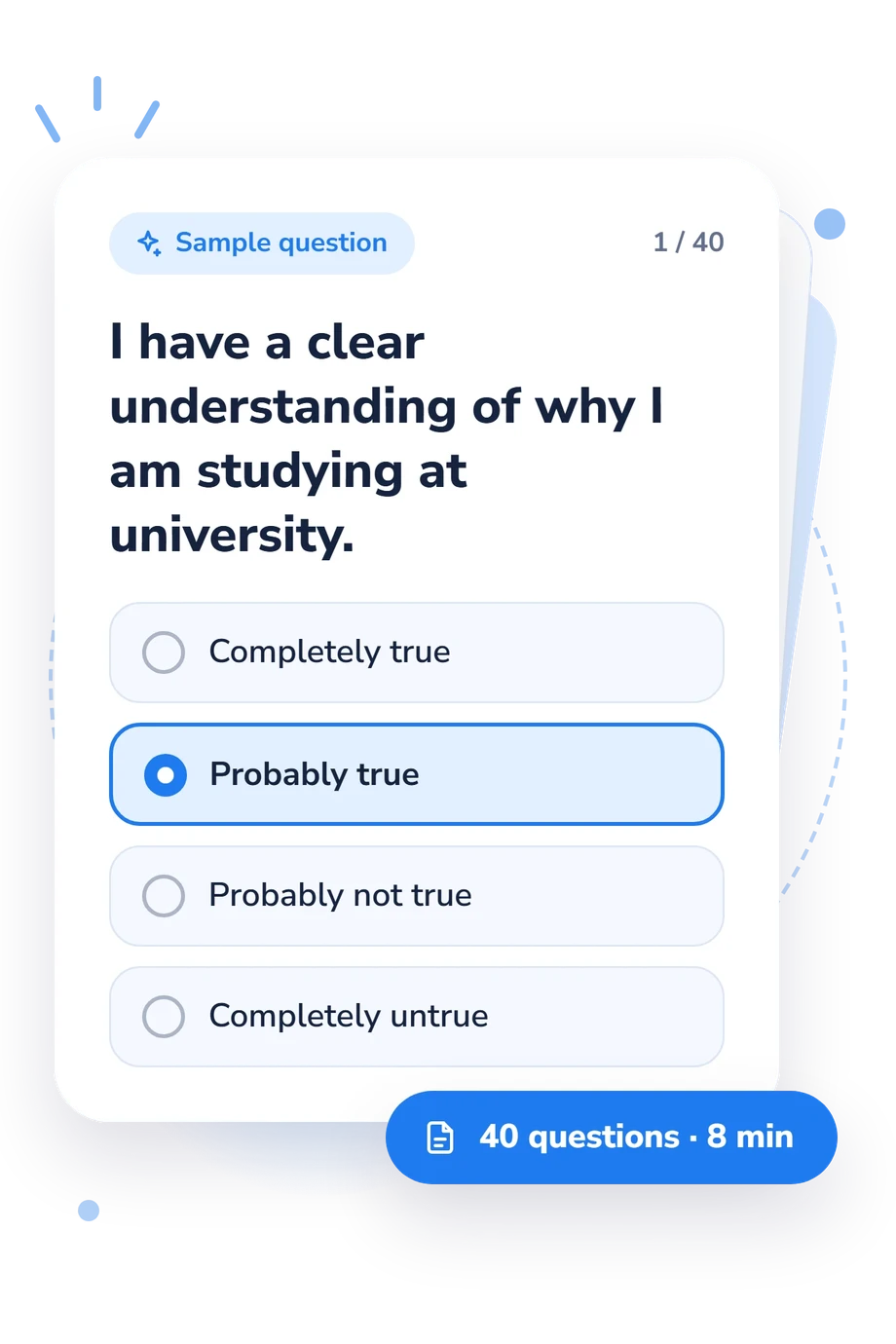
Below are a number of statements concerning your academic activities. Please read each statement carefully and indicate the extent to which you agree with it. Try not to spend too much time thinking about your answers, but do not skip any statements. Pay close attention to the wording of the items. They are either direct or reverse-worded. Silently ask yourself, “Is this true?”, and then select the response that best corresponds to your answer.
    • Completely true
    • Probably true
    • Probably not true
    • Completely untrue
    • Completely true
    • Probably true
    • Probably not true
    • Completely not true
    • Completely true
    • Probably true
    • Probably untrue
    • Completely untrue
WHAT THE TEST MEASURES
About This Assessment
Questionnaire on Mindful Regulation of Learning Activities, QMRLA Test

Conscious Self-Regulation of Learning Activity Questionnaire Test - Symptoms and Signs

self-regulation
academic motivation

This questionnaire is a brief self-report measure designed to assess how individuals consciously manage their learning processes. The Conscious Self-Regulation of Learning Activity Questionnaire focuses on perceived use of strategies such as planning, monitoring, and adjusting study-related actions in response to goals and challenges.

It includes 40 items and typically takes about 8 minutes to complete. Response patterns can be used to describe relative strengths and gaps in self-regulatory approach to learning and to inform educational or counseling discussions; interpretation should consider the respondent’s context and is not intended to serve as a standalone diagnostic indicator. Zimmerman and Schunk are cited as authors.

The Conscious Self-Regulation of Learning Activity Questionnaire may be used in educational settings and research to characterize self-regulation habits across different learning demands.

Author: Barry J. Zimmerman, Dale H. Schunk
Literature: Zimmerman, B. J. Becoming a self-regulated learner: An overview. Theory Into Practice. 2002.; Pintrich, P. R. The role of goal orientation in self-regulated learning. In M. Boekaerts, P. R. Pintrich, & M. Zeidner (Eds.), Handbook of self-regulation. Academic Press. 2000.
Popular tests
Comments
Leave a Comment