
Sleep-Related Behavior Questionnaire (SRBQ) Test
How the Scales are Structured
Who Usually Takes This Test?
See How You Compare
Below is a preview of how scores are typically distributed across each scale.
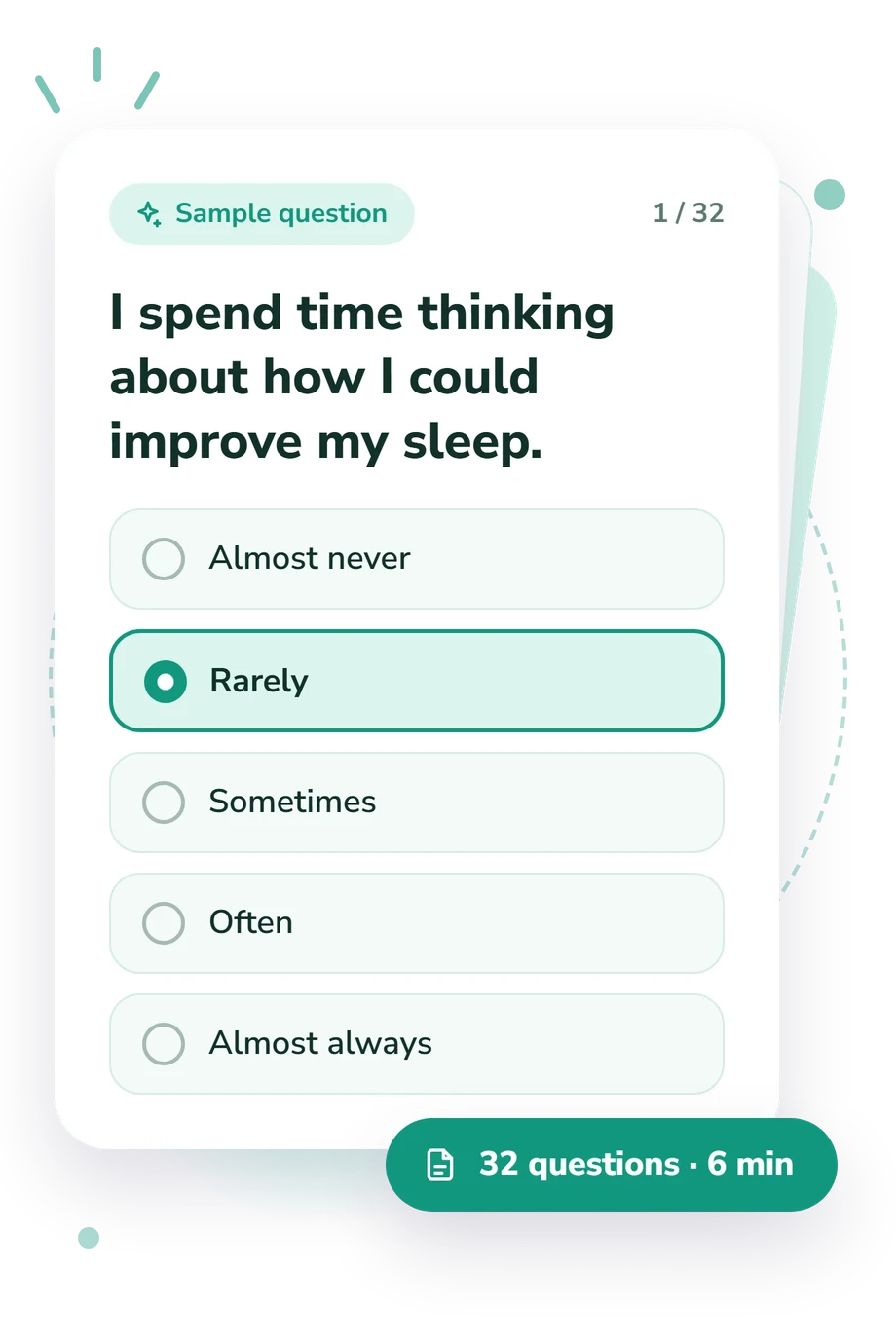
Example Questions From the Test
- Almost never
- Rarely
- Sometimes
- Often
- Almost always
- Almost never
- Rarely
- Sometimes
- Often
- Almost always
- Almost never
- Rarely
- Sometimes
- Often
- Almost always
Sleep-Related Behavior Questionnaire (SRBQ) Test - Description and methodology of the test
People who notice that worries about sleep shape their daytime choices can use the Sleep-Related Behavior Questionnaire (SRBQ) Test to examine those patterns in a structured way. It is intended for self-reflection around insomnia-related routines, avoidance, and attempts to control sleep. As a sleep behavior assessment, it can show whether these responses are occasional or prominent and help identify habits worth discussing or reconsidering.
What the Questionnaire Measures
The questionnaire focuses on safety behaviors: actions taken to prevent feared consequences of poor sleep. Items ask about going to bed early, napping, clock-checking, suppressing thoughts, reducing commitments, and avoiding activities or social situations. These sleep-related coping strategies can feel protective in the moment while also keeping attention fixed on sleep, narrowing daytime functioning, and sometimes exacerbating sleep problems.
The result is organized around one displayed dimension:
- The Unproductive Safety Behaviors scale (0-128) measures strategies intended to prevent perceived negative consequences of insomnia but based on inaccurate beliefs about sleep; the bands are Low 0-13, Moderate 14-49, and High 50-128.
The bands describe how strongly this pattern is represented in the response profile. Read the result as a prompt to examine the relationship between sleep concerns, daily choices, and attempts to manage perceived risk.
Methodology and Scientific Basis
Each item uses a five-point frequency response, from Almost never to Almost always. The online form reports one total and displayed bands, but does not specify how responses contribute; interpret the result at band level rather than infer item weights. This format records frequency rather than a yes/no judgment.
The questionnaire is conceptually consistent with the original Sleep-Related Behaviours Questionnaire by Ree and Harvey (2004), but this online version is neither the original instrument nor an adaptation. Its conceptual framework is consistent with Harvey's (2002) cognitive model of insomnia, which describes how efforts to control sleep and prevent daytime consequences can maintain worry and unhelpful patterns. Lebrun and colleagues (2020) studied an adapted version in a nonclinical sample; this supports the construct's relevance but does not validate this English form. Displayed bands are reporting categories, not universal clinical norms.
Results from this insomnia questionnaire should be interpreted alongside the situations behind the answers. Current stress, recent sleep disruption, memory, and self-awareness can affect self-report, so the score is a reflection aid rather than a clinical diagnosis.
- Ree, M. J., & Harvey, A. G. (2004). Investigating Safety Behaviours in Insomnia: The Development of the Sleep-related Behaviours Questionnaire (SRBQ). Behaviour Change, 21(1), 26-36. 10.1375/bech.21.1.26.35971
- Harvey, A. G. (2002). Identifying safety behaviors in insomnia. The Journal of Nervous and Mental Disease, 190(1), 16-21. 10.1097/00005053-200201000-00004
- Harvey, A. G. (2002). A cognitive model of insomnia. Behaviour Research and Therapy, 40(8), 869-893. 10.1016/S0005-7967(01)00061-4
- Lebrun, C., Gély-Nargeot, M.-C., Maudarbocus, K. H., & Bayard, S. (2020). Assessing Sleep-Related Safety Behaviors: Adaptation and Validation of a French Version of the Sleep-Related Behaviors Questionnaire in a Nonclinical Sample. Behavioral Sleep Medicine, 18(1), 107-119. 10.1080/15402002.2018.1546178
Updated: