
Freudly+971 508685814hello@freudly.ai
Freudly
intuition

Self-Perceived Intuition Questionnaire Test
Take the online Self-Perceived Intuition Questionnaire Test - AI psychologist FreudlyYou can take Self-Perceived Intuition Questionnaire Testhere. Online version of a simple and accurate psychological test with interpretation.en
Understand how you experience and trust intuition in daily life in about 16 minutes. With 85 questions, it offers clear insights you can use in counseling, career planning, or personal growth.
Start Online Test
Questions: 8516 minutes
08:30
October 2, 2025
October 2, 2025
Material has been updated
October 2, 2025
Material has been published
17,063 views
1,593 completions
1,394 likes
Verified by Daniel Hall
Psychologist with 25 years of experience
Share
Scale Explorer

How the Scales are Structured

example score
2/5
Present Orientation (PO)
Measures how much a person relies on intuition to respond to what is happening now or in the immediate near future.
Low present-focus
Moderate present-focus
High present-focus
01: Low present-focus | 23: Moderate present-focus | 45: High present-focus
A score of 2 suggests a moderate tendency to use intuitive signals for in-the-moment situations, though this may be inconsistent or depend on context.
example score
3/5
In Professional Activity (IPA)
Measures how strongly a person believes they can rely on intuition to guide decisions and actions in professional work situations.
Low reliance
Moderate reliance
High reliance
01: Low reliance | 23: Moderate reliance | 45: High reliance
A score of 3 suggests a moderate tendency to trust and use intuitive judgments at work, typically alongside deliberate analysis and available information.
example score
2/5
Future Orientation (FO)
Measures how strongly a person’s intuition is oriented toward anticipating and sensing possible future events.
Low future orientation
Moderate future orientation
High future orientation
01: Low future orientation | 23: Moderate future orientation | 45: High future orientation
A score of 2 suggests a moderate tendency to use intuition for anticipating future events, with this ability showing up sometimes rather than consistently.
example score
2/5
Past Orientation (PO)
Measures how strongly a person believes they can intuitively know or sense past events without deliberate reasoning or external information.
Low
Moderate
High
01: Low | 23: Moderate | 45: High
A score of 2 suggests a moderate tendency to notice or trust intuitive impressions about past events, though this is not a consistent or strongly relied-upon source of understanding.
example score
3/5
Emotional Stability (ES)
Measures how well inner calm and independence from external disturbances support the expression of intuition.
Low balance
Moderate balance
High balance
01: Low balance | 23: Moderate balance | 45: High balance
A score of 3 indicates a moderate level of equanimity, suggesting intuition is often accessible when relatively calm but may be disrupted by stronger external pressures.
example score
2/5
Altered States (AS)
Measures how strongly you believe altered states of consciousness (e.g., sleep, meditation, trance) help intuition emerge.
Low
Moderate
High
01: Low | 23: Moderate | 45: High
A score of 2 suggests a moderate belief that altered states can support intuition, but this is not a dominant source of intuitive experience for you.
example score
3/5
Kinesthetic Modality (KM)
Measures how strongly a person relies on bodily sensations as intuitive signals when evaluating decisions or situations.
Low
Moderate
High
01: Low | 23: Moderate | 45: High
A score of 3 indicates a moderate tendency to notice and sometimes trust bodily cues (e.g., tension or ease) as guidance, while still balancing them with other information.
example score
3/5
Visual Modality (VM)
Measures how strongly a person experiences intuition as spontaneous visual images or mental pictures that guide decisions.
Low
Moderate
High
01: Low | 23: Moderate | 45: High
A score of 3 suggests a moderate tendency to notice intuitive visual images that sometimes help point toward solutions.
example score
2/5
Auditory Modality (AM)
Measures the extent to which intuition is experienced as auditory cues such as an inner voice or imagined sounds that guide decisions or actions.
Low
Moderate
High
01: Low | 23: Moderate | 45: High
A score of 2 indicates a moderate tendency to notice occasional inner-voice or sound-like intuitive cues, but they are not a dominant guide in everyday decisions.
example score
2/5
Interpersonal Relationships (IR)
Measures how much you rely on intuitive impressions and cues when understanding and interacting with other people.
Low
Moderate
High
01: Low | 23: Moderate | 45: High
A score of 2 indicates a moderate tendency to notice and sometimes trust intuitive signals in interpersonal situations, while still relying substantially on deliberate reasoning or explicit information.
example score
3/5
Self-Focused Intuition (SFI)
Measures how strongly a person directs intuition toward understanding their own feelings, motives, and life experiences.
Low
Moderate
High
01: Low | 23: Moderate | 45: High
A score of 3 suggests a moderate tendency to notice and use intuitive insights about oneself, with this ability showing up in some situations more than others.
example score
1/5
Everyday Life Activation (ELA)
This scale measures how often and how confidently a person relies on intuition in routine everyday situations such as communication, shopping, or walking.
Low activation
Moderate activation
High activation
01: Low activation | 23: Moderate activation | 45: High activation
A score of 1 indicates low activation of intuition in everyday life, suggesting you rarely use gut feelings in typical daily situations and tend to rely more on deliberate cues.
example score
2/5
Activation in Extreme Situations (AiES)
Measures how strongly a person’s intuition becomes activated to support rapid decisions in dangerous, high-pressure, or high-responsibility situations.
Low activation
Moderate activation
High activation
01: Low activation | 23: Moderate activation | 45: High activation
A score of 2 suggests a moderate tendency to rely on intuitive cues in extreme situations, with intuition present but not consistently leading decision-making under pressure.
example score
3/5
Negative State (NS)
Measures how strongly intuition is experienced or relied upon when a person is in negative emotional or physical states such as stress, discomfort, or fatigue.
Low
Moderate
High
01: Low | 23: Moderate | 45: High
A score of 3 indicates a moderate tendency for negative states to coincide with or amplify intuitive impressions in challenging situations.
example score
4/5
Positive State (PS)
Measures how much feeling physically and emotionally well supports the expression and use of intuition.
Low positive state
Moderate positive state
High positive state
01: Low positive state | 23: Moderate positive state | 45: High positive state
A score of 4 indicates a high positive state, suggesting that feelings of comfort and well-being are likely to help you notice and trust intuitive cues in everyday situations.
example score
3/5
Temporal Orientation (TO)
Measures how flexibly you intuitively attune to information about the past, present, and future.
Limited temporal range
Moderate temporal flexibility
High temporal flexibility
01: Limited temporal range | 23: Moderate temporal flexibility | 45: High temporal flexibility
A score of 3 suggests a moderate ability to use intuition across time perspectives, with some consistency but not full flexibility across past, present, and future cues.
example score
2/5
Intention/Psychokinesis (I)
Measures how strongly you feel your inner intention or will can influence events through intuition.
Low
Moderate
High
01: Low | 23: Moderate | 45: High
A score of 2 suggests a moderate sense that focused intention can sometimes shape outcomes, but this feeling is not consistently strong across situations.
example score
3/5
Voluntary Use of Intuition (VUoI)
Measures how readily a person can deliberately engage intuition as a tool for decision-making rather than relying only on spontaneous gut feelings.
Mostly spontaneous
Sometimes intentional
Deliberately engaged
01: Mostly spontaneous | 23: Sometimes intentional | 45: Deliberately engaged
A score of 3 suggests you can intentionally draw on intuition at times, though it may still be inconsistent across situations.
example score
4/5
Intuition Accuracy (IA)
Measures how clear, detailed, and dependable a person perceives their intuitive information and decisions to be.
Low accuracy
Moderate accuracy
High accuracy
02: Low accuracy | 34: Moderate accuracy | 5: High accuracy
A score of 4 suggests you generally experience your intuition as fairly clear and reliable, with occasional uncertainty or variability across situations.
example score
2/5
Intuition Strength (IS)
Measures how frequently, intensely, and meaningfully you experience intuitive sensations in daily life.
Low
Moderate
High
01: Low | 23: Moderate | 45: High
A score of 2 suggests a moderate level of intuitive experiences that show up sometimes and may be noticed in certain situations but are not consistently vivid or central to decisions.
example score
3/5
Total Score (TS)
This total score summarizes the overall strength and consistency of your self-reported intuitive perceptions and their use across everyday situations.
Low
Moderate
High
02: Low | 34: Moderate | 5: High
A score of 3 indicates a moderate overall level of intuition, suggesting you sometimes rely on and notice intuitive signals, though not consistently across situations.
Start Online Test
just completed the test
DATA-BASED USER COHORTS

Who Usually Takes This Test?

Decision-makers under pressure
41%OF USERS
People in fast-paced roles take it to see whether they trust their gut appropriately when choices must be made quickly.
Personal growth seekers
34%OF USERS
Curious self-improvers use it to understand how much intuition guides their habits, goals, and everyday problem-solving.
Counseling and coaching clients
25%OF USERS
People in therapy or coaching take it to clarify how intuition affects relationships, communication, and self-confidence.
BASED ON AGGREGATED, ANONYMIZED DATA FROM TENS OF THOUSANDS OF FREUDLY USERS.
Benchmarking

See How You Compare

Once you complete the test, your results are compared with real-world data from people in your country.
Below is a preview of how scores are typically distributed across each scale.
For example, in the present (Feitp)
Average
3.1
Normal range
2.43.8
min.
0
max.
5
This curve shows how scores are typically distributed.
Once you complete the test, your result will appear on the scale so you can see how you compare.
In professional activities (Ipa)
Average
3.1
Normal range
2.53.7
min.
0
max.
5
This curve shows how scores are typically distributed.
Once you complete the test, your result will appear on the scale so you can see how you compare.
E.g., for the future (Eftf)
Average
2.2
Normal range
1.33
min.
0
max.
5
This curve shows how scores are typically distributed.
Once you complete the test, your result will appear on the scale so you can see how you compare.
For example, about the past (Featp)
Average
3.6
Normal range
2.74.5
min.
0
max.
5
This curve shows how scores are typically distributed.
Once you complete the test, your result will appear on the scale so you can see how you compare.
Balance (B)
Balance (B)
Average
3
Normal range
2.23.7
min.
0
max.
5
This curve shows how scores are typically distributed.
Once you complete the test, your result will appear on the scale so you can see how you compare.
Altered States (AS)
Altered States (AS)
Average
3.3
Normal range
2.44.2
min.
0
max.
5
This curve shows how scores are typically distributed.
Once you complete the test, your result will appear on the scale so you can see how you compare.
Kinesthetic modality (Km)
Average
1.3
Normal range
0.52.1
min.
0
max.
5
This curve shows how scores are typically distributed.
Once you complete the test, your result will appear on the scale so you can see how you compare.
Visual modality (Vm)
Average
3
Normal range
23.9
min.
0
max.
5
This curve shows how scores are typically distributed.
Once you complete the test, your result will appear on the scale so you can see how you compare.
Auditory modality (Am)
Average
1.4
Normal range
0.52.3
min.
0
max.
5
This curve shows how scores are typically distributed.
Once you complete the test, your result will appear on the scale so you can see how you compare.
Interpersonal Relationships (IR)
Average
1.8
Normal range
0.82.7
min.
0
max.
5
This curve shows how scores are typically distributed.
Once you complete the test, your result will appear on the scale so you can see how you compare.
Self-subjective relationships (Sr)
Average
3.7
Normal range
2.84.5
min.
0
max.
5
This curve shows how scores are typically distributed.
Once you complete the test, your result will appear on the scale so you can see how you compare.
Active in everyday life (Aiel)
Average
1.3
Normal range
0.52.1
min.
0
max.
5
This curve shows how scores are typically distributed.
Once you complete the test, your result will appear on the scale so you can see how you compare.
Act. in extreme situations (Aies)
Average
3.4
Normal range
2.74.2
min.
0
max.
5
This curve shows how scores are typically distributed.
Once you complete the test, your result will appear on the scale so you can see how you compare.
Negative State (NS)
Negative State (NS)
Average
2.7
Normal range
1.93.6
min.
0
max.
5
This curve shows how scores are typically distributed.
Once you complete the test, your result will appear on the scale so you can see how you compare.
Positive State (PS)
Positive State (PS)
Average
2
Normal range
1.42.7
min.
0
max.
5
This curve shows how scores are typically distributed.
Once you complete the test, your result will appear on the scale so you can see how you compare.
Temporal Orientation (TO)
Average
3
Normal range
2.33.8
min.
0
max.
5
This curve shows how scores are typically distributed.
Once you complete the test, your result will appear on the scale so you can see how you compare.
Intention/Psychokinesis (I)
Average
1.9
Normal range
1.12.7
min.
0
max.
5
This curve shows how scores are typically distributed.
Once you complete the test, your result will appear on the scale so you can see how you compare.
The Arbitrary Nature of Intuition (TANoI)
Average
1.5
Normal range
0.92.1
min.
0
max.
5
This curve shows how scores are typically distributed.
Once you complete the test, your result will appear on the scale so you can see how you compare.
Accuracy of Intuition (AoI)
Average
3
Normal range
2.23.9
min.
0
max.
5
This curve shows how scores are typically distributed.
Once you complete the test, your result will appear on the scale so you can see how you compare.
The Power of Intuition (TPoI)
Average
3.2
Normal range
2.54
min.
0
max.
5
This curve shows how scores are typically distributed.
Once you complete the test, your result will appear on the scale so you can see how you compare.
Total score (Ts)
Total score (Ts)
Average
2.2
Normal range
1.52.9
min.
0
max.
5
This curve shows how scores are typically distributed.
Once you complete the test, your result will appear on the scale so you can see how you compare.
Featured On
SAMPLE QUESTIONS

Example Questions From the Test

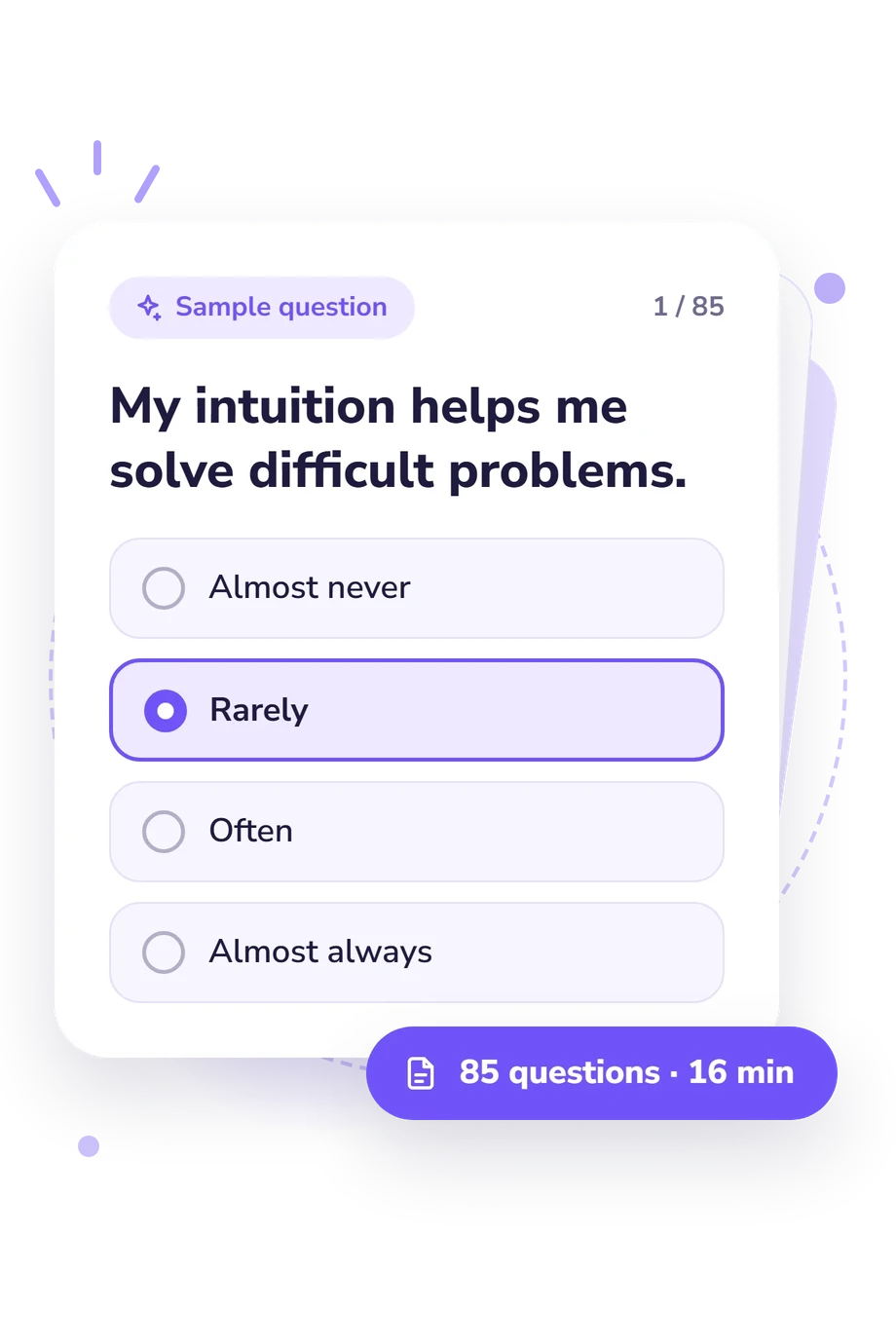
You are asked to rate how intuition manifests in your life. For each statement, select the response option that you feel best reflects your life experience. There are no right or wrong answers.
    • Almost never
    • Rarely
    • Often
    • Almost always
    • Almost never
    • Rarely
    • Often
    • Almost always
    • Almost never
    • Rarely
    • Often
    • Almost always
WHAT THE TEST MEASURES
About This Assessment
Questionnaire on Beliefs About One's Own Intuition, QBOI Test

Self-Perceived Intuition Questionnaire Test - Symptoms and Signs

intuition

This self-report measure assesses how individuals perceive and report using intuitive processes in everyday life. The Self-Perceived Intuition Questionnaire is intended to capture perceived tendencies to rely on rapid, non-deliberative impressions across common situations and activities.

The instrument includes 85 items and typically requires about 16 minutes to complete. Item content broadly reflects perceived intuition in personal, interpersonal, and self-regulatory contexts, supporting descriptive profiling of self-perceived intuitive functioning.

Developed by Seymour Epstein and Gary Klein, the Self-Perceived Intuition Questionnaire may be used in clinical, counseling, or research settings to facilitate discussion of decision-making style and perceived reliance on intuitive judgments, with interpretation guided by the broader assessment context.

Author: Gary Klein, Seymour Epstein
Literature: Kahneman, D. Thinking, fast and slow. Farrar, Straus and Giroux. 2011.; Epstein, S. Integration of the cognitive and the psychodynamic unconscious. American Psychologist. 1994.
Popular tests
Comments
Leave a Comment