
Checklist for Autism Spectrum Disorder (CASD) Test
How the Scales are Structured
Who Usually Takes This Test?
See How You Compare
Below is a preview of how scores are typically distributed across each scale.
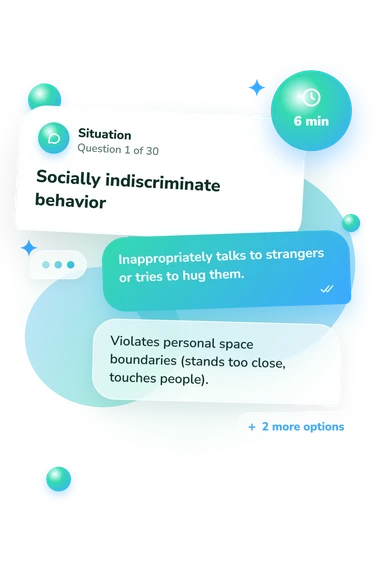
Example Questions From the Test
- Seeks to be alone; appears detached; avoids contact with others; prefers to play alone rather than with peers.
- Plays alongside peers but does not engage in shared play.
- Has difficulty forming friendships.
- Limited social smiling and eye contact (looks away, "through" people, or only at the speaker’s mouth; makes eye contact only after being prompted, or not at all).
- Limited ability to show and share (e.g., does not show toys to adults, does not seek praise, or does not share experiences or achievements with others).
- Lack of flexibility in play with peers (insists on repetitive, rule-bound play related to unusual interests).
- Enjoys games and activities that involve physical contact with others (e.g., tickling, chasing), but has difficulty with social interaction (e.g., does not play social games that require taking turns).
- Is egocentric or absorbed in an inner world (e.g., engages in self-stimulatory activity, talks to self, excessively fantasizes about cartoons, movies, etc.).
- Forgets that others are present; does not respond when others try to make contact.
Checklist for Autism Spectrum Disorder (CASD) Test - Description and methodology of the test
Caregivers and professionals seeking a structured way to organize observations about a child’s development may find the Checklist for Autism Spectrum Disorder (CASD) Test useful. As an autism spectrum disorder questionnaire, it gathers signs across communication, social interaction, behavior, sensory processing, and development. The result summarizes the level of indications reflected in the responses and helps clarify whether broader evaluation deserves attention.
What This Assessment Explores
Items cover social reciprocity, play, language, flexibility, sensory responses, emotions, attention, and danger awareness. It suits caregivers or clinicians seeking an organized profile of a child rather than a conclusion from one behavior.
Question themes contributing to the single total score are:
- Social communication describes responses to people, shared attention, language, cues, and relationships.
- Restricted and repetitive patterns show whether interests, movements, play, or routines become fixed or hard to interrupt.
- Sensory and bodily responses capture reactions to sound, touch, movement, pain, food, sleep, and visual exploration.
- Developmental and behavioral features summarize language history, uneven abilities, emotions, attention, fears, frustration, and safety awareness.
Used as an autism traits checklist, this questionnaire organizes patterns across settings. The CASD Total Score is 0-100: Low indications 0-33, Moderate indications 34-66, and High indications 67-100. It estimates autistic-trait risk and may signal need for evaluation.
Methodology and Evidence Base
Questions use concrete descriptions of behaviors and situations rather than abstract ratings. Response choices cover limited reciprocal interaction, sensory aversion, repetitive play, language differences, meltdowns, and danger awareness; some items refer to current or past characteristics. Selected responses form the displayed total, but the online form does not specify how many points each answer adds.
The CASD manual presents the instrument as a structured developmental screening tool. Mayes and Calhoun connect relevant symptoms with DSM descriptions; later studies examine overlap with ADHD and identify the most discriminating autism items. This CASD screening questionnaire is conceptually consistent with that work, not an adaptation of it.
Interpretation depends on the reporter’s knowledge and the child’s behavior across settings. Recall, current stress, response bias, and differences between home and school can affect answers. The result is not a standalone diagnosis; elevated indications require professional interpretation, while manual norms and professional scoring conditions are not documented for the online form.
- Mayes, Susan Dickerson. CASD: Checklist for Autism Spectrum Disorder: Manual. Wood Dale, IL: Stoelting, 2012. 10.1037/t03996-000
- Mayes, Susan Dickerson, and Susan L. Calhoun. Symptoms of Autism in Young Children and Correspondence with the DSM. Infants and Young Children, 12(2), 90-97, 1999. 10.1097/00001163-199910000-00011
- Mayes, Susan Dickerson, Susan L. Calhoun, Rebecca D. Mayes, and Sarah Molitoris. Autism and ADHD: Overlapping and Discriminating Symptoms. Research in Autism Spectrum Disorders, 6(1), 277-285, 2012. 10.1016/j.rasd.2011.05.009
- Mayes, Susan D. Brief Report: Checklist for Autism Spectrum Disorder: Most Discriminating Items for Diagnosing Autism. Journal of Autism and Developmental Disorders, 48(3), 935-939, 2018. 10.1007/s10803-017-3401-0