
Romantic Relationship Motivation Types Questionnaire (CMQ) Test
How the Scales are Structured
Who Usually Takes This Test?
See How You Compare
Below is a preview of how scores are typically distributed across each scale.
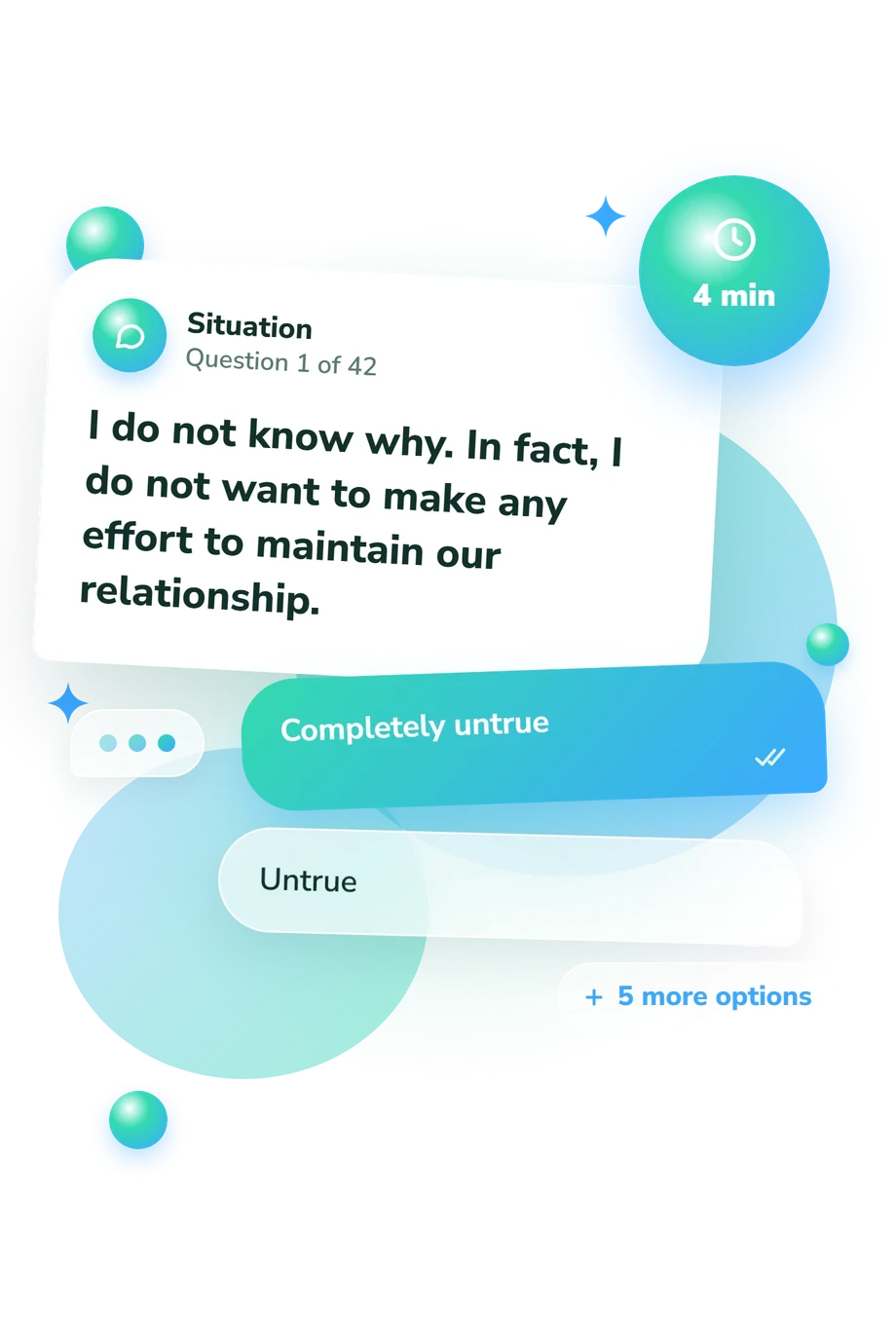
Example Questions From the Test
- Does not apply to reality at all
- Does not apply to reality
- Rather does not apply to reality
- Neither applies nor does not apply
- Rather applies to reality
- Applies to reality
- Completely applies to reality
- Not true at all
- Not true
- Rather not true
- Neither true nor untrue
- Rather true
- True
- Completely true
- Completely untrue
- Untrue
- Somewhat untrue
- Neither true nor untrue
- Somewhat true
- True
- Completely true
Romantic Relationship Motivation Types Questionnaire (CMQ) Test - Description and methodology of the test
People who want to understand why they remain engaged in a partnership can use the Romantic Relationship Motivation Types Questionnaire (CMQ) Test as a structured self-reflection exercise. As a romantic relationship motivation questionnaire, it focuses on the motives behind effort, commitment, enjoyment, obligation, and uncertainty. It produces a profile of motivational tendencies rather than a single relationship-quality verdict.
What This Assessment Explores
The assessment maps why someone stays engaged: enjoyment, personal meaning, guilt, outside pressure, or unclear motivation. Used as a relationship motivation test, it describes motivational tendencies rather than relationship quality.
These six dimensions are:
- Integrated Regulation (1-7) shows values-based motives: Low integration (1-3.1), Moderate integration (3.2-4.5), High integration (4.6-7).
- Identified (1-7) reflects personally meaningful action: Low identified (1-2.3), Moderate identified (2.4-4.3), High identified (4.4-7).
- Introjected Regulation (1-7) captures guilt or self-esteem pressure: Low introjection (1-1.8), Moderate introjection (1.9-3.9), High introjection (4-7).
- External Regulation (1-7) indicates demands, rewards, or feared consequences: Low external control (1-1.6), Moderate external control (1.7-3.4), High external control (3.5-7).
- Amotivation (1-7) indicates unclear or absent reasons: Low (1-2.71), Elevated (2.72-7).
- Intrinsic Motivation (1-7) reflects enjoyment and interest for their own sake: Low (1-2.8), Moderate (2.9-4.4), High (4.5-7).
Methodology and Evidence Base
Each statement uses seven graded response options, generally moving from non-applicability or untruth through neutrality to complete applicability or truth. Items address enjoyment, shared experiences, personal development, intimacy, obligation, outside expectations, and uncertainty.
Answers are grouped into six motivational dimensions rather than one total score. Each band is a descriptive level within its dimension; a high score on one motive can coexist with a high or low score elsewhere.
Its conceptual reference is the Couple Motivation Questionnaire (Blais et al., 1990). This online questionnaire is conceptually consistent with that instrument, but the wording should not be treated as a direct adaptation. The Russian study by Klein and Kostenko (2021) provides related evidence about self-determination in romantic relationships. Ryan and Deci (2000) provide the autonomy framework distinguishing intrinsic, identified, introjected, and externally regulated motivation from amotivation.
These sources support the motivational framework, not population norms for this online version or validation of its displayed bands. Because answers depend on current circumstances and self-perception, the profile may shift with mood, defensiveness, or limited self-awareness; it is a reflection aid, not a diagnosis.
- Klein, K. G., & Kostenko, V. Y. (2021). Self-determination in romantic relationships: Findings from the Russian adaptation of the Couple Motivation Questionnaire. Psychological Studies, 14(78). 10.54359/ps.v14i78.126
- Blais, M. R., Sabourin, S., Boucher, C., & Vallerand, R. J. (1990). Toward a motivational model of couple happiness. Journal of Personality and Social Psychology, 59(5), 1021-1031. 10.1037/0022-3514.59.5.1021
- Ryan, R. M., & Deci, E. L. (2000). Intrinsic and extrinsic motivations: Classic definitions and new directions. Contemporary Educational Psychology, 25(1), 54-67. 10.1006/ceps.1999.1020
Updated: