
Believability of Anxious Feelings and Thoughts Questionnaire (BAFT) Test
How the Scales are Structured
Who Usually Takes This Test?
See How You Compare
Below is a preview of how scores are typically distributed across each scale.
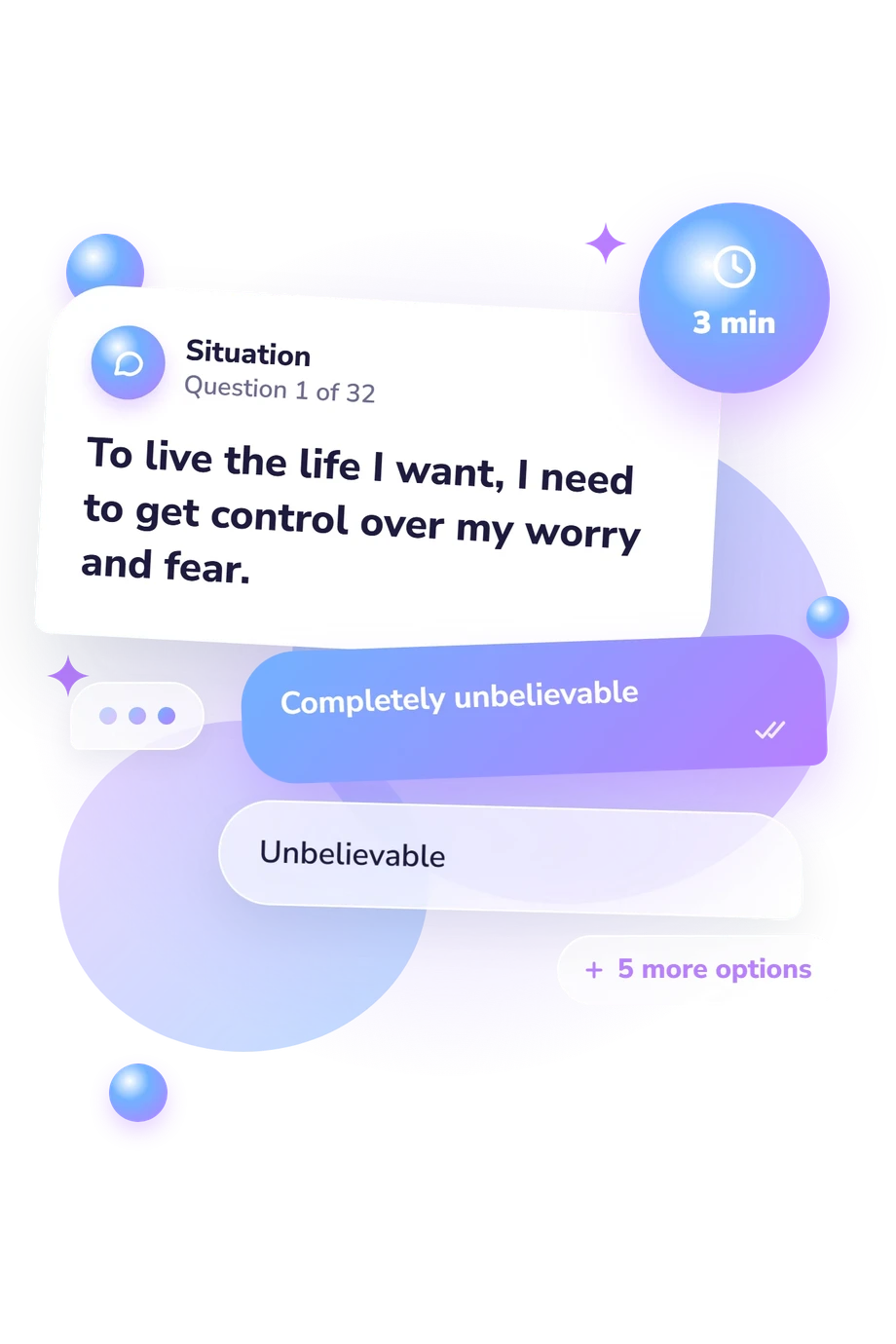
Example Questions From the Test
- Completely unbelievable
- Unbelievable
- Somewhat unbelievable
- Neutral
- Somewhat believable
- Believable
- Completely believable
- Completely unbelievable
- Unbelievable
- Slightly unbelievable
- Neither believable nor unbelievable
- Slightly believable
- Believable
- Completely believable
- Completely unbelievable
- Unbelievable
- Slightly unbelievable
- Neither believable nor unbelievable
- Somewhat believable
- Believable
- Completely believable
Believability of Anxious Feelings and Thoughts Questionnaire (BAFT) Test - Description and methodology of the test
People who experience anxious thoughts and feelings as highly believable, difficult to control, or closely tied to bodily sensations may use the Believability of Anxious Feelings and Thoughts Questionnaire (BAFT) Test to examine those patterns more closely. As an anxiety self-assessment, it helps a respondent consider how anxious experiences influence judgment, emotional control, and attention to bodily sensations. The result offers a structured profile for reflection rather than a single global label.
What This Assessment Explores
Questions examine how a person interprets anxiety, including self-judgment, control efforts, feared consequences, and attention to bodily sensations. In this BAFT questionnaire, higher scores indicate greater reported fusion of anxious thoughts and feelings with negative self-evaluation, efforts to control emotion, bodily sensations, or the perceived believability and meaning of anxious experiences, depending on the scale.
These four scales describe result dimensions:
- Negative Evaluation (6-42) reflects fusion of anxiety with harsh self-judgment: Low 6-17; Moderate 18-29; High 30-42.
- Emotion Regulation (5-35) reflects entanglement with controlling anxious feelings: Low 5-14; Moderate 15-24; High 25-35.
- Somatic Problems (5-35) reflects preoccupation with anxiety-related bodily sensations: Low 5-14; Moderate 15-24; High 25-35.
- Believability of Anxious Feelings and Thoughts (16-112) reflects how convincing and meaningful anxious experiences seem: Low believability 16-47; Moderate believability 48-79; High believability 80-112.
The profile highlights patterns for self-reflection.
Methodology and Scientific Basis
Each statement uses a seven-point believability response, from completely unbelievable to completely believable; midpoint labels vary slightly across items. The format asks how convincing a thought or feeling seems, rather than whether it is objectively true. The questionnaire reports four displayed scale scores and bands, but its item-weighting formula is not stated.
The questionnaire is conceptually consistent with BAFT (Herzberg et al., 2012), a published measure of cognitive fusion around anxious experiences. Ruiz, Odriozola-González, and Suárez-Falcón (2014) examined a Spanish version, while the Acceptance and Commitment Therapy model described by Hayes et al. (2006) provides the broader framework for fusion, control efforts, and entanglement with internal events. These studies support the published instruments, but they do not establish standardization, norms, reliability, or validity for this online version.
Interpret the profile as a prompt for examining recurring beliefs and reactions in the context of current anxiety. A self-report measure of cognitive fusion in anxiety can be influenced by mood, recent events, comprehension, and willingness to answer candidly, so a high result identifies a reported pattern, not its cause, severity, or diagnosis.
- Herzberg, K. N., Sheppard, S. C., Forsyth, J. P., Credé, M., Earleywine, M., & Eifert, G. H. (2012). The Believability of Anxious Feelings and Thoughts Questionnaire (BAFT): A psychometric evaluation of cognitive fusion in a nonclinical and highly anxious community sample. Psychological Assessment, 24(4), 877-891. 10.1037/a0027782
- Ruiz, F. J., Odriozola-González, P., & Suárez-Falcón, J. C. (2014). The Spanish version of the Believability of Anxious Feelings and Thoughts Questionnaire. Psicothema, 26(3), 308-313. 10.7334/psicothema2013.221
- Hayes, S. C., Luoma, J. B., Bond, F. W., Masuda, A., & Lillis, J. (2006). Acceptance and Commitment Therapy: Model, processes and outcomes. Behaviour Research and Therapy, 44(1), 1-25. 10.1016/j.brat.2005.06.006
Updated: