
Interpersonal Identity Questionnaire Test
How the Scales are Structured
Who Usually Takes This Test?
See How You Compare
Below is a preview of how scores are typically distributed across each scale.
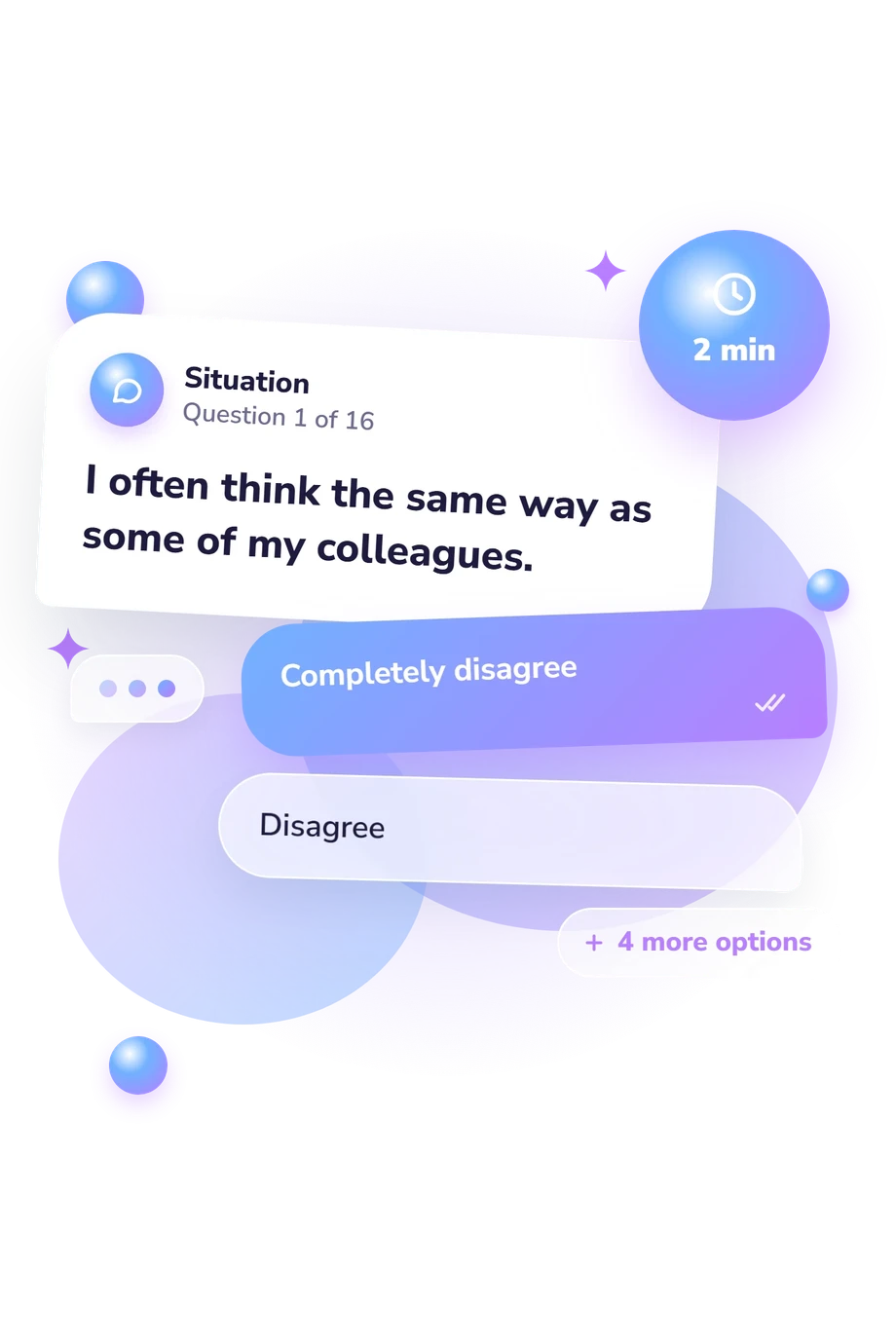
Example Questions From the Test
- Strongly disagree
- Disagree
- Somewhat disagree
- Somewhat agree
- Agree
- Strongly agree
- Completely disagree
- Disagree
- Somewhat disagree
- Somewhat agree
- Agree
- Completely agree
- Strongly disagree
- Disagree
- Somewhat disagree
- Somewhat agree
- Agree
- Strongly agree
Interpersonal Identity Questionnaire Test - Description and methodology of the test
People who want to understand how they relate to significant colleagues may use the Interpersonal Identity Questionnaire Test as a focused self-reflection exercise. It suits anyone examining workplace similarity, approval, belonging, and expectations in everyday interactions. The result offers a structured prompt for deciding which aspects of these relationships deserve closer reflection.
What This Assessment Measures
Rather than treating identity as one quality, the questionnaire separates three ways of experiencing a significant colleague relationship. Items address shared views and interests, unease when opinions differ, distress when common ground is missing, sensitivity to expectations, and attempts to resemble a colleague. Together, they frame identity in workplace relationships through thought, feeling, belonging, and conduct.
The three displayed components are:
- Behavioral Component (2-12) shows stable enactment of meaningful characteristics and conduct aligned with expectations: Low consistency 2-5, Moderate consistency 6-10, High consistency 11-12.
- Affective Component (3-18) reflects emotional connection, positivity, congruence, and reactions involving self or another person: Low connection/positivity 3-8, Moderate connection/positivity 9-14, and High connection/positivity 15-18.
- Cognitive Component (3-18) reflects belonging, an integrative bond, and perception of self or another through current characteristics: Low 3-10, Moderate 11-16, High 17-18.
Methodology and Evidence Base
The questionnaire uses a six-choice self-report format for each statement, moving from strong or complete disagreement to strong or complete agreement. The respondent places personal experience on this continuum, so the resulting scores depend on candid, context-sensitive answers.
The method is conceptually consistent with the Questionnaire of Interpersonal Identity developed by Sidorenkov and Pavlenko, which describes interpersonal identity through behavioral, affective, and cognitive manifestations. Related theoretical and empirical work by Sidorenkov and Trishkina examines interpersonal identity, while a study by Sidorenkov, Salnikova, Vorontsov, and Klimov examines identification dimensions in workgroups and collaborative contributions. This online questionnaire is a brief self-reflection tool, not a standardized adaptation of a published instrument.
Responses produce the three displayed component scores, and each has its own stated range and bands. The bands describe the level shown for each component rather than a single overall score or evidence that one dimension outweighs another. Because this brief self-report is sensitive to current workplace circumstances, mood, relationship salience, and self-awareness, its profile is a structured reflection snapshot rather than a clinical judgment or complete account of group relationships.
- Sidorenkov, Andrey V., and Roman V. Pavlenko. “Group Profile Computer Technique: A Tool for Complex Study of Small Groups.” SAGE Open, 5(1), 1-13, 2015. 10.1177/2158244015569418
- Sidorenkov, A. V., and N. S. Trishkina. “Empirical Grounds for the Model of Individuals’ Identity Manifestation in Small Group.” Psychological Journal, 31(5), 17-29, 2010.
- Sidorenkov, Andrey V., Ekaterina S. Salnikova, Dmitry V. Vorontsov, and Alexey A. Klimov. “Dimensions of Identification in the Workgroup and Employees’ Contributions to Collaborative Activities.” SAGE Open, 10(4), article 2158244020976385, 2020. 10.1177/2158244020976385
Updated: