
Psychological Difficulties Questionnaire Test
How the Scales are Structured
Who Usually Takes This Test?
See How You Compare
Below is a preview of how scores are typically distributed across each scale.
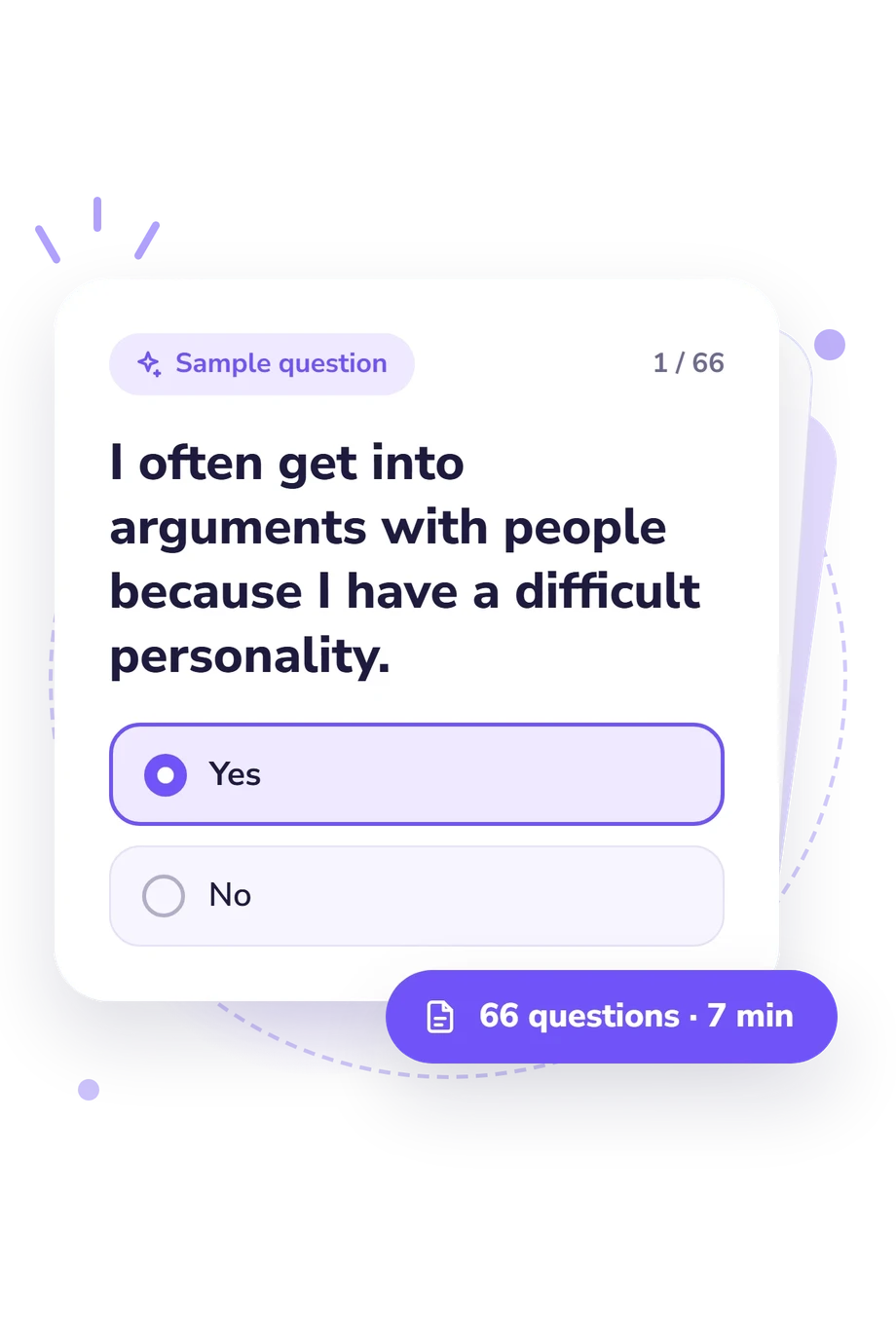
Example Questions From the Test
- Yes
- No
- Yes
- No
- Yes
- No
Psychological Difficulties Questionnaire Test - Description and methodology of the test
For readers who want a structured way to examine strain, the Psychological Difficulties Questionnaire Test offers a self-report of concerns that may affect family relationships, social confidence, work satisfaction, and personal circumstances. It can help a person notice whether difficulties appear limited, moderate, or pronounced. The result offers an assessment of psychological difficulties by indicating the general level represented by these concerns, rather than separate scores for each area.
What This Assessment Explores
The questionnaire examines situations in family life, parenting, relationships, work, and everyday life. Its themes contribute context to one overall indication of psychological difficulties, not separate scored traits.
Taken as a whole, this questionnaire about psychological difficulties describes item situations rather than a multi-domain profile.
These are the main themes represented in the items:
- Psychological Difficulties (0-33) assesses the respondent’s level of psychological difficulties: Low (0-12), Moderate (optimal) (13-23), or High (24-33); the high band may indicate distress or pronounced problems, while a low score may reflect limited awareness.
- Family and parenting situations cover conflict, distance, and uncertainty in close relationships as part of the overall result.
- Social and personal situations cover comfort with others, adaptation, loneliness, self-criticism, frustration, and feeling blocked without separate scores.
- Work and life concerns cover achievement, direction, and daily satisfaction within the same scale.
Methodology and Scientific Basis
Each item is answered Yes or No. The questionnaire displays one overall psychological difficulties score and one result band; its item-to-score conversion and any weighting rule are not specified, so the scoring process cannot be independently reconstructed.
The Malaise Inventory (Rutter et al., 1970) is a published self-report measure of psychological malaise; its relationship to this online questionnaire is not established. Research by McGee, Williams, and Silva (1986) evaluated that published instrument, while Rodgers, Pickles, Power, Collishaw, and Maughan (1999) examined its validity in general-population samples. These studies provide evidence about the published Malaise Inventory, not about this 33-item online version.
In practice, the result indicates the current level of psychological difficulties, and a high score may indicate psychological distress or pronounced problems, as the catalogue describes. Because the source studies do not establish identical norms, reliability, validity, or clinical cutoffs for this online version, and because responses can shift with mood, circumstances, self-awareness, and candour, read the band as a structured indication of perceived difficulty rather than a diagnosis or complete account of psychological functioning.
- Rutter, M., Tizard, J., & Whitmore, K. (1970). Education, Health and Behaviour. Longman, London.
- McGee, R., Williams, S. M., & Silva, P. A. (1986). An evaluation of the Malaise Inventory. Journal of Psychosomatic Research, 30(2), 147-152. 10.1016/0022-3999(86)90044-9
- Rodgers, B., Pickles, A., Power, C., Collishaw, S., & Maughan, B. (1999). Validity of the Malaise Inventory in general population samples. Social Psychiatry and Psychiatric Epidemiology, 34(6), 333-341. 10.1007/s001270050153
Updated: