
Freudly+971 508685814hello@freudly.ai
Freudly
dishonesty

Attitudes Toward Lying Questionnaire Test
Take the online Attitudes Toward Lying Questionnaire Test - AI psychologist FreudlyYou can take Attitudes Toward Lying Questionnaire Testhere. Online version of a simple and accurate psychological test with interpretation.en
Understand how you view different kinds of lies from people close to you in just 7 minutes. With 34 items, it gives clear insights to support counseling, team trust, or research.
Start Online Test
Questions: 347 minutes
08:30
October 2, 2025
October 2, 2025
Material has been updated
October 2, 2025
Material has been published
32,233 views
2,145 completions
1,833 likes
Verified by Daniel Hall
Psychologist with 25 years of experience
Share
Scale Explorer

How the Scales are Structured

example score
7/8
Justifying Lie (JL)
Measures how acceptable and understandable the respondent finds justificatory lies used to reduce blame after a shameful act is revealed.
Low acceptance
Moderate acceptance
High acceptance
02: Low acceptance | 35: Moderate acceptance | 68: High acceptance
A score of 7 falls in the High acceptance range, suggesting the respondent is generally more inclined to view justificatory lies as understandable or permissible for mitigating consequences.
example score
5/8
Fantasy Lying (FL)
Measures how acceptable or typical the person finds harmless fantasy-style lying used to embellish one’s image without intent to harm.
Low
Moderate
High
02: Low | 35: Moderate | 68: High
A score of 5 falls in the Moderate range, suggesting a noticeable but not dominant tendency to view image-enhancing, harmless fantasy lies as acceptable or understandable.
example score
4/8
Lying for Someone's Benefit (LfSB)
Measures how acceptable you find withholding important information to protect someone from harm.
Low acceptance
Moderate acceptance
High acceptance
02: Low acceptance | 35: Moderate acceptance | 68: High acceptance
A score of 4 indicates a moderate tendency to view protective withholding as acceptable in some situations, while still valuing openness in others.
example score
5/8
Polite Lie (PL)
Measures how acceptable and commonplace the person finds etiquette-based “polite lies” used to maintain social harmony.
Low acceptance
Moderate acceptance
High acceptance
02: Low acceptance | 35: Moderate acceptance | 68: High acceptance
A score of 5 suggests a moderate acceptance of etiquette lies, viewing them as situationally appropriate but not universally justified.
example score
7/12
Reasons for Lying (RfL)
Measures how strongly a person attributes various motives and reasons for lying to other people.
Few motives attributed
Moderate motives attributed
Many motives attributed
04: Few motives attributed | 58: Moderate motives attributed | 912: Many motives attributed
A score of 7 indicates a moderate tendency to see multiple possible reasons behind others’ lying rather than assuming a single motive.
example score
3/8
Lying as Self-Presentation (LaSP)
Measures how acceptable or typical a person finds lying that is used to enhance one’s image in interactions with acquaintances or strangers.
Low
Moderate
High
02: Low | 35: Moderate | 68: High
A score of 3 falls in the Moderate range, suggesting a generally mixed or situational attitude toward self-presentation lies rather than a strong acceptance or rejection.
example score
3/8
Gossip (G)
Measures how acceptable or typical a person finds sharing unverified information about others (gossip) as a form of lying.
Low
Moderate
High
02: Low | 35: Moderate | 68: High
A score of 3 falls in the Moderate range, suggesting a mixed or situational attitude toward gossip-related unverified information rather than a consistently rejecting or endorsing stance.
example score
4/8
Omission (O)
Measures how acceptable or impactful the respondent perceives lying by omission (withholding relevant information) in close relationships and everyday interactions.
Low acceptance
Moderate acceptance
High acceptance
02: Low acceptance | 35: Moderate acceptance | 68: High acceptance
A score of 4 indicates a moderate acceptance of omission, suggesting the respondent may see silence as sometimes permissible but still potentially misleading depending on context.
Start Online Test
just completed the test
DATA-BASED USER COHORTS

Who Usually Takes This Test?

Couples and close friends
41%OF USERS
People who want clearer boundaries around honesty in their relationship and to understand which kinds of lies feel acceptable or harmful.
Therapists and counselors
34%OF USERS
Practitioners who use a quick questionnaire to discuss trust, conflict triggers, and motives attributed to others’ deception in sessions.
HR and researchers
25%OF USERS
Professionals studying communication norms in teams or groups who need a structured, fast measure of attitudes toward different lie types.
BASED ON AGGREGATED, ANONYMIZED DATA FROM TENS OF THOUSANDS OF FREUDLY USERS.
Benchmarking

See How You Compare

Once you complete the test, your results are compared with real-world data from people in your country.
Below is a preview of how scores are typically distributed across each scale.
Lie-justification (L)
Average
5
Normal range
3.56.5
min.
0
max.
8
This curve shows how scores are typically distributed.
Once you complete the test, your result will appear on the scale so you can see how you compare.
Lie-Fantasy (L)
Lie-Fantasy (L)
Average
3.8
Normal range
2.55
min.
0
max.
8
This curve shows how scores are typically distributed.
Once you complete the test, your result will appear on the scale so you can see how you compare.
Lies for a Good Cause (LfaGC)
Average
5.9
Normal range
4.96.9
min.
0
max.
8
This curve shows how scores are typically distributed.
Once you complete the test, your result will appear on the scale so you can see how you compare.
Etiquette Lies (EL)
Etiquette Lies (EL)
Average
4.3
Normal range
3.35.3
min.
0
max.
8
This curve shows how scores are typically distributed.
Once you complete the test, your result will appear on the scale so you can see how you compare.
Causes of Lying (CoL)
Average
3
Normal range
1.14.9
min.
0
max.
12
This curve shows how scores are typically distributed.
Once you complete the test, your result will appear on the scale so you can see how you compare.
Self-Presentation Lies (SL)
Average
5.1
Normal range
3.66.6
min.
0
max.
8
This curve shows how scores are typically distributed.
Once you complete the test, your result will appear on the scale so you can see how you compare.
Gossip (G)
Gossip (G)
Average
2.4
Normal range
1.23.6
min.
0
max.
8
This curve shows how scores are typically distributed.
Once you complete the test, your result will appear on the scale so you can see how you compare.
Default (D)
Default (D)
Average
3.8
Normal range
2.45.1
min.
0
max.
8
This curve shows how scores are typically distributed.
Once you complete the test, your result will appear on the scale so you can see how you compare.
Featured On
SAMPLE QUESTIONS

Example Questions From the Test

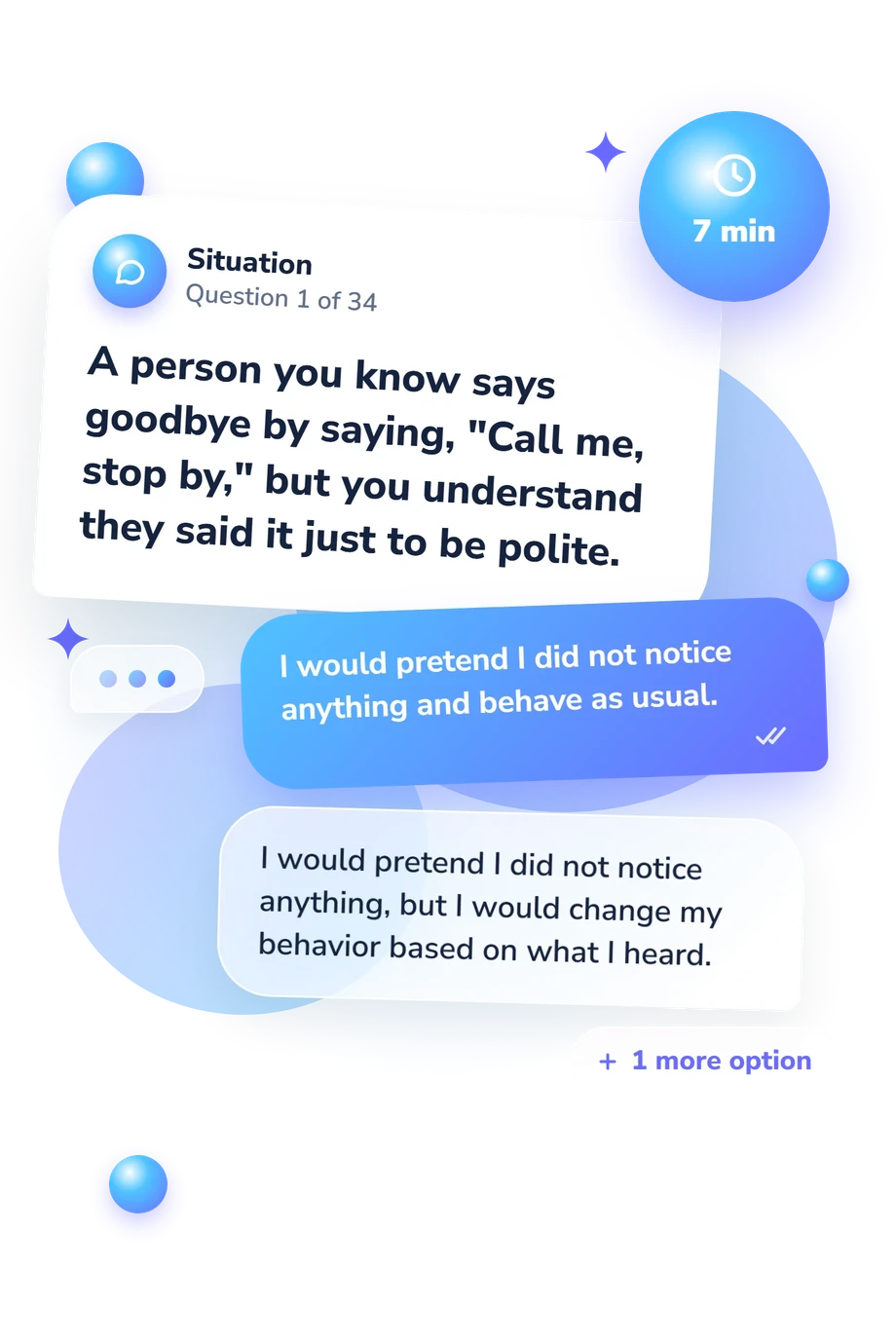
In everyday life, people often witness information being distorted as it is communicated. In some cases, the distortion is ignored; in others, it elicits indignation. You will now be presented with a series of common situations in which you witness information being distorted. Please recall how you typically respond in such situations and select one response option. If you have not encountered a particular situation, please try to imagine it.
    • This is one of the main reasons for lying
    • This is often a reason for lying
    • This is rarely a reason for lying
    • This is one of the main reasons for lying
    • This is often a reason for lying
    • This is rarely a reason for lying
    • This is one of the main reasons for lying.
    • This is often a reason for lying.
    • This is rarely a reason for lying.
WHAT THE TEST MEASURES
About This Assessment
Questionnaire on Attitudes Toward Lying Test

Attitudes Toward Lying Questionnaire Test - Symptoms and Signs

dishonesty

This questionnaire assesses how an individual evaluates the acceptability and impact of different forms of deception in interpersonal contexts. The Attitudes Toward Lying Questionnaire can be used to characterize attitudes toward lying by close others (e.g., family, friends, coworkers) and related inferences about motives for deception.

Developed by Paul Ekman, it consists of 34 items and typically requires about 7 minutes to complete. Items are intended to capture distinctions among common types of lies and perceived reasons for lying, supporting clinical formulation or research focused on trust, boundaries, and interpersonal expectations.

The Attitudes Toward Lying Questionnaire is generally interpreted in conjunction with the referral question and other clinical information, and results should be considered descriptive of attitudes rather than direct indicators of actual honesty or behavior.

Author: Paul Ekman
Literature: DePaulo, B. M., Kashy, D. A., Kirkendol, S. E., Wyer, M. M., & Epstein, J. A. Lying in everyday life. Journal of Personality and Social Psychology. 1996.
Popular tests
Comments
Leave a Comment