
Strategic Response to Coping Scale (SRCS) Test
How the Scales are Structured
Who Usually Takes This Test?
See How You Compare
Below is a preview of how scores are typically distributed across each scale.
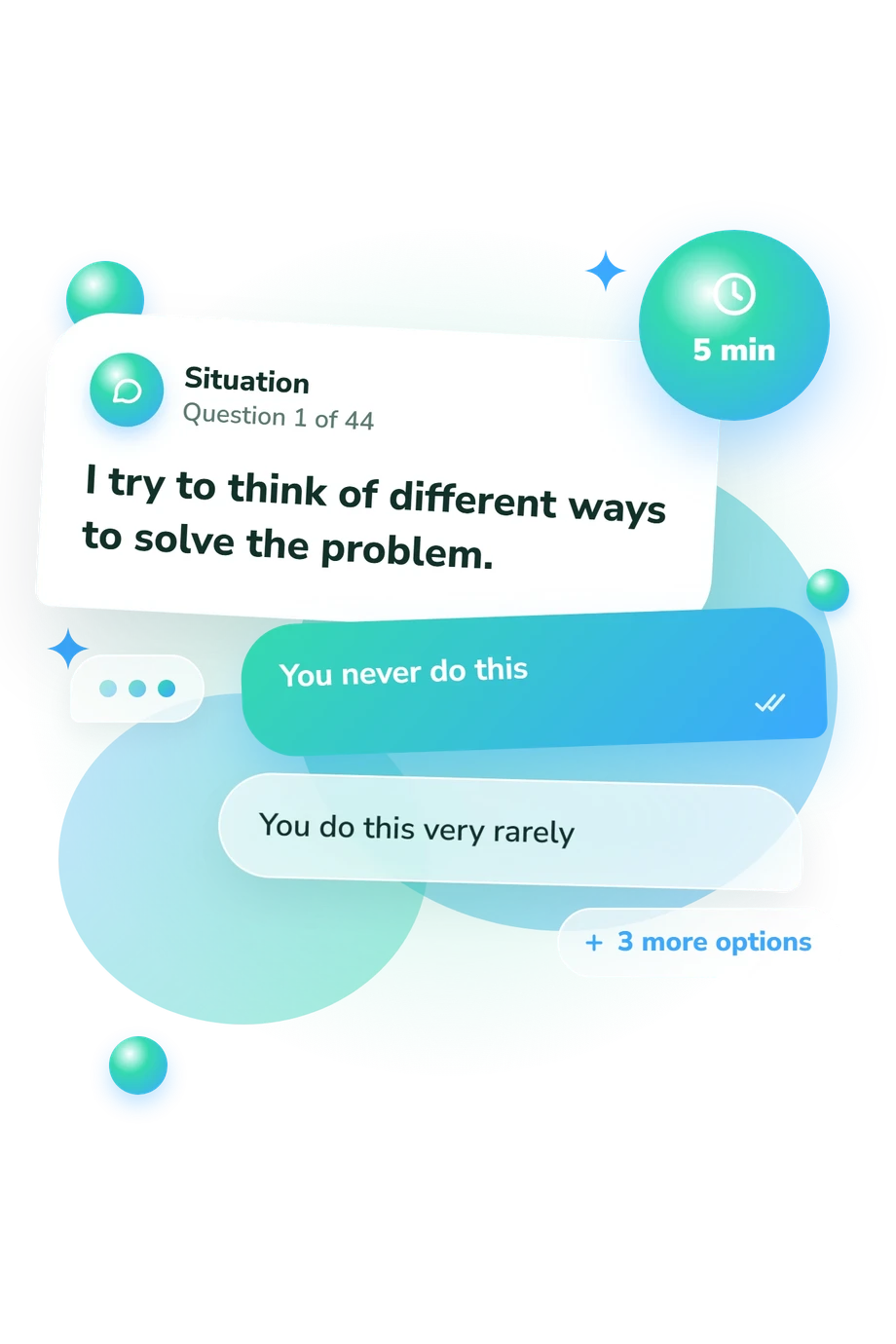
Example Questions From the Test
- You never do this
- You do this very rarely
- You do this sometimes
- You do this often
- You always do this
- You never do this
- You do this very rarely
- You sometimes do this
- You often do this
- You always do this
- You never do this
- You very rarely do this
- You sometimes do this
- You often do this
- You always do this
Strategic Response to Coping Scale (SRCS) Test - Description and methodology of the test
For people who want to understand their usual reactions when pressure rises, a structured profile of responses to stress is useful. The Strategic Response to Coping Scale (SRCS) Test provides that profile. It is intended for self-reflection after a difficult event, during recurring strain, or when comparing problem solving, externalization, internalization, psychological distancing, and seeking social support. The resulting coping profile can make personal patterns easier to name and discuss.
What This Assessment Explores
The questionnaire examines responses to difficult situations rather than one isolated emotion. Its items cover coping strategies, seeking help, stepping back mentally, expressing distress outwardly, turning distress inward, and changing circumstances. Results show which responses are more frequent, without presenting one as universally best. The profile contains five dimensions:
- Distancing (0-5) measures psychological distance from stress; Low distancing 0-1, Moderate distancing 2-3, High distancing 4-5.
- Externalization (0-5) measures outward emotion, including aggression or blame; Low 0-1, Moderate 2-3, High 4-5.
- Internalization (0-5) measures inward distress and self-blame; Low internalization 0-1, Moderate 2-3, High internalization 4-5.
- Seeking Social Support (0-5) measures how often you seek help or advice; Low 0-1, Moderate 2-3, High 4-5.
- Problem Solving (0-5) measures active efforts to address difficulties; Low use 0-1, Moderate 2-3, High use 4-5.
Methodology and Evidence Base
Most items use first-person statements about stress responses, such as planning, seeking advice, avoiding thoughts, worry, and anger; one question-based item asks about perceived ability to change circumstances. Five options run from never to always, and the self-report format captures typical behavior rather than an ideal response.
Scoring produces five dimension results. Higher results indicate more frequent use of a pattern, while the displayed bands describe frequency levels. These descriptive levels do not by themselves indicate harm; usefulness depends on context and consequences.
The questionnaire is conceptually consistent with the Self-Report Coping Scale (Causey & Dubow, 1992), a related but non-identical measure. Lazarus and Folkman’s (1984) transactional view of stress and coping provides the theoretical framework, treating coping as shaped by person and situation; this questionnaire is not an adaptation of either source.
Wright et al. (2010) and Kochenderfer-Ladd and Skinner (2002) add context for coping and emotional or interpersonal stress, not validation of this online questionnaire. Memory, honesty, current circumstances, and self-awareness can shape responses, so interpret the results in relation to the stressful situation and its consequences.
- Causey, D. L., & Dubow, E. F. (1992). Development of a self-report coping measure for elementary school children. Journal of Clinical Child Psychology, 21(1), 47-59. 10.1207/s15374424jccp2101_8
- Wright, M., Banerjee, R., Hoek, W., Rieffe, C., & Novin, S. (2010). Depression and social anxiety in children: Differential links with coping strategies. Journal of Abnormal Child Psychology, 38(3), 405-419. 10.1007/s10802-009-9375-4
- Kochenderfer-Ladd, B., & Skinner, K. (2002). Children’s coping strategies: Moderators of the effects of peer victimization? Developmental Psychology, 38(2), 267-278. 10.1037/0012-1649.38.2.267
- Lazarus, R. S., & Folkman, S. (1984). Stress, appraisal, and coping. New York, NY: Springer Publishing Company.
Updated: