
Morality Test
How the Scales are Structured
Who Usually Takes This Test?
See How You Compare
Below is a preview of how scores are typically distributed across each scale.
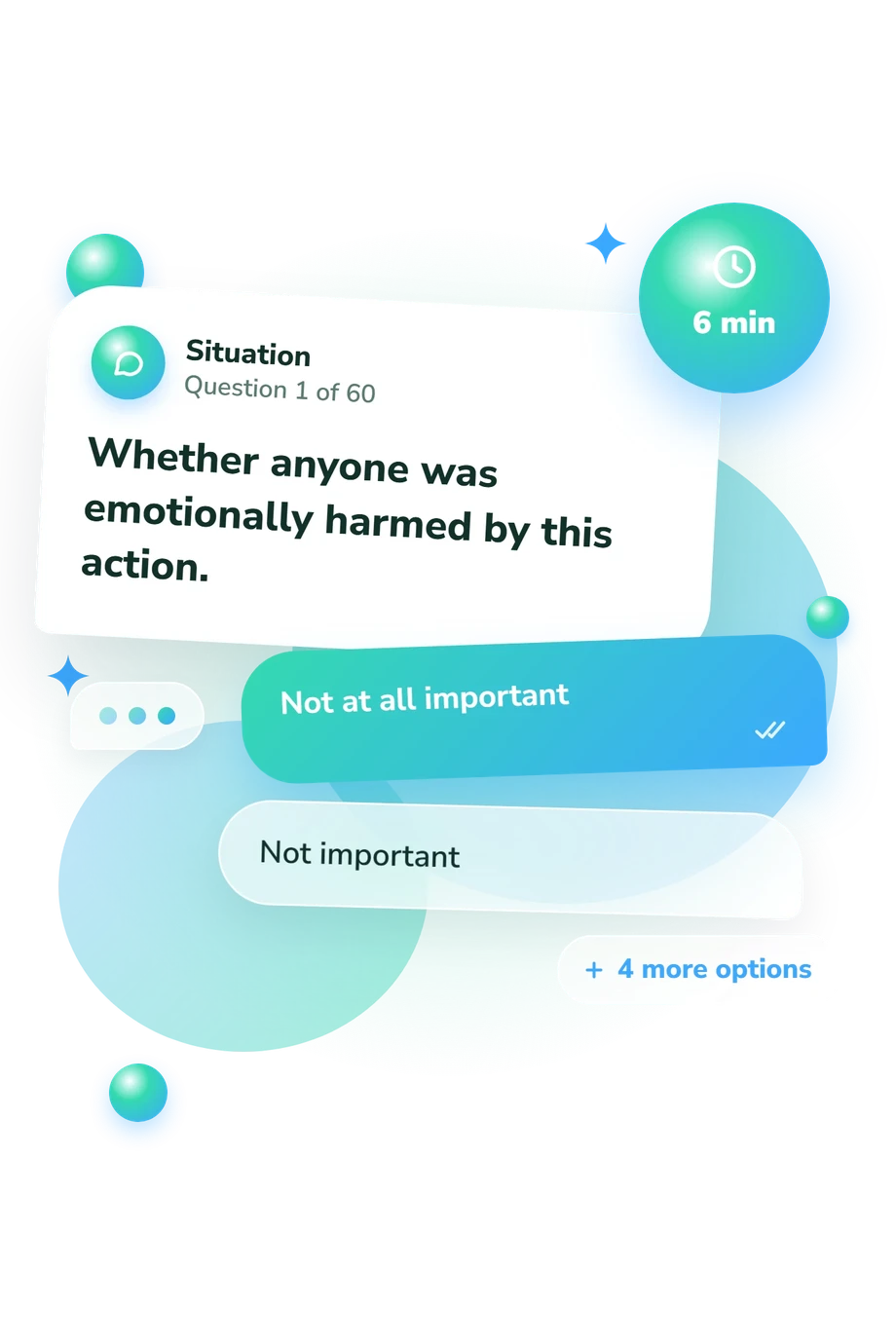
Example Questions From the Test
- Not at all important
- Not important
- Somewhat important
- Quite important
- Very important
- Extremely important
- Not at all important
- Not important
- Somewhat important
- Fairly important
- Very important
- Extremely important
- Not at all important
- Not important
- Somewhat important
- Fairly important
- Very important
- Extremely important
Morality Test - Description and methodology of the test
People who want to understand the principles behind everyday judgments can use the Morality Test to examine why care, fairness, loyalty, authority, purity, or personal freedom carries different weight across situations. It suits readers reflecting on ethical priorities, relationships, and social choices. As a moral values test, it produces a profile of emphases rather than a single verdict about character.
What This Assessment Explores
A moral foundations test compares:
- Community Ethics (0-5) reflects welfare; Low 0-2.4, Moderate 2.4-3.8, High 3.8-5.
- Ethics of Autonomy (0-5) measures rights/freedom; Lower autonomy focus 0-2.5, Moderate autonomy focus 2.5-4, High 4-5.
- Purity (0-5) measures purity; Low 0-2.5, Moderate 2.5-4, High 4-5.
- Respect (0-5) measures authority/tradition; Low 0-2.2, Moderate 2.2-3.7, High 3.7-5.
- Ingroup Loyalty (0-5) measures loyalty; More individualistic 0-2.2, Balanced 2.2-4, Strong group loyalty 4-5.
- Fairness (0-5) measures impartiality; Lower priority 0-2.6, Moderate priority 2.6-4.1, High 4.1-5.
- Care/Harm Avoidance (0-5) measures care/harm; Lower concern 0-2.2, Moderate concern 2.2-4, Higher concern 4-5.
Methodology and Scientific Basis
The questionnaire uses two six-point response formats. Some items ask how important a consideration is in judging an action; others ask agreement with statements about virtues, authority, equality, roles, and group obligations. Choices run from low importance or strong disagreement to highest endorsement.
Results appear on the displayed 0-5 scales, but the online version does not state how responses become points. It provides no population norms, so the ranges are not universal cutoffs or an overall ranking.
Its structure is conceptually consistent with the Moral Foundations Questionnaire (Graham et al., 2011), which organizes moral judgment around care, fairness, loyalty, authority, and purity. Graham, Haidt, and Nosek’s 2009 study supports the broader foundations framework; this questionnaire is not presented as a validated reproduction or adaptation of either study.
As a moral personality test, it is most useful for noticing patterns in self-reported priorities. Scores can shift with current context, memory, social desirability, and interpretation of wording, so mixed results may reflect different reactions to different situations rather than a stable trait.
- Graham, J., Nosek, B. A., Haidt, J., Iyer, R., Koleva, S., & Ditto, P. H. (2011). Mapping the moral domain. Journal of Personality and Social Psychology, 101(2), 366-385. 10.1037/a0021847
- Graham, J., Haidt, J., & Nosek, B. A. (2009). Liberals and conservatives rely on different sets of moral foundations. Journal of Personality and Social Psychology, 96(5), 1029-1046. 10.1037/a0015141
Updated: