
Internet Behavior Questionnaire Test
How the Scales are Structured
Who Usually Takes This Test?
See How You Compare
Below is a preview of how scores are typically distributed across each scale.
Example Questions From the Test
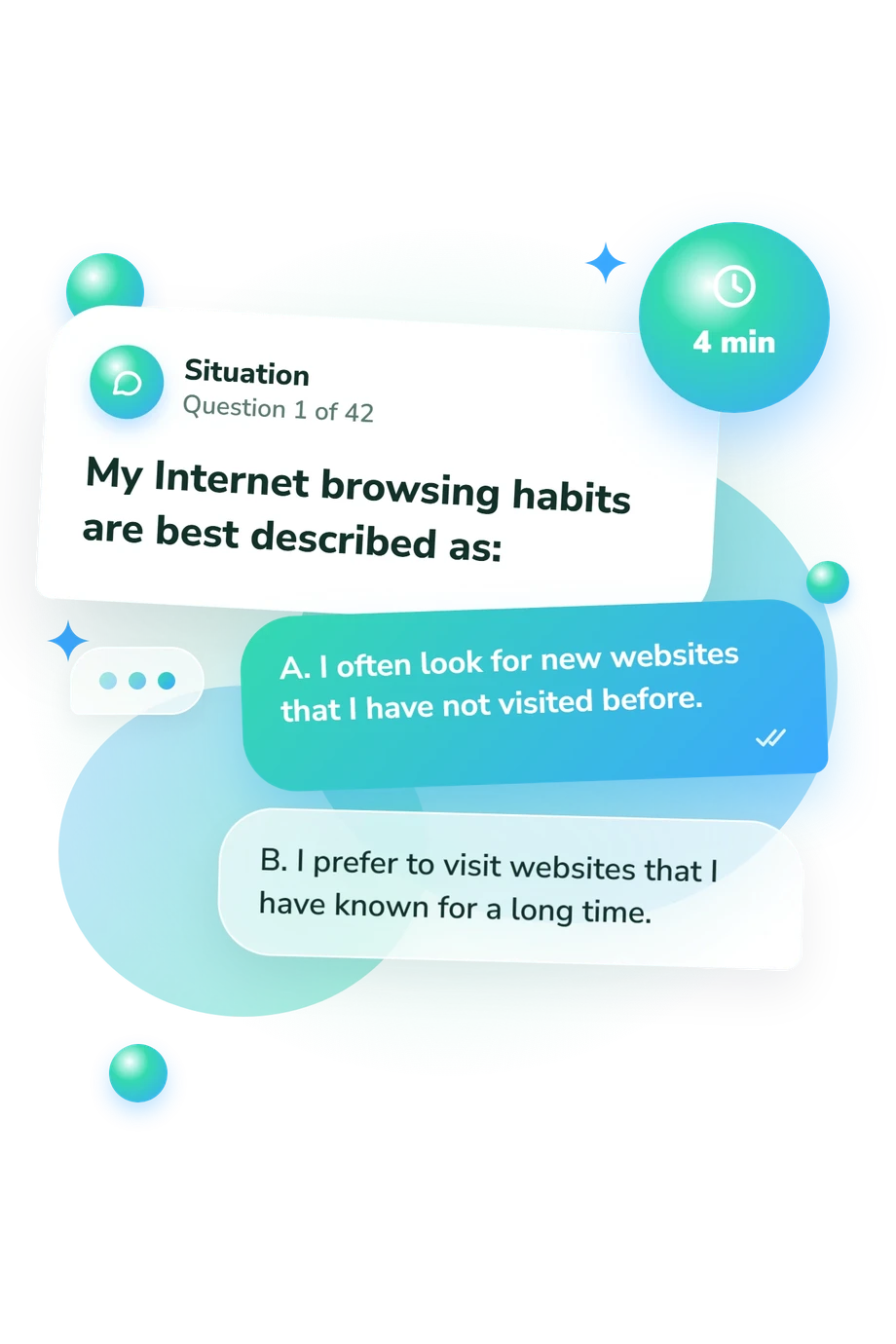
- A. I often look for new websites that I have not visited before.
- B. I prefer to visit websites that I have known for a long time.
- A. Online, I often make the first contact.
- B. The initiative to meet online usually does not come from me.
- A. When I feel sad or lonely, I usually go online.
- B. I do not feel a need to go online when I am in a bad mood.
Internet Behavior Questionnaire Test - Description and methodology of the test
People who want a clearer view of their online habits can use this online behavior questionnaire to compare three aspects of digital behavior in one profile. The Internet Behavior Questionnaire Test helps readers notice whether exploration, participation, and control over use move together or diverge, giving them a practical basis for reflecting on routines, priorities, and possible changes in how they go online.
What This Assessment Explores
The questions examine how a person approaches online alternatives, communication, self-presentation, and control over time spent connected. They suit readers who want a profile of participation and difficulty regulating use, without assuming frequent internet use is harmful. This internet behavior test shows how curiosity and involvement compare with difficulty regulating use, helping readers see what their result says about online participation and control.
The result organizes these themes into three dimensions:
- Activity in Action (0-6) shows whether searching online leads to implemented choices; Low follow-through (0-2), Moderate follow-through (3-4), and High follow-through (5-6) mark increasing follow-through.
- Perceptual Activity (0-8) shows interest in different opinions, people, and communication methods; Low (0-4), Moderate (5-7), and High (8-8) mark increasing consideration of alternatives.
- Internet Addiction (0-7) reflects compulsive use and loss of control; Low risk (0-2), Elevated tendency (3-5), and Pronounced addiction pattern (6-7) mark the levels shown in result.
Methodology and Scientific Basis
The closest instrument is Internet Behavior Questionnaire (Zhichkina, 2001). As an online communication questionnaire, this test is conceptually consistent with that work and is not presented as an adaptation of the published instrument. Zhichkina’s 2004 work supplies social-psychological context for internet communication, while Sungurova and colleagues (2018) offer contextual research on electronic communication across age groups.
The paired alternatives cover exploratory browsing, interest in other viewpoints, initiating and sustaining exchanges, self-presentation, mood-linked use, and interference with offline responsibilities. Respondents choose the statement that better matches their experience. The online form then reports three displayed scores and their bands; because the options are not a frequency scale, the result describes endorsed tendencies rather than exact hours online.
Interpret each score through its displayed band and read the dimensions together. For this online form, the bands are descriptive categories, not standardized population norms for this questionnaire. Self-report remains sensitive to current mood, recent experiences, memory, privacy concerns, and the wish to appear consistent or favorable. It is a structured reflection tool, so unusual or distressing patterns need to be understood within the person’s wider circumstances.
- Zhichkina, Anastasia Evgenievna. (2001). The Relationship Between Identity and Behavior on the Internet Among Adolescent Users: Candidate Dissertation in Psychology. Lomonosov Moscow State University, Moscow, 199 pp.
- Zhichkina, Anastasia Evgenievna. (2004). Social-Psychological Aspects of Communication on the Internet. Moscow: Dashkov and Co., 117 pp.
- Sungurova, Nina L., Natalya B. Karabuschenko, Ekaterina M. Khvorova, and Daria G. Boguslavskaya. (2018). Features of Electronic Communication in Social Networks of Users of Different Ages. In Psychology and Education - ICPE 2018, vol. 49, European Proceedings of Social and Behavioural Sciences, pp. 650-658. 10.15405/epsbs.2018.11.02.75
Updated: