
Organizational Justice Questionnaire Test
How the Scales are Structured
Who Usually Takes This Test?
See How You Compare
Below is a preview of how scores are typically distributed across each scale.
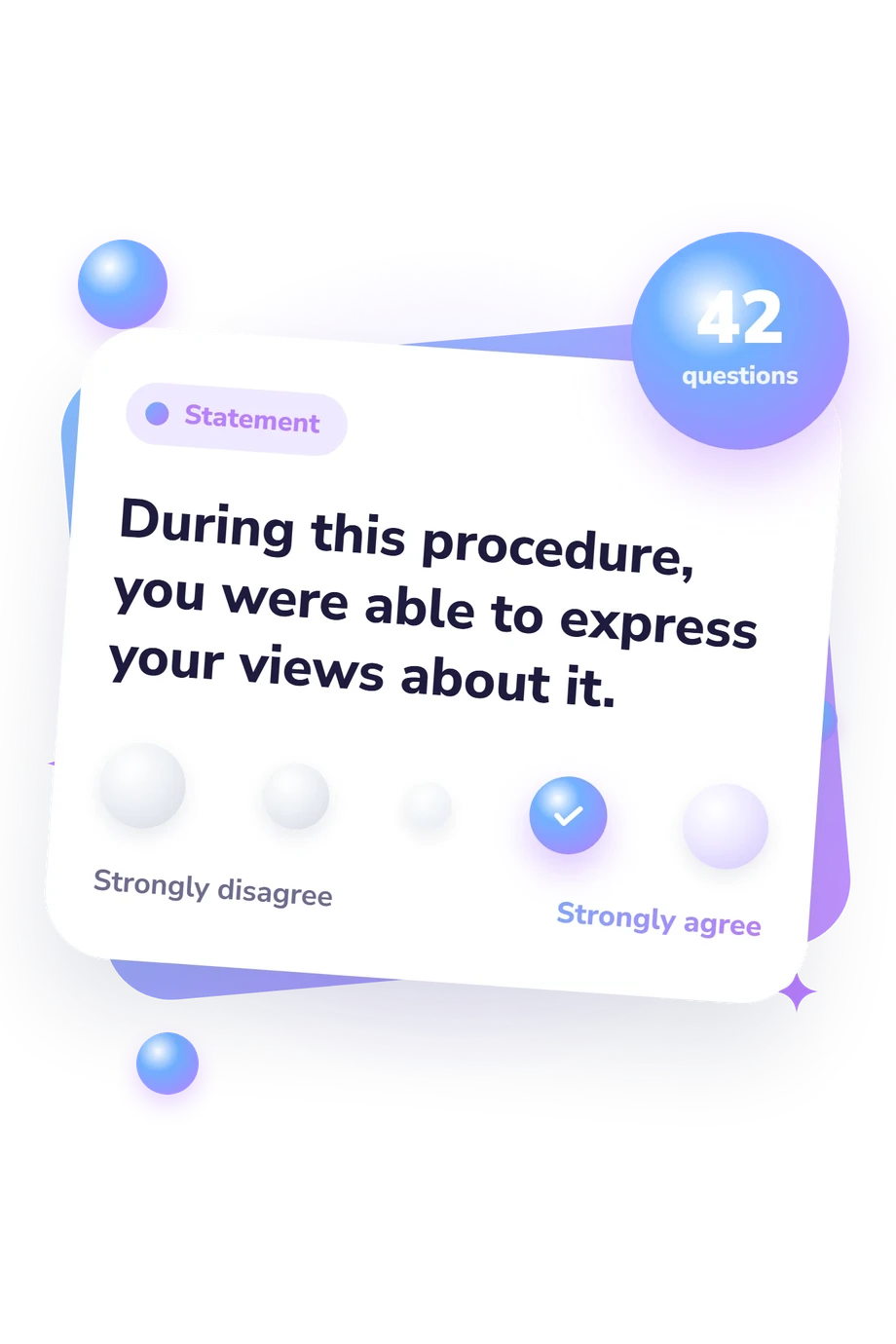
Example Questions From the Test
- Strongly disagree
- Disagree
- Not sure
- Agree
- Strongly agree
- Strongly disagree
- Disagree
- Not sure
- Agree
- Strongly agree
- Strongly disagree
- Disagree
- Not sure
- Agree
- Strongly agree
Organizational Justice Questionnaire Test - Description and methodology of the test
For employees, managers, or anyone reviewing a workplace decision, the Organizational Justice Questionnaire Test provides a structured way to examine how fairness is experienced rather than assumed. Its profile can organize a workplace concern into clearer points for discussion or follow-up. As an organizational justice test, this questionnaire can make private reactions more specific and easier to reflect on or discuss.
What This Assessment Explores
Questions cover voice, influence, appeals, outcome fairness, respectful treatment, and the quality of explanations. This workplace justice questionnaire suits reflection on an appraisal, selection, review, or other formal organizational decision. The profile presents four dimensions, showing the respondent's position within each dimension's own displayed range or band without ranking the scales against one another:
- Procedural Justice (3-15) indicates perceived control and fair decision procedures; Low 3-6, Moderate 7-15.
- Distributive Justice (5-25) assesses impartiality and whether outcomes and rewards reflect effort and ability, while also considering the accuracy and completeness of information about the result; Low 5-14, High 15-25.
- Interpersonal Justice (5-25) shows whether management interactions feel respectful, polite, and ethical; Low 5-17, High 18-25.
- Informational Justice (6-30) indicates transparent communication through complete, clear, timely, honest, and personally attentive explanations; Low transparency 6-18, Moderate transparency 19-23, High transparency 24-30.
Methodology and Scientific Basis
The questionnaire uses five response options, from Strongly disagree to Strongly agree, with a middle Not sure or Unsure choice. Items address distinct aspects of fairness. The result presents these dimensions separately with displayed bands; the response format does not state how answers contribute to a score or establish a universal pass mark or clinical cutoff.
Its framework is conceptually consistent with Colquitt (2001), which distinguishes several forms of organizational fairness, while Greenberg (1990) situates justice judgments within organizational behavior. Bies and Moag (1986) are especially relevant to the emphasis on respectful conduct and fair communication. This questionnaire is not a direct reproduction or validated adaptation of those published instruments. As an organizational fairness assessment, this questionnaire is best understood as a structured self-report reflection.
Interpretation is strongest when the respondent considers the specific event, decision-maker, and context behind each answer. Current emotions, incomplete information, memory, and the wish to appear reasonable can influence ratings. The profile can identify perceived strengths or tensions, but it cannot establish why they occurred or replace a broader review of organizational circumstances.
- Colquitt, J. A. (2001). On the dimensionality of organizational justice: A construct validation of a measure. Journal of Applied Psychology, 86(3), 386-400. 10.1037/0021-9010.86.3.386
- Greenberg, J. (1990). Organizational justice: Yesterday, today, and tomorrow. Journal of Management, 16(2), 399-432. 10.1177/014920639001600208
- Bies, R. J., & Moag, J. S. (1986). Interactional justice: Communication criteria of fairness. In R. J. Lewicki, B. H. Sheppard, & M. H. Bazerman (Eds.), Research on Negotiations in Organizations (Vol. 1, pp. 43-55). JAI Press.
Updated: