
Iowa-Netherlands Comparison Orientation Measure (INCOM) Test
How the Scales are Structured
Who Usually Takes This Test?
See How You Compare
Below is a preview of how scores are typically distributed across each scale.
Example Questions From the Test
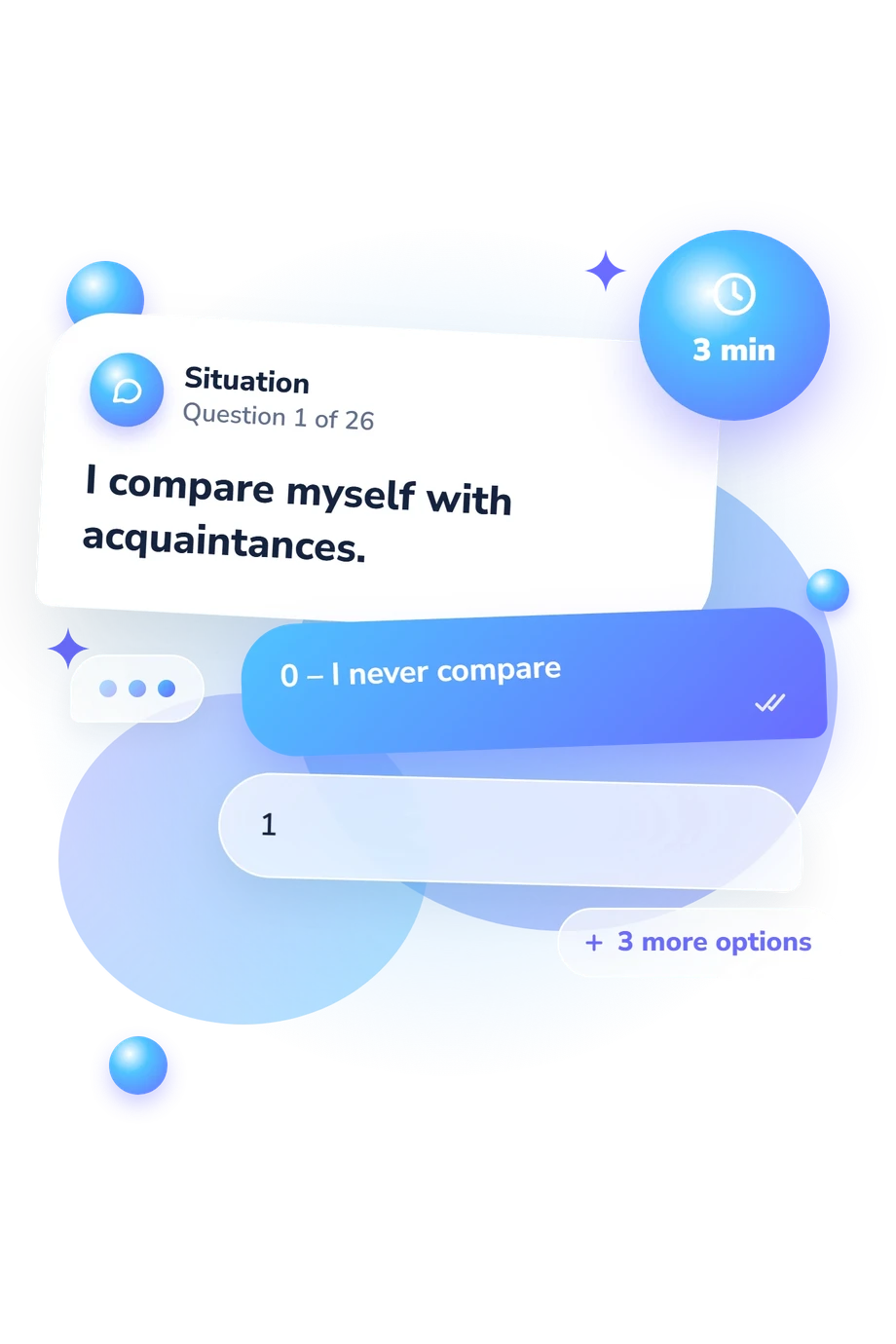
- 0: I never compare
- 1
- 2
- 3
- 4: I compare all the time
- 0 – never compare
- 1
- 2
- 3
- 4 – compare all the time
- 0 — I never compare
- 1
- 2
- 3
- 4 — I compare all the time
Iowa-Netherlands Comparison Orientation Measure (INCOM) Test - Description and methodology of the test
People who notice that their self-evaluation changes with context may find the Iowa-Netherlands Comparison Orientation Measure (INCOM) Test useful for examining comparison habits without treating a single moment as a complete picture. The INCOM questionnaire suits respondents who want to examine whether comparison habits shape confidence, motivation, or judgments of progress. Results provide a descriptive profile for self-reflection.
What This Assessment Explores
As a social comparison orientation questionnaire, this assessment examines whether self-evaluation is anchored to other people or to different versions of oneself. Items cover close contacts, unfamiliar people, average types, imagined people, and past, ideal, feared, or unrealized selves. The pattern shows the main reference points.
The three target-related scales and the overall score describe these routes and their reporting bands:
- With Strangers (0-8) reflects broad-group comparison: Low 0-3, Moderate 4-6, High 7-8.
- With Familiar People (0-16) reflects reliance on close contacts: Low comparison 0-11, High comparison 12-16.
- Self-Comparison (0-28) reflects evaluating successes and failures against past achievements; future, ideal, feared, and unrealized selves are item contexts, while the bands are Low self-comparison 0-8, Moderate self-comparison 9-21, and High self-comparison 22-28.
- Social Comparison Orientation (0-52) summarizes the broader tendency to evaluate oneself through others: Low 0-14, Moderate 15-39, High 40-52.
Methodology and Evidence Base
Each item uses a five-point frequency response from 0 (never compare) to 4 (compare all the time). The respondent selects the option that best represents typical experience. In this social comparison test, the chosen frequency level is the recorded response.
The questionnaire documents the response scale and displayed bands, but not an item-by-item aggregation or weighting rule. Three target-related scores and an overall score are reported; their bands are descriptive categories, not universal norms or clinical cutoffs.
The closest structural source is the ROOSS questionnaire described by Samoylenko, Savchenko, and Korbut (2017), with psychometric comparisons reported by Savchenko, Samoylenko, and Korbut (2019). Gibbons and Buunk (1999) provide the INCOM framework, while Suls, Martin, and Wheeler (2002) discuss comparison targets and effects. This online questionnaire is conceptually consistent with the cited ROOSS and INCOM work; it is not a reproduction of the original INCOM measure or a validated adaptation.
Self-report remains sensitive to current context, self-awareness, and response bias, so scores are best read as reflection prompts rather than fixed personal traits.
- Samoylenko, E. S., Savchenko, T. N., & Korbut, A. V. (2017). A Methodological Instrument for Measuring Orientation Toward Types of Social Comparison. In A. L. Zhuravlev & V. A. Koltsova (Eds.), Fundamental and Applied Research in Contemporary Psychology: Results and Prospects of Development (pp. 532-541). Moscow: Institute of Psychology of the Russian Academy of Sciences.
- Savchenko, T. N., Samoylenko, E. S., & Korbut, A. V. (2019). Comparison of Psychometric Indicators of Instruments for Measuring Orientation Toward Social Comparison. Experimental Psychology, 12(2), 112-130. 10.17759/exppsy.2019120209
- Gibbons, F. X., & Buunk, B. P. (1999). Individual Differences in Social Comparison: Development of a Scale of Social Comparison Orientation. Journal of Personality and Social Psychology, 76(1), 129-142. 10.1037//0022-3514.76.1.129
- Suls, J., Martin, R., & Wheeler, L. (2002). Social Comparison: Why, With Whom, and With What Effect? Current Directions in Psychological Science, 11(5), 159-163. 10.1111/1467-8721.00191
Updated: