
Freudly+971 508685814hello@freudly.ai
Freudly
arrange

Organizational Socialization Questionnaire Test
Take the online Organizational Socialization Questionnaire Test - AI psychologist FreudlyYou can take Organizational Socialization Questionnaire Test here. Online version of a simple and accurate psychological test with interpretation.en
In seven minutes, the Organizational Socialization Questionnaire Test uses 35 questions to explore how well you understand your job, team, and organization. Your result highlights areas of workplace adjustment and integration, helping you reflect on what you know, where support may help, and how confidently you navigate your work environment.
Questions: 357 minutes
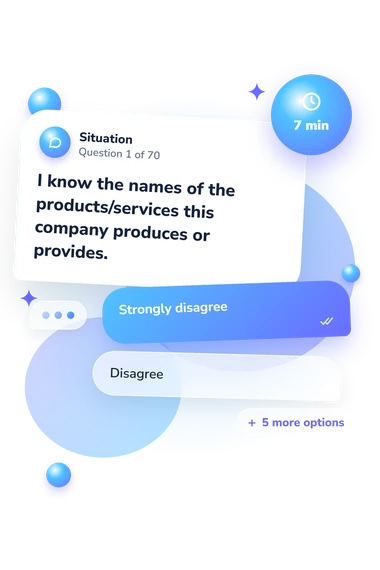
Organizational Socialization Questionnaire Test: situation and reply bubbles
October 2, 2025October 2, 2025Material has been updatedOctober 2, 2025Material has been published
27,780 views
2,002 completions
1,659 likes
Daniel HallPsychologist · Test reviewer
1,659 likes
Scale Explorer

How the Scales are Structured

Work SocializationWS
Assesses how well a newcomer has learned their job tasks, expected work behaviors, and how to collaborate with colleagues to perform the role.
example score64/77
64/77Well adaptedexample score
11 – 40Needs support
41 – 58Developing
59 – 77Well adapted
A score of 64 falls in the “Well adapted” range, suggesting strong understanding of job responsibilities and effective adjustment to day-to-day work interactions.
Group SocializationGS
Measures how well a newcomer understands and fits into their workgroup’s norms, values, and interaction style.
example score38/84
38/84Developing integrationexample score
12 – 35Low integration
36 – 60Developing integration
61 – 84Strong integration
A score of 38 suggests developing integration into the team, with some understanding of group norms and routines but still room to feel more fully included.
Organizational SocializationOS
Measures how well the employee understands the company’s values, rules, policies, customs, management style, and internal language.
example score51/84
51/84Developing understandingexample score
12 – 35Limited understanding
36 – 60Developing understanding
61 – 84Strong understanding
A score of 51 suggests a developing understanding of the organization’s culture and rules, with some areas likely still becoming clear through onboarding and experience.
Overall Organizational SocializationOOS
Measures how fully an employee has integrated into the organization through understanding and acceptance of its values, rules, goals, and policies.
example score80/245
80/245Low socializationexample score
35 – 104Low socialization
105 – 174Moderate socialization
175 – 245High socialization
A score of 80 falls in the Low socialization range, suggesting the employee is still developing a clear understanding of and alignment with the company’s norms and expectations.
just completed the test
DATA-BASED USER COHORTS

Who Usually Takes This Test?

New hires in onboarding
46%OF USERS
People in their first weeks or months at a new company who want to see how well they’ve settled into the culture, team, and tasks.
HR and onboarding specialists
33%OF USERS
HR professionals who run onboarding and need a quick check to spot where newcomers need support and track adaptation over time.
Team leads and managers
21%OF USERS
Managers who want to understand how integrated a newcomer feels with the team and whether role expectations are clear.
BASED ON AGGREGATED, ANONYMIZED DATA FROM TENS OF THOUSANDS OF FREUDLY USERS.
Benchmarking

See How You Compare

Once you complete the test, your results are compared with real-world data from people in your country.
Below is a preview of how scores are typically distributed across each scale.
Shaded area — where most people score
Dot — the average
You — your score lands on each curve after the test— your score, after the test
Work SocializationWS
You?
Average33.7
Typical rangeTypical23.2 – 44.2
Possible11 – 77
Group SocializationGS
You?
Average48.7
Typical rangeTypical36.4 – 60.9
Possible12 – 84
Organizational SocializationOS
You?
Average42.9
Typical rangeTypical30.7 – 55.2
Possible12 – 84
Overall Level of Organizational SocializationOLoOS
You?
Average139.7
Typical rangeTypical106 – 173.3
Possible35 – 245
Featured On
SAMPLE QUESTIONS

Example Questions From the Test

You are presented with a set of statements describing your attitudes toward various aspects of your new company. Please read each statement carefully and indicate the extent to which you agree with it.
    • Strongly disagree
    • Disagree
    • Disagree somewhat
    • Do not know
    • Agree somewhat
    • Agree
    • Strongly agree
    • Strongly disagree
    • Disagree
    • Somewhat disagree
    • Don’t know
    • Somewhat agree
    • Agree
    • Strongly agree
    • Strongly disagree
    • Disagree
    • Somewhat disagree
    • Don't know
    • Somewhat agree
    • Agree
    • Strongly agree
WHAT THE TEST MEASURES

Organizational Socialization Questionnaire Test - Description and methodology of the test

arrange

People starting a role, changing teams, or trying to understand workplace expectations can use this assessment to examine how thoroughly they have learned the practical and social side of employment. The Organizational Socialization Questionnaire Test connects everyday workplace knowledge with adjustment across the job, work group, and wider organization. As a workplace adjustment questionnaire, it can show where orientation, feedback, or self-directed learning may be useful.

What This Assessment Explores

Questions address learned knowledge and behavior at work: job duties, priorities, tools, support routes, team relationships, departmental norms, organizational goals, policies, structure, and workplace language. An employee integration assessment shows which parts of the setting they understand and where adjustment needs work.

The displayed dimensions are:

  • Work Socialization (11-77) measures job-task knowledge, required behavior, and colleague interaction: Needs support 11-40; Developing 41-58; Well adapted 59-77.
  • Group Socialization (12-84) measures team norms, values, and rules: Low integration 12-35; Developing integration 36-60; Strong integration 61-84.
  • Organizational Socialization (12-84) measures organizational values, goals, rules, policies, norms, management style, and language: Limited understanding 12-35; Developing understanding 36-60; Strong understanding 61-84.
  • Overall Organizational Socialization (35-245) measures integration into the organizational environment, including understanding of the company’s values, goals, rules, and policies, and internalization of corporate norms: Low socialization 35-104; Moderate socialization 105-174; High socialization 175-245.

Methodology and Scientific Basis

The sampled statements use seven response options, from Strongly disagree to Strongly agree, with a middle Do not know or Not sure choice. Respondents rate their own workplace knowledge and behavior rather than answer factual questions. Higher displayed scores indicate greater knowledge, stronger integration, better occupational adjustment, or more successful adaptation as the relevant scale rises.

The 35-item structure-11 job, 12 group, and 12 organizational items-matches the Newcomer Socialization Questionnaire (Haueter et al., 2003), which this online questionnaire adapts. Spagnoli, Livi, and Farnese (2018) examined that instrument’s construct validity and measurement invariance among newcomers and full members. Evidence for the published instrument does not establish norms for this workplace socialization measure or its displayed bands.

Interpret the profile as a snapshot of perceived workplace learning. The separate dimensions let you inspect perceived job knowledge, group integration, and organizational understanding rather than relying on the overall band alone. Memory, honesty, current context, and access to information can affect responses, while onboarding, role changes, and experience can change scores. The bands are practical categories, not universal standards.

Author: John P. Wanous
Literature:
  • Haueter, J. A., Macan, T. H., & Winter, J. (2003). Measurement of newcomer socialization: Construct validation of a multidimensional scale. Journal of Vocational Behavior, 63(1), 20-39. 10.1016/S0001-8791(02)00017-9
  • Spagnoli, P., Livi, S., & Farnese, M. L. (2018). How do newcomers and full member employees conceive organizational socialization? Measurement invariance and construct validity of the Newcomer Socialization Questionnaire in Italy. TPM - Testing, Psychometrics, Methodology in Applied Psychology, 25(4), 485-502. 10.4473/TPM25.4.2
Popular tests
Comments
Leave a Comment