
Parental Mediation Questionnaire Test
How the Scales are Structured
Who Usually Takes This Test?
See How You Compare
Below is a preview of how scores are typically distributed across each scale.
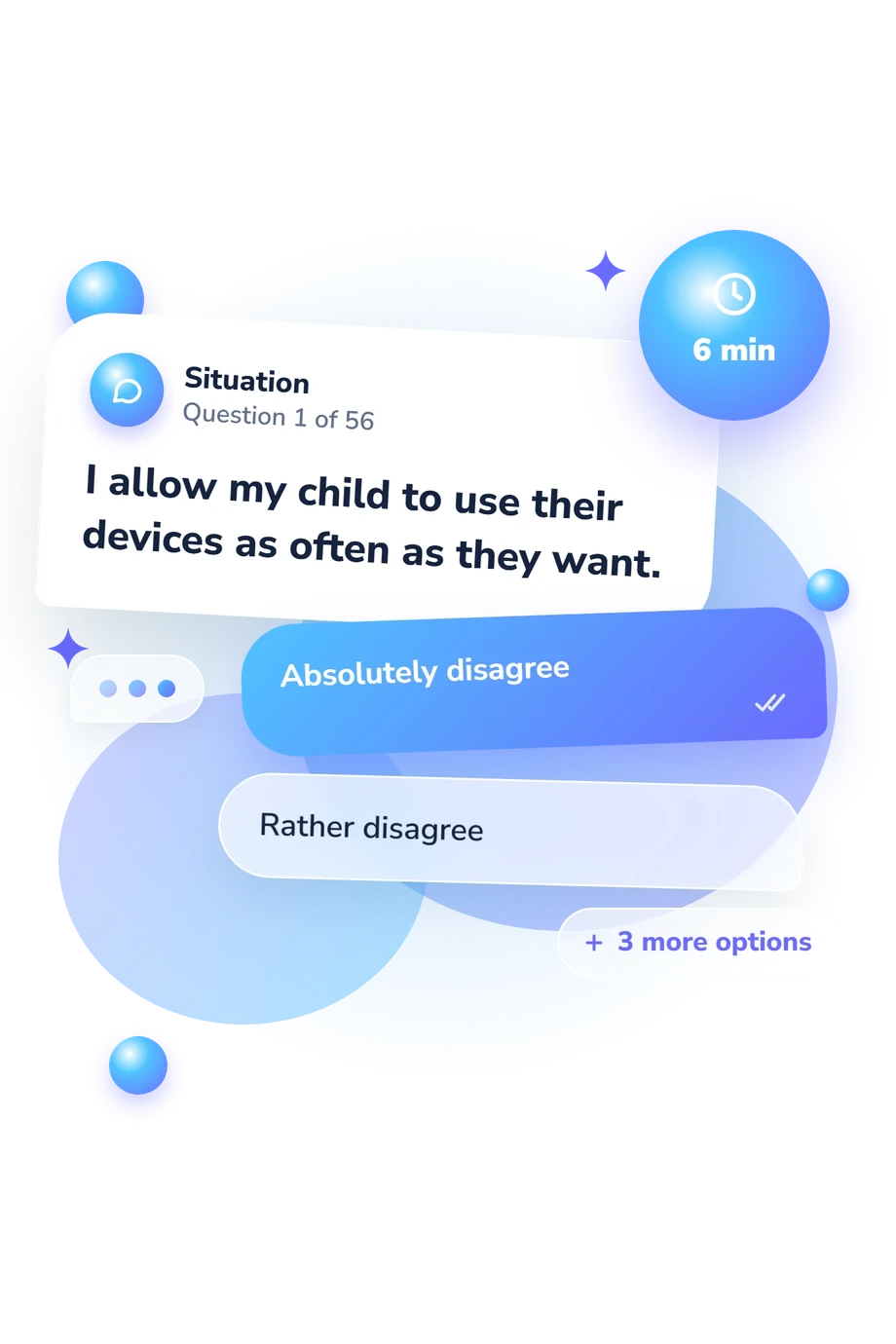
Example Questions From the Test
- Strongly disagree
- Somewhat disagree
- Neither agree nor disagree
- Somewhat agree
- Strongly agree
- Completely disagree
- Somewhat disagree
- Partly agree, partly disagree
- Somewhat agree
- Completely agree
- Strongly disagree
- Rather disagree
- Neither agree nor disagree
- Rather agree
- Strongly agree
Parental Mediation Questionnaire Test - Description and methodology of the test
Parents who want to understand how they guide a child’s phone, app, and online activity can use this questionnaire to examine everyday mediation choices. The Parental Mediation Questionnaire Test turns responses about rules, conversations, monitoring, and shared digital experiences into a profile of involvement and control. As a digital parenting questionnaire, it supports practical reflection on family habits without ranking one household against another.
What This Assessment Explores
Responses focus on how adults regulate, discuss, monitor, and share a child’s digital activity. This parental mediation questionnaire highlights patterns of comfort, communication, collaboration, intervention, and control rather than defining a single ideal style. The six displayed scales are:
- Mediation Comfort (0-91) captures ease with mediation: Low comfort (0-55) or High comfort (56-91).
- Active Communication (0-86) reflects digital discussion: Limited communication (0-54) or Active communication (55-86).
- Joint Activities (0-63) reflects shared digital participation: Low collaboration (0-37) or High collaboration (38-63).
- Intervention-Ignoring (0-98) indicates intervening versus overlooking activity: More ignoring (0-64) or Active intervention (65-98).
- Restrictions And Limits (0-74) reflects freedom versus prohibitions: More freedom (0-36) or Strict restrictions (37-74).
- Control-Indulgence (0-95) places mediation toward permissiveness or control: More permissive (0-58) or More controlling (59-95).
Methodology and Evidence Base
Items use self-report statements with varied response formats: agreement options run from strong disagreement to strong agreement, while behavior prompts use frequency choices from never to always. Together they cover rules, monitoring, conversations, attitudes, and shared digital activities.
The questionnaire is conceptually consistent with Proekt et al. (2025), a published parental mediation instrument about building digital competence and setting boundaries, but that study does not validate this online version or establish its norms or reliability. Livingstone and Helsper (2008), alongside Livingstone et al. (2017), provide the wider framework of mediation strategies, online risks, opportunities, and parental digital skills.
Results from this parental mediation assessment are best read as a pattern across the displayed bands, not a pass-fail score. Higher or lower results show the direction represented by each scale, while meaning depends on family context and the child’s needs. Self-report may reflect memory, current conflict, social desirability, or limited self-awareness, so the profile is not a diagnosis and benefits from concrete examples or broader assessment.
- Proekt, Yu. L., Spasskaya, E. B., Ivannushkina, N. O., & Sidnenko, E. V. (2025). Building vs. Banning: Development, preliminary validation and evaluation of a parental mediation questionnaire for schoolchildren’s digital behavior. Psychology in Education, 7(2), 165-183. 10.33910/2686-9527-2025-7-2-165-183
- Livingstone, S., & Helsper, E. J. (2008). Parental mediation of children’s Internet use. Journal of Broadcasting & Electronic Media, 52(4), 581-599. 10.1080/08838150802437396
- Livingstone, S., Ólafsson, K., Helsper, E. J., Lupiáñez-Villanueva, F., Veltri, G. A., & Folkvord, F. (2017). Maximizing opportunities and minimizing risks for children online: The role of digital skills in emerging strategies of parental mediation. Journal of Communication, 67(1), 82-105. 10.1111/jcom.12277
Updated: